

Makeup organization is usually sorted by category. Eyes together, lips together, base together. Each of those groups mixes products with wildly different clocks running on them.
Mascara has three months. A powder blusher has two or three years. Sorting them into the same drawer by what they do puts a 3-month item behind a 3-year one.
That clock is printed on almost every product, and it goes unread. It is a small open jar icon with a number and the letter M beside it.
Sort by the clock instead, and the collection organises itself. Short clocks go where you see them, long clocks go anywhere, and the ones with no clock left go out.
The symbol on the back that nobody reads
Period After Opening is the number that matters, and it starts the day the seal breaks rather than the day you bought it. A 12M product opened two years ago has no time left on it.
| Product | Typical clock | Where that puts it |
|---|---|---|
| Mascara and liquid eyeliner | 3 months | Front row, replaced four times a year |
| Liquid and cream eyeshadow, lip gloss | 6 months | Front row |
| Liquid foundation and concealer | 6 to 12 months | Middle, used daily so it usually runs out first |
| Lipstick | 1 to 2 years | Anywhere reachable |
| Powder blusher, bronzer, eyeshadow | 2 to 3 years | Back, top shelf, deep drawer |
| Brushes | About a year, washed weekly | Upright and out, not in a drawer |
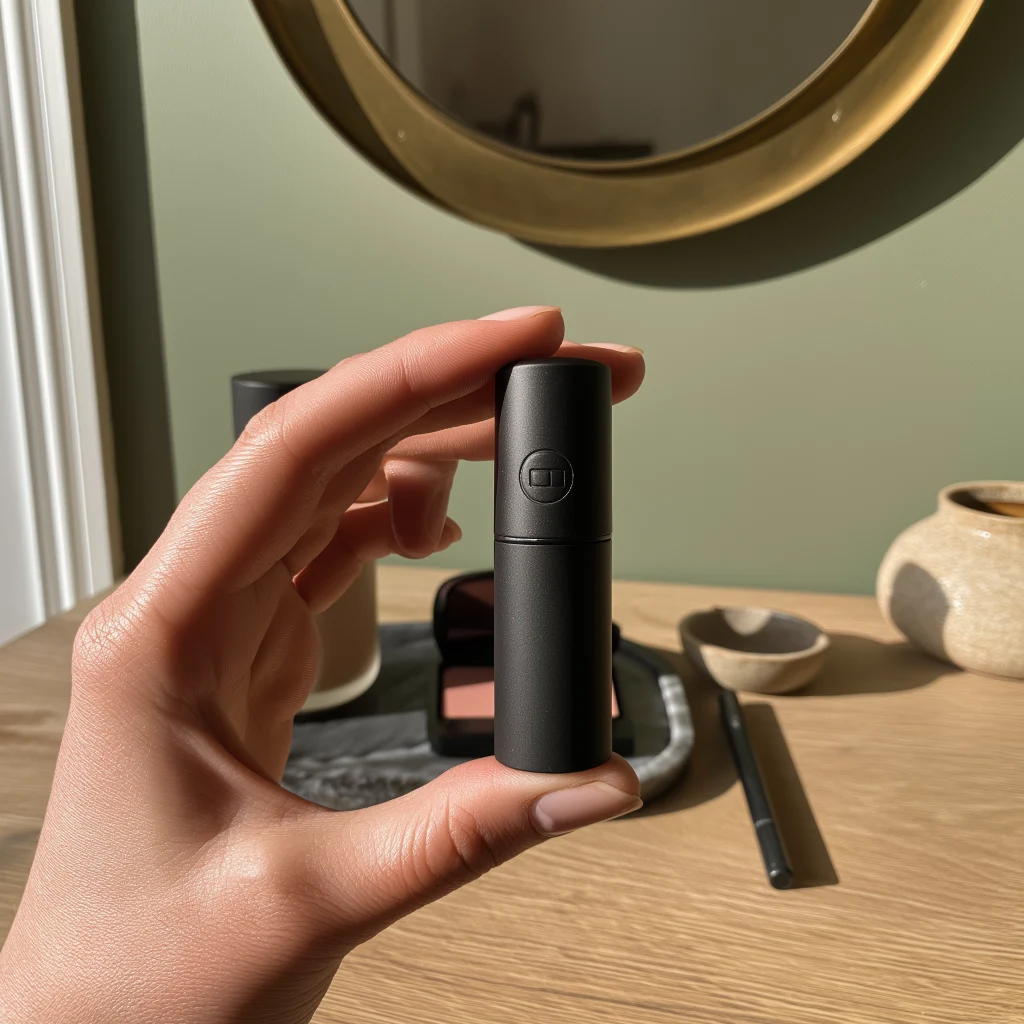
Write the opening month on the base of every product the day you open it, in marker.
The printed clock tells you how long, and only your own note tells you from when. Together they answer the question, and separately neither does.
Eye products are the safety case
Everything else on the list is a performance question. Eye products are not, and that is why the 3-month figure is firm rather than cautious.
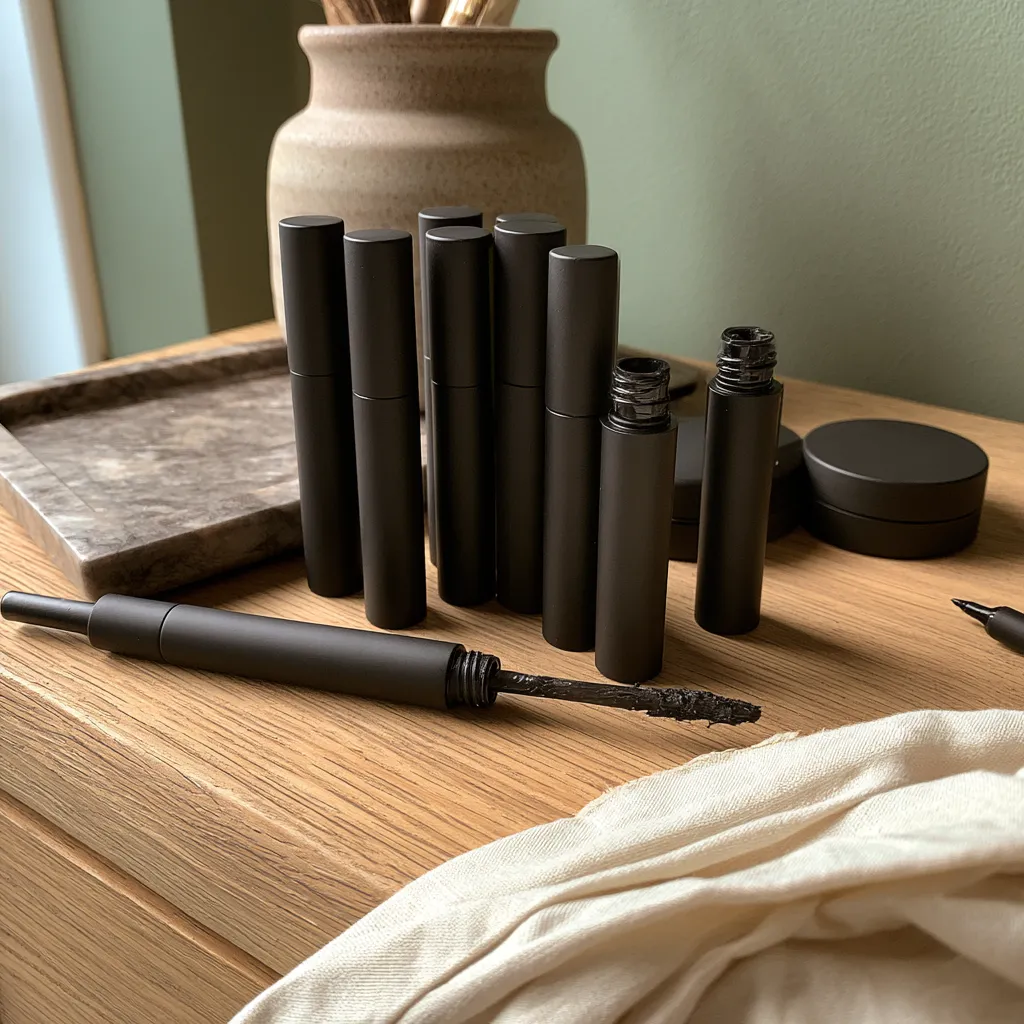
The American Academy of Dermatology puts the lifespan of mascara at three months and cites a medical journal finding Staphylococcus aureus in mascara after three months of use. Keeping cosmetics longer than recommended can lead to eye infection, acne-like breakouts, or irritated skin.
The wand is the mechanism. It goes from the lash line into a warm, sealed tube and back again, several times a day, carrying whatever was on the lashes with it.
Replace mascara and liquid eyeliner every three months, whatever the tube looks like.
3 months is easy to lose track of and easy to automate. Write the month on the tube in marker the day you open it, then set a repeating 3-month reminder on your phone the same day. The reminder costs ten seconds once and removes the decision four times a year.
The eye product rules that are not negotiable
- Never share eye products with anyone, for any occasion
- Never add water or drops to a drying tube, which feeds what is growing in it
- Throw out anything used while you had an eye infection
- Keep the cap fully closed, since air speeds up everything
- Buy the smaller tube, since the clock runs out before the product does
That last point is the one that saves money rather than costing it. A large mascara and a small mascara both end at three months, so the large one is throwing away more product.
The same logic runs against multipacks and gift sets. Four mascaras bought together start four separate clocks the moment each one opens, and nothing pauses while they wait.
Buy eye products one at a time in the smallest size, since the clock rather than the volume decides when it goes.
Sort by the clock, not by the category
Once every item carries an opening date, sorting is mechanical. Three bands, front to back, and the band decides the position rather than what the product is for.
The three bands
- Under six months of clock, in the front row where you see them daily
- Six months to two years, in the middle where they are reachable
- Over two years, at the back or on a high shelf
- No date written on it and no memory of opening it, out
- Brushes and sponges separate again, upright and washed
Put the short clocks in front, since an item you cannot see is an item that expires unused.
Category sorting fights this, because the eyeshadow palette that lasts three years and the cream shadow that lasts six months belong side by side under any category system.
Clock sorting splits them, and the split is the point. Good makeup organization puts the two products in different places precisely because they do the same job on different timescales.
This is the same readable-face problem a spice drawer has, in a different collection. Every storage method shows you one face of a container, and the label has to be on the face you look at.
The daily ten and the aging fifty
A collection of sixty items with ten in regular use has fifty aging without being touched. That is 83 percent of the drawer running down its clock for nothing.
| Items owned | Used regularly | Aging unused |
|---|---|---|
| 40 | 8 | 32 items, 80 percent |
| 60 | 10 | 50 items, 83 percent |
| 80 | 12 | 68 items, 85 percent |
Cost per use makes the same point in money. A 30 dollar foundation used three times before the clock runs out costs $ 10 per use, and the same product used daily costs 50 cents.
That is not an argument for owning less on principle. It is an argument for knowing which items are earning their slot and which are storing a countdown.
Count the items you genuinely used this week before buying any organizer.
The buying side is where the fifty came from, and it is upstream of any storage fix. The point in the buying loop worth interrupting applies to cosmetics as sharply as to anything larger.
Read more: why chains tangle and studs disappear in the same drawer
Where the collection should live
Heat and humidity shorten every clock on the table, which rules out the room makeup is most often kept in.
A bathroom swings through a wide temperature range and fills with steam twice a day. A bedroom drawer holds a steadier temperature and stays dry.
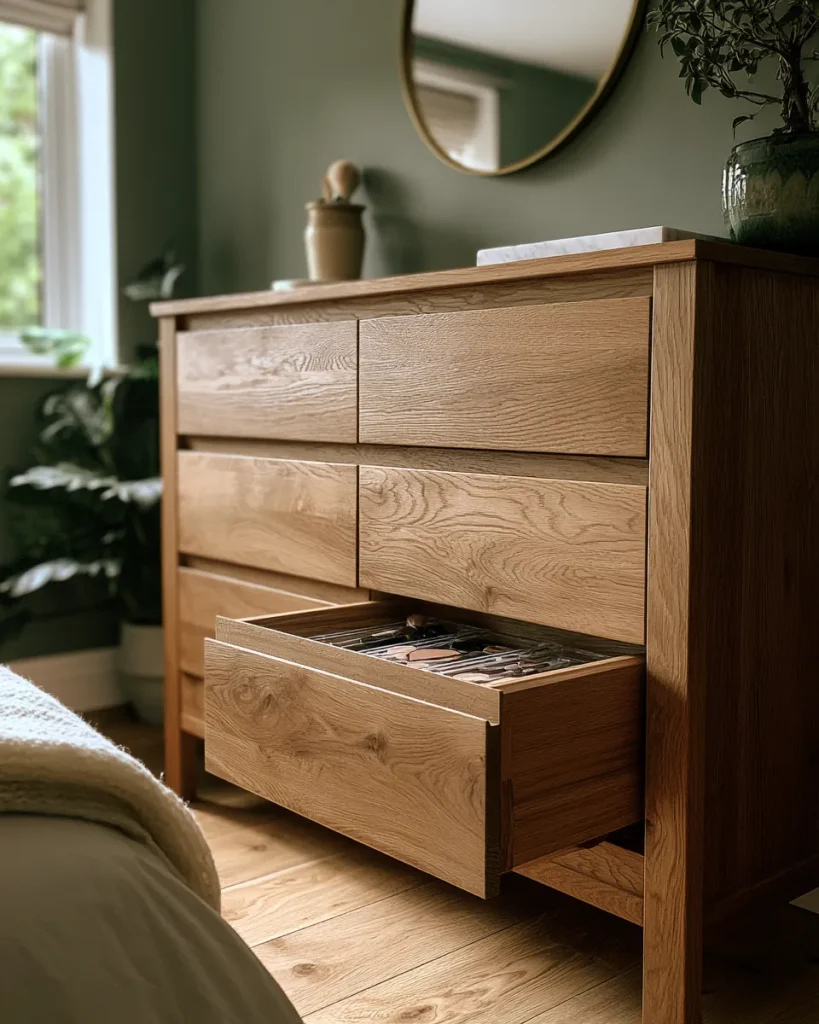
Store makeup out of the bathroom, in a bedroom drawer rather than a cabinet above a sink.
What each location does to the clock
- A bedroom drawer, steady and dark, which is the best available
- A dresser top in daylight, where sunlight degrades pigments and SPF
- A bathroom cabinet, warm and humid, which shortens everything
- A car, which cooks cream products beyond use in a single summer
- A windowsill, which is the worst of the daylight cases
A dresser top is the default and it costs a surface you need for other things. The three moments a bedside surface has to serve shows how quickly a small top fills.
Read more: the readable-face rule that decides how any shallow drawer gets sorted
The drawer beats the display
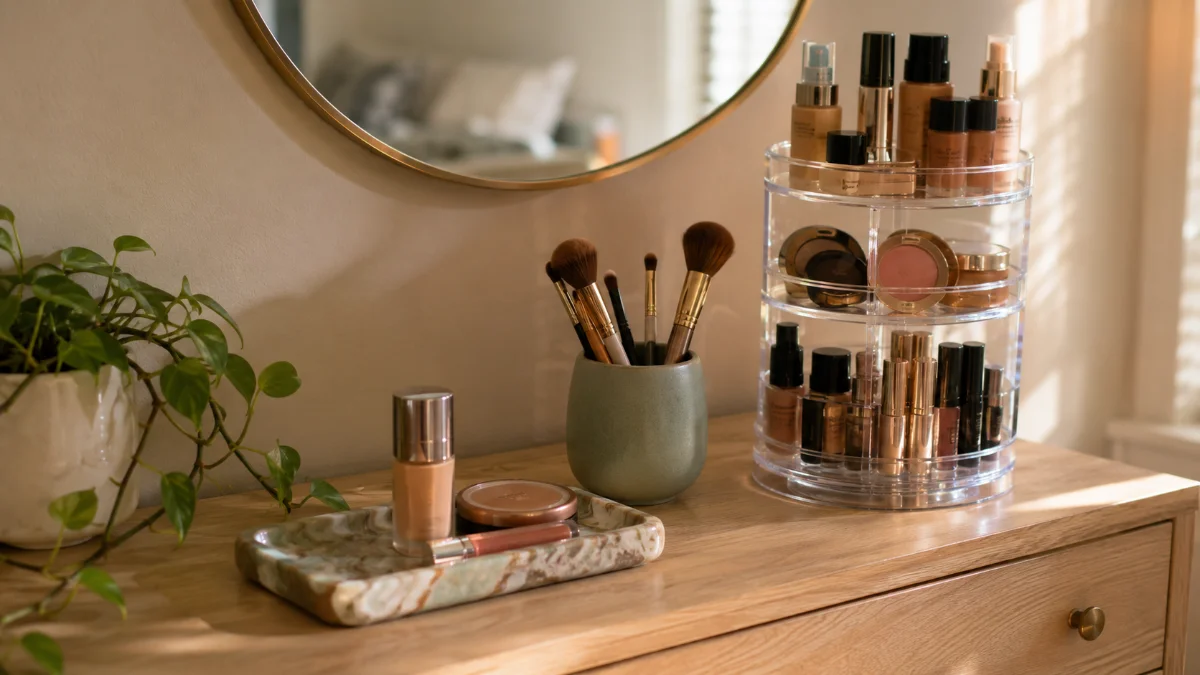
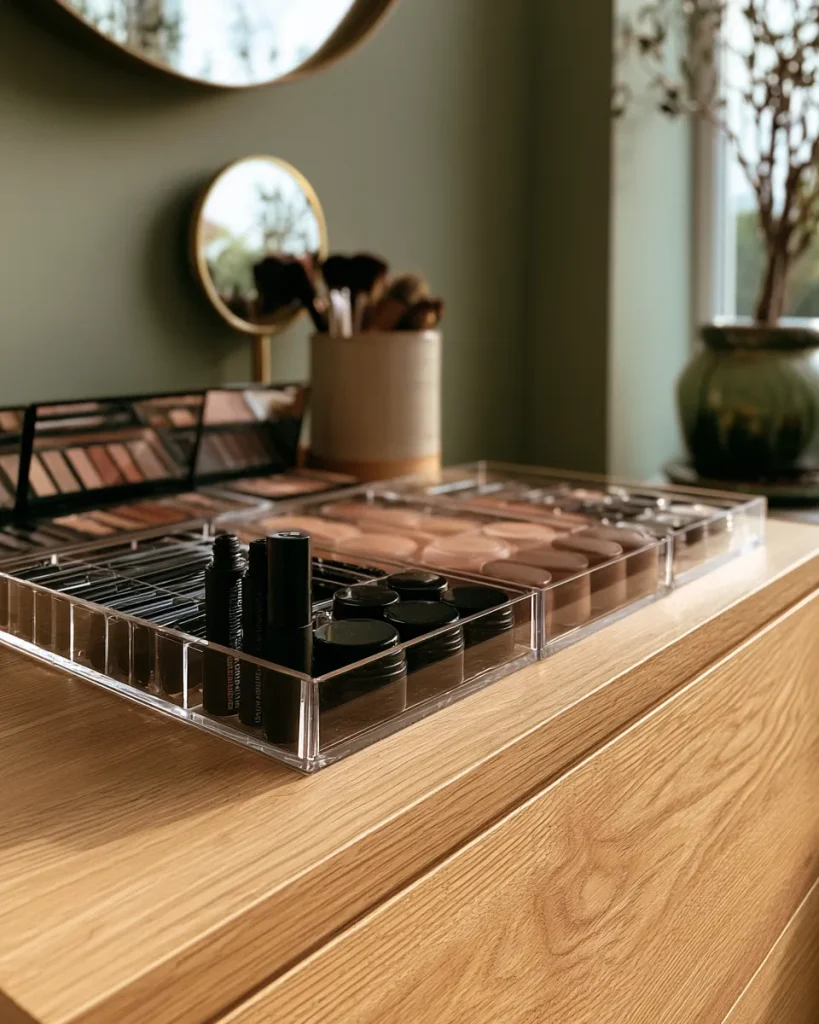
Acrylic risers and lipstick towers photograph well and they put the collection in daylight on a surface you were using for something else.
They also make the collection look like a display rather than a working set, which encourages it to grow without anyone deciding to. A full riser looks correct, and a half-empty one looks wrong.
Most makeup organization products are sold on that appearance. A drawer divider is the less photogenic answer and it holds more, darker, in less space.
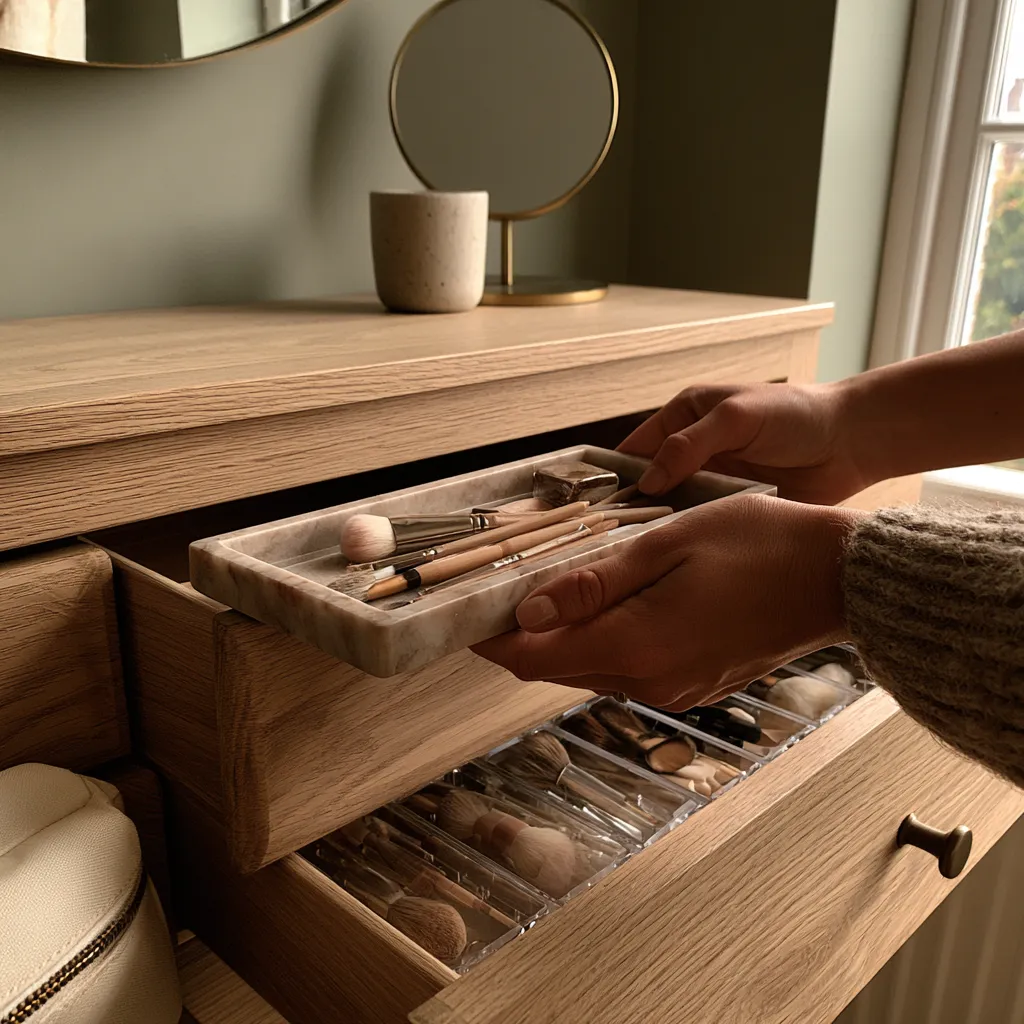
A shallow drawer holds more, keeps it dark, and hides nothing if the items lie in a single layer with the labels facing up.
What a makeup drawer needs
- One layer only, since a second layer hides the first
- Dividers sized to the products rather than to the drawer
- Compartments deep enough for a standing lipstick, about 3 inches
- A separate shallow tray for the daily ten, liftable in one movement
- Nothing stacked, and nothing in a bag inside the drawer
Keep the drawer to one visible layer, and give the daily items their own liftable tray.
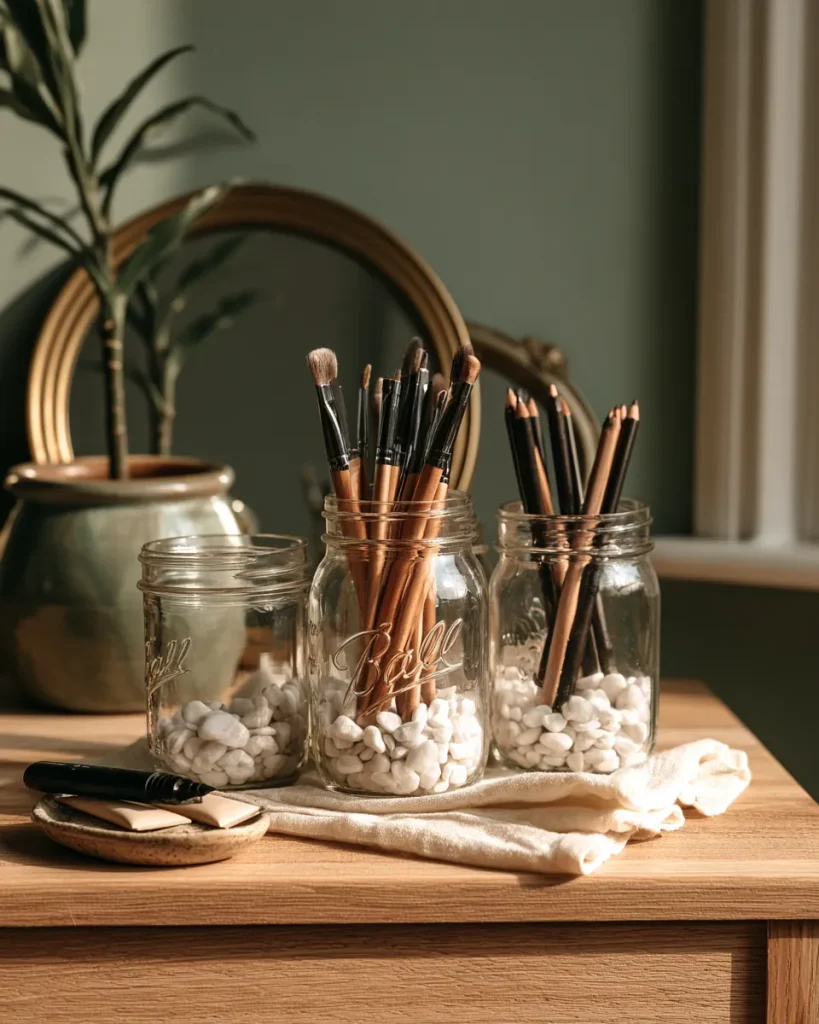
Brushes are the exception that wants height rather than depth, and they belong upright in a pot on the surface. What a wall fixing or shelf will hold above a dresser covers the alternative if the surface is full.
Wash brushes every seven to ten days, since a clean brush protects the product as well as your skin.
What leaves the collection
The clock does most of the deciding, which makes this the easiest cull on the site. Five categories go without argument.
Out on the first pass
- Any eye product opened more than three months ago
- Anything that has changed smell, colour, or texture
- Shades bought for one event and never worn again
- Products with no date and no memory of when they were opened
- Anything used during an eye or skin infection
Shades bought for one event are the group people argue with. The honest question is not whether you might wear it again, it is whether it will still be usable when you do.
That is the same reasoning that clears a wardrobe, and it works the same way here. Sorting by the reason each item is still there applies without modification.
If the whole dresser feels immovable rather than merely full, the order matters more than the method. The room by room sequence that stops a clear out stalling is the better place to begin.
Read more: the storage a small bedroom is not currently using
Dating first, dividers last
The dating step comes first because it changes what the cull removes, and the cull comes before any purchase because it changes the size of the system.
The sequence
- Empty everything onto a towel and group by product type
- Find the open jar symbol on each item and note the number
- Write the opening month on anything you can date, and discard the rest
- Remove every eye product opened over three months ago
- Sort what remains into the three clock bands
- Buy dividers last, sized to what survived
Where the dresser is shared, two separate trays beat one shared drawer for the same reason two people need two rotations. The conflicts a bedroom serving two people creates cover the wider version.
Anything that ends up stored rather than used belongs out of the bedroom entirely, and what a small bedroom looks like once the surfaces are clear is the version worth aiming at.
Makeup organization works when the clock decides the position. The short clocks sit where you see them, the long clocks sit behind, and nothing sits in a drawer counting down unseen.