

The best dorm room ideas work around three fixed constraints: you cannot drill the walls, the furniture is bolted or standard issue, and you are sharing roughly 180 square feet with another person. Everything worth doing starts by getting the bed off the floor, adding light that is not the overhead fluorescent, and using adhesive rather than hardware.
Most dorm decorating advice ignores all three. It shows rooms with painted accent walls and floating shelves, which no residence hall permits, and it never mentions that your RA will inspect the room and that you pay for damage at move-out.
So these 24 dorm room ideas are sorted by what the room actually gives you: the layout you inherit, the walls you cannot mark, the lighting you have to fix yourself, the bed that came with the room, and the roommate you did not choose. Under-bed storage is its own subject with its own guide, so it is not repeated here.
Dorm Room Ideas Start With What You Cannot Change
Read the housing contract before you buy anything. It will tell you the three things that decide most of your decisions, and every year students spend money on things the contract already prohibits.
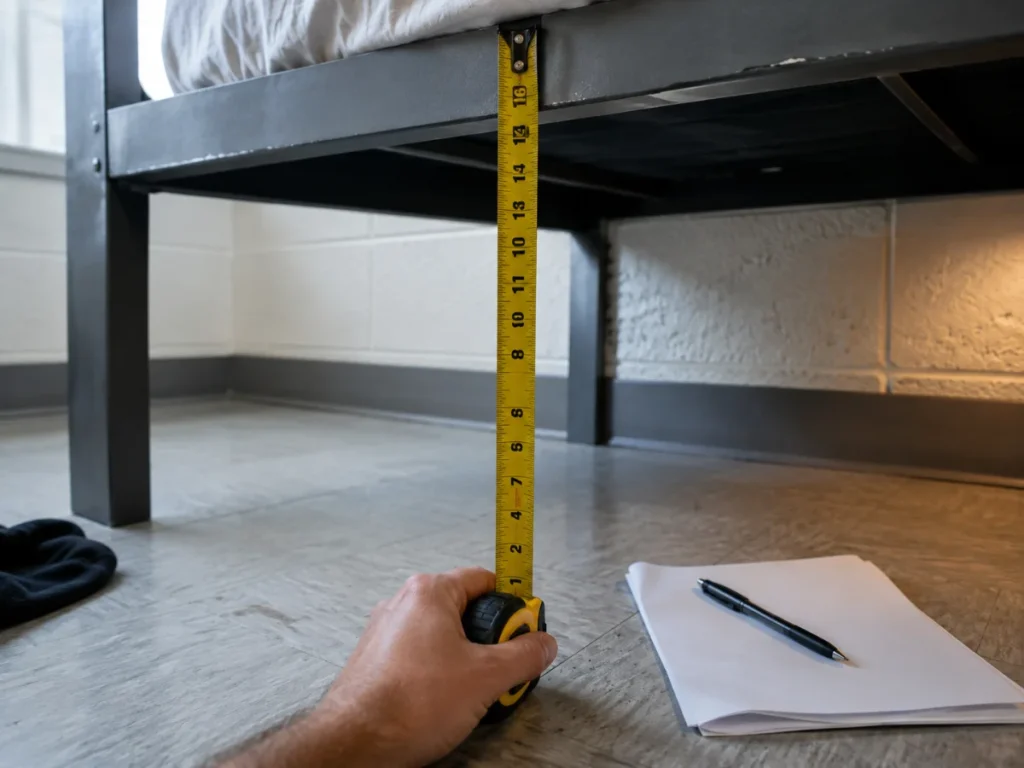
The first is whether the bed can be lofted or raised, and by how much. Some halls loft on request, some let you do it yourself, and some forbid it. The second is what you may attach to walls. Nearly every hall bans nails, screws, and tape that pulls paint, which leaves adhesive strips and tension-mounted anything. The third is the electrical rules, which usually cover extension cords, power strips, and whether string lights are allowed at all.
Then measure two things: the mattress, which is almost always twin XL rather than twin, and the distance from the floor to the underside of the bed frame. Those two numbers determine what bedding fits and what storage fits. Guessing on either is the most expensive mistake in this whole list.
Dorm Room Layout Ideas for Lofted and Standard Beds
Layout in a dorm is decided by the bed height, because the bed is the largest object and the only one whose position genuinely changes the room. Sort that first and the rest follows.
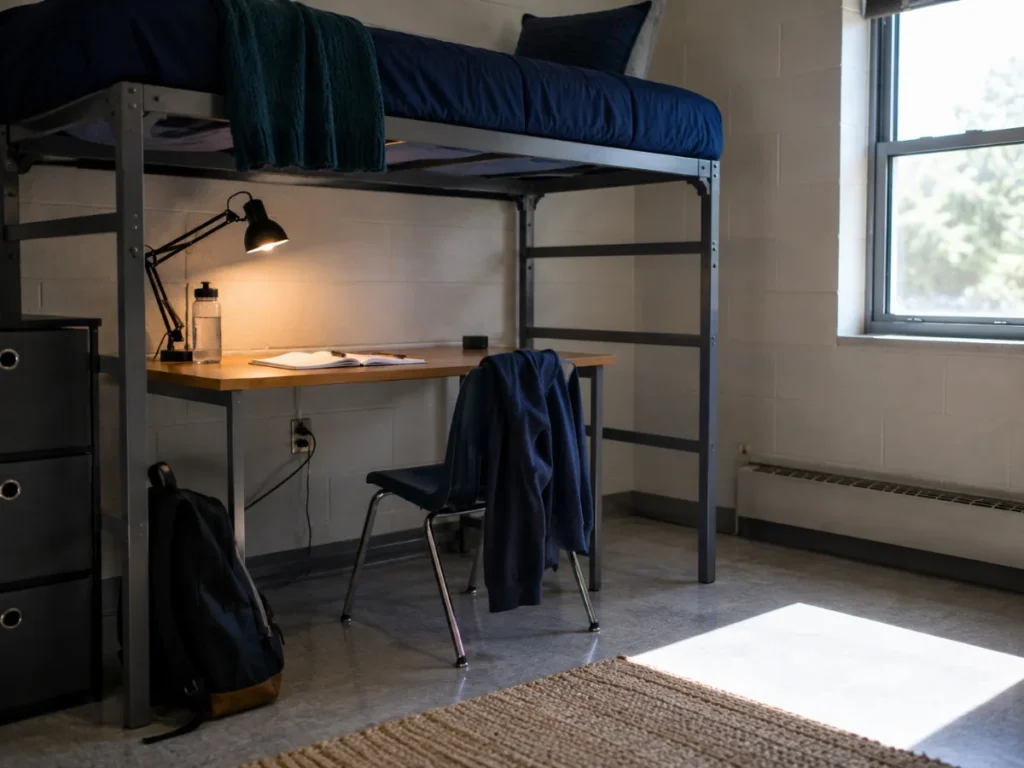
1. Loft the Bed Before You Unpack Anything
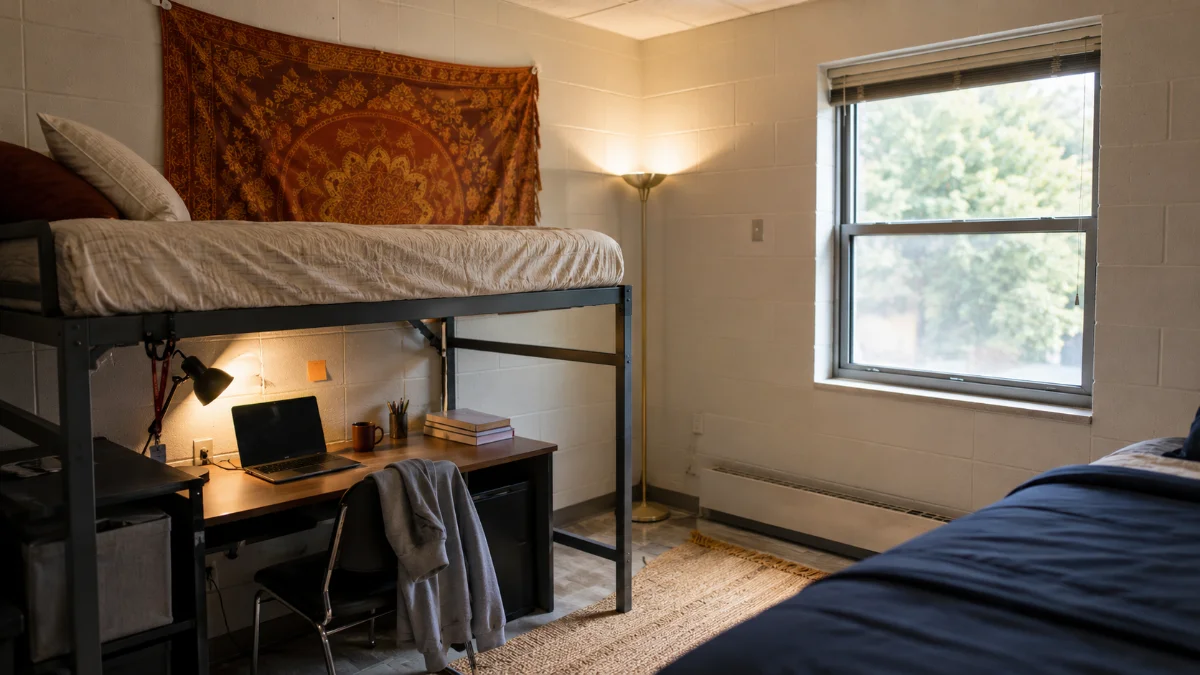
If your hall allows lofting, do it on move-in day rather than in October. A lofted bed converts the floor beneath it into a desk zone, a seating zone, or storage, which is roughly 20 square feet you otherwise lose. Lofting after you have unpacked means dismantling a furnished room, so it does not happen.
2. Bed Risers When Lofting Is Not Allowed
Risers add 5 to 8 inches and work in halls that forbid full lofting. Check the weight rating and buy the version with a recessed cup rather than a flat top, because dorm bed legs are narrow and slide off flat risers.
3. Turn the Desk to Face Into the Room
Dorm desks arrive pushed against a wall facing a blank surface. Turning the desk so you face into the room, or at least sideways, makes a small room feel less like a cell and gives you a sight line to the door. If the desk is bolted, add a mirror on the wall above it instead. The same layout logic applies to any desk squeezed into a bedroom.
4. Keep One Clear Path From Door to Bed
Leave a walkway of at least 24 inches from the door to the bed with nothing in it. In a shared room, this path gets used in the dark by someone who did not turn on the light, and it is the single most common source of noise complaints between roommates.
Dorm Room Wall Decor That Comes Off Cleanly
Every wall treatment in a dorm has to satisfy one rule: it comes down at the end of the year without taking paint with it. That rules out nails, screws, poster putty, and most tape. What remains still covers a lot of ground.
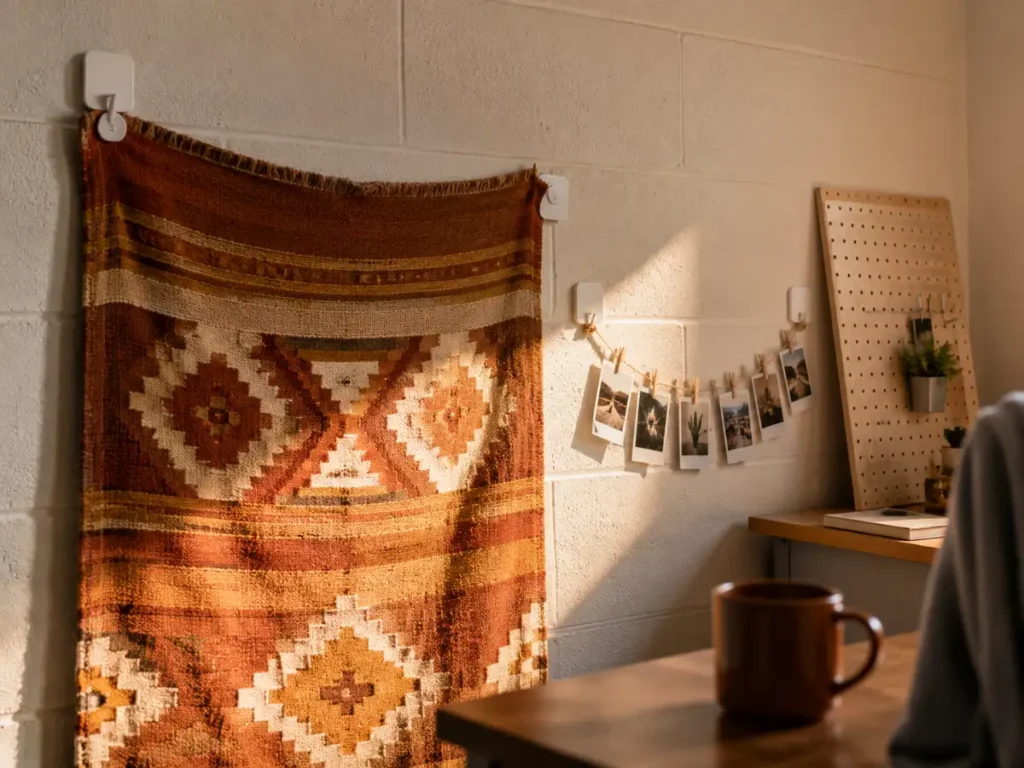
5. Adhesive Strips Rated for Double the Weight
Buy strips rated for at least twice what you are hanging. A hook rated for 3 pounds holding a 2.5-pound frame will fail, usually at night. Wipe the wall with rubbing alcohol first and wait the full hour before loading, because cinder block and fresh institutional paint are both harder to bond to than drywall.
6. A Tapestry Instead of Framed Art
One large tapestry covers more wall than six frames, weighs almost nothing, and needs four adhesive hooks rather than twenty. Expect 20 to 35 dollars. It also softens sound in a room with hard surfaces on every side, which framed prints do not.
7. Removable Wallpaper on the Closet Door
Papering a whole dorm wall is a lot of work and a lot of removal. Papering the inside of the closet door or the front of the wardrobe is a fraction of the area and delivers most of the visual payoff. A roll runs 30 to 60 dollars, and one roll covers a door with material left over.
8. A Leaning Pegboard Rather Than a Mounted One
A pegboard propped against the wall behind the desk gives you hanging storage with zero attachment to the wall. Around 25 to 40 dollars. Anchor the bottom against the desk so it cannot slide. If you want fixed wall storage instead, the shelving rules that work in any small bedroom apply here too, assuming your hall permits it.
9. A Photo Wire Instead of a Photo Wall
A length of wire or twine strung between two adhesive hooks, with small clips along it, holds twenty photos on two attachment points. About 10 to 15 dollars. You can swap the photos all year without touching the wall again, which a grid of individually stuck prints does not allow.
Dorm Room Lighting Ideas Beyond the Overhead
Dorm overhead lighting is the single biggest reason these rooms feel institutional. It is usually one ceiling fixture with a cool white bulb, and no amount of decorating overcomes it. Fixing the light is the highest-impact change in this entire list.
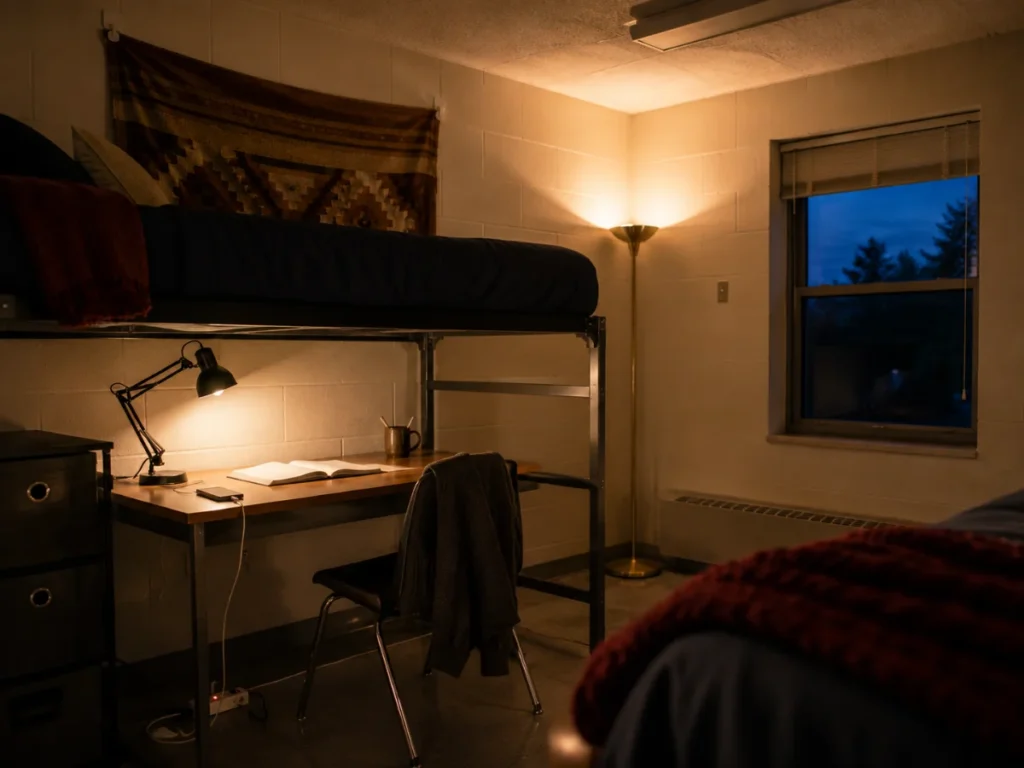
Before you buy, know the safety rules, because student housing has a genuine fire problem rather than a theoretical one. The US Fire Administration lists overloaded power strips and candles among the specific causes of fires in college housing, advises keeping lamps and bulbs away from anything that can burn, and says to use only power strips with internal overload protection. In practice: no candles, never daisy-chain power strips, and keep string lights off bedding and curtains.
10. Never Use the Overhead Alone
Two or three smaller light sources at different heights beat one ceiling fixture in every room, and the effect is strongest in a dorm because the starting point is so bad. Turn the overhead off entirely once you have alternatives and the room stops reading as a facility.
11. A Clip-On Desk Lamp
A clip lamp attaches to the desk edge or the bed frame and takes no surface space, which matters because dorm desks are small. Expect 15 to 25 dollars. Get one with a flexible neck so a lofted bed can borrow it for reading.
12. A Floor Lamp in the Corner
One floor lamp bouncing light off the ceiling changes a room more than any decorative object you can buy. Around 30 to 50 dollars. Position it in the corner furthest from the window so it fills the darkest part of the room rather than doubling up on daylight.
13. Swap Every Bulb to 2700K
Colour temperature is printed on the box, and it is the cheapest fix available. 2700K reads as warm evening light. The 4000K and 5000K bulbs that come standard in institutional fixtures read as a corridor. A pack costs 10 to 15 dollars and takes five minutes.
Dorm Bedding and the Comfort Layer
The bed occupies about a third of a dorm room, and you sleep, study, and sit on it, so it carries more weight than any other purchase. Two of these four are comfort rather than decoration, and they matter more.
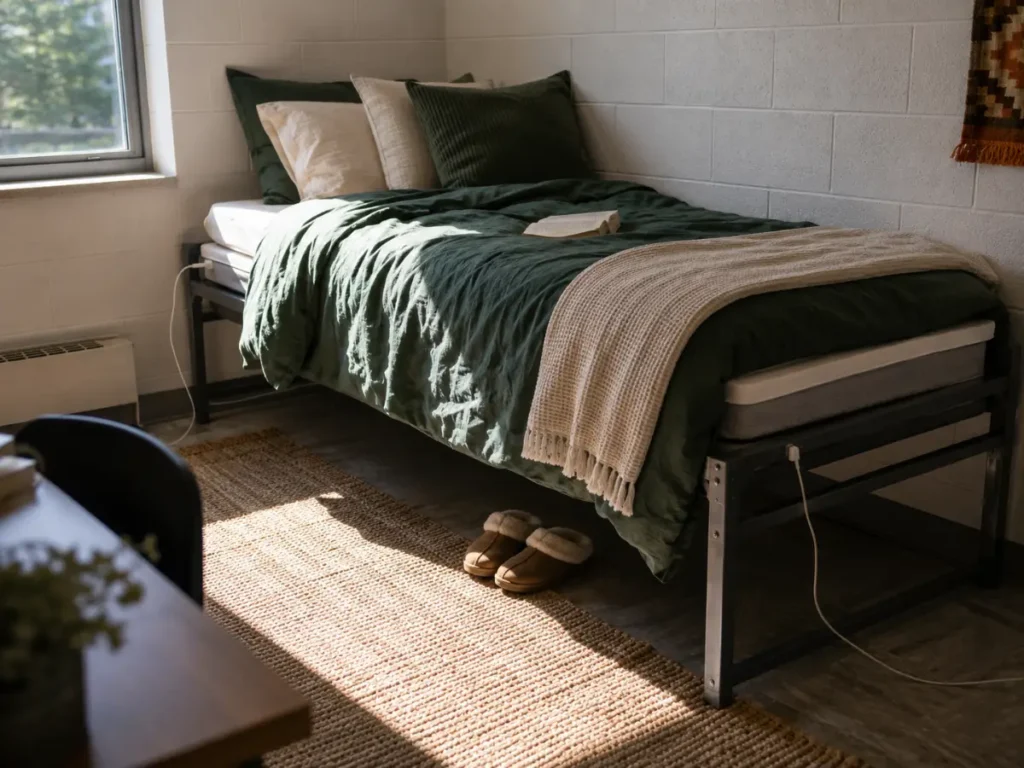
14. Buy Twin XL, Not Twin
Almost every residence hall uses twin XL mattresses, which are 5 inches longer than a standard twin. Standard twin sheets will not stay on. Check your housing website for the exact size before ordering, since a small number of halls still use regular twin and a few use full.
15. A Mattress Topper Is Not Optional
Dorm mattresses are thin, vinyl-wrapped, and built to survive a decade of students rather than to be slept on. A 2- or 3-inch foam topper at 40 to 80 dollars is the difference between sleeping well and not. This is the one item on this list worth spending real money on.
16. Four Pillows, Not Two
Two to sleep on and two firmer ones to sit against, because you will use the bed as a sofa whether you plan to or not. It also makes the bed look properly made rather than sparse, which is the cheapest visual upgrade in the room.
17. A Rug That Covers the Walking Path
Dorm flooring is vinyl tile or industrial carpet, and it is the coldest-looking surface in the room. A rug that runs the length of the walking path, not a small square floating in the middle, breaks it up and cuts noise. Expect 40 to 90 dollars for a 3 by 5 or larger.
Dorm Room Ideas for Guys
Searches for dorm room ideas for guys are a distinct category rather than a rule about who likes what, and the pattern in them is consistent: darker and more neutral colours, fewer decorative objects, and function ahead of styling. If that describes what you want, these three moves get you there fastest.
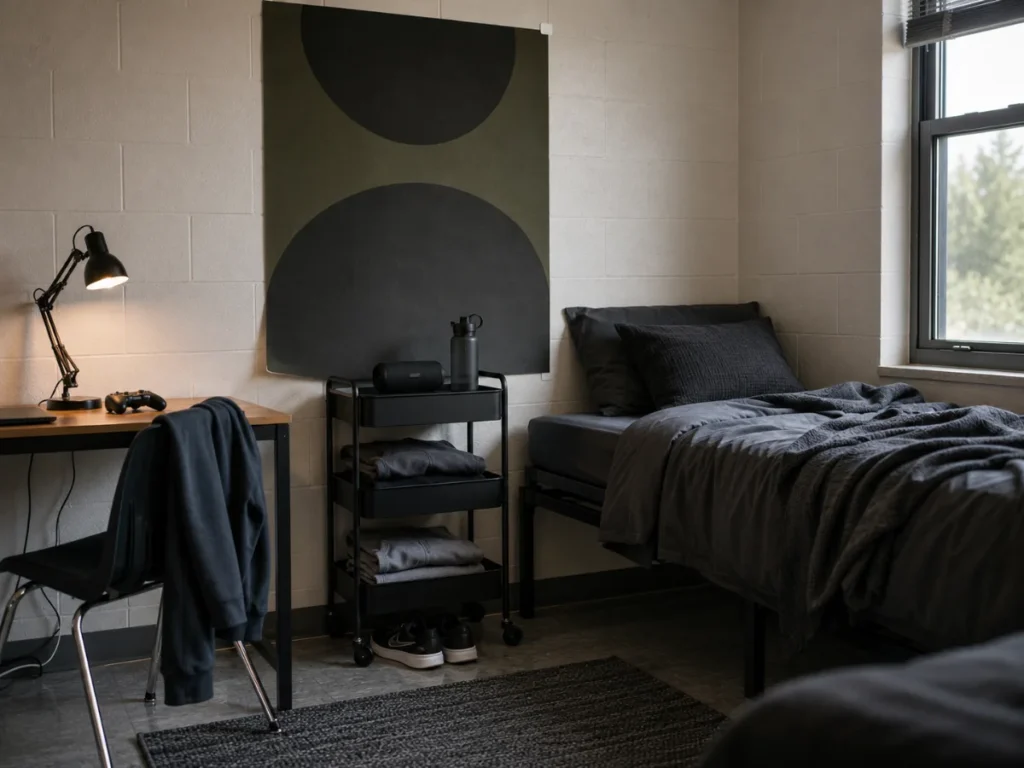
18. Build on a Darker Base
Charcoal, navy, or olive bedding hides wear in a room that gets no deep cleaning until June, and it reads as deliberate against institutional beige walls. It also gives you a base that one bright accent can sit against without the room looking busy.
19. One Large Piece Instead of Many Small Ones
A single large tapestry, flag, or poster covering a substantial area beats a scattered collection of small prints. Fewer attachment points, less to take down in May, and a room with one strong focal point rather than visual noise on every wall.
20. Choose Surfaces That Do a Job
A rolling cart at 30 to 50 dollars holds everything and moves. A desk lamp with a built-in USB port removes a charger. In a room this size, an object that only decorates is competing for space with an object that also works, and the working one wins.
Sharing a Dorm Room With a Roommate
Most dorm room problems are not design problems, they are two-people problems. These four are worth settling in the first week, before the pattern sets.
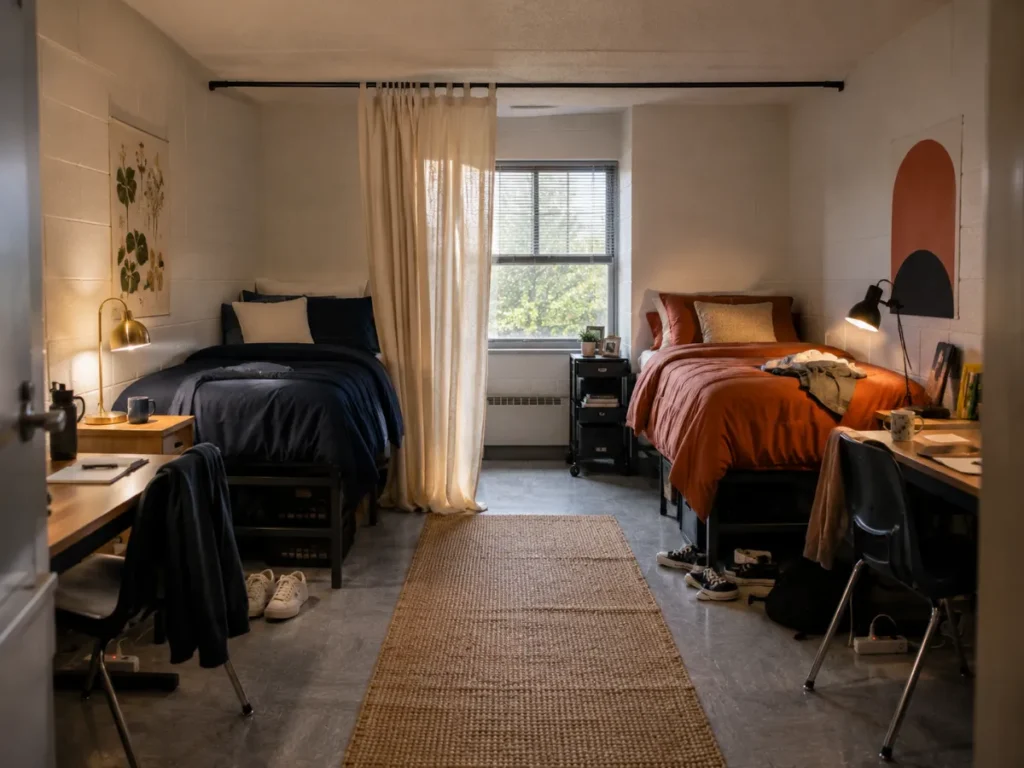
21. Agree on Lights Out in Week One
Different sleep schedules cause more roommate conflict than anything else. Agree on a rough lights-out time and an agreement that after it, the overhead stays off, and lamps are fine. It takes two minutes and prevents the argument you would otherwise have in November.
22. Two Lamps, Not One
One shared light means one person controls when the other sleeps. Two lamps, one per side, at 15 to 25 dollars each, remove that entirely. This is the same reason two of anything you both use daily beats one shared version.
23. Split Storage by Shelf, Not by Pile
Assign shelves, drawers, and fridge levels explicitly on day one. Shared storage without assigned zones becomes one person's storage within a month, usually the person who unpacked first, and it is awkward to renegotiate later.
24. A Curtain Divider for a Shared Double
A ceiling-track or tension-rod curtain between the two halves gives each person a visual boundary without building anything. Around 25 to 45 dollars. Check the rules first, since some halls prohibit anything that blocks sight lines to the door.
Frequently Asked Questions
What Should You Not Bring to a Dorm Room?
Candles, halogen lamps, extension cords, and anything requiring nails or screws. The US Fire Administration names candles and overloaded power strips among the specific causes of college housing fires, and most halls ban all four outright. Also skip full-size furniture, a printer you will use twice, and more clothes than the wardrobe holds.
How Do You Decorate a Dorm Room Without Damaging the Walls?
Use adhesive strips rated for double the weight, tension rods, and leaning rather than mounting. A tapestry on four hooks, removable wallpaper on a closet door, and a photo wire between two hooks cover a lot of wall on very few attachment points.
Are String Lights Allowed in Dorm Rooms?
It depends on the hall, and a significant number prohibit them. Where they are allowed, keep them off bedding and curtains, do not run them under rugs, and never connect them through a daisy-chained power strip. Check the housing contract rather than assuming.
How Do You Make a Dorm Room Feel Less Institutional?
Fix the lighting first. Turn off the overhead, add two or three warm 2700K lamps at different heights, then add one large soft surface such as a tapestry or a rug. Those two changes do more than any amount of decorative objects.
Where to Start With Dorm Room Ideas
Do the lighting on move-in day. Two lamps and a pack of 2700K bulbs costs about 60 dollars total and changes the room more than everything else on this list combined, because the fluorescent overhead is what makes a dorm feel like a facility rather than a room.
After that, get the bed sorted: lofted or raised, twin XL sheets, a real topper, four pillows. Then handle the walls with adhesive and tension rather than hardware. The pattern behind all 24 dorm room ideas is the same one: you cannot change the building, so spend your money and effort on the three things you fully control, which are light, the bed, and the surfaces you can attach to without leaving a mark.