

Bedroom shelf ideas go wrong in one direction. People choose the shelf, then the place, then the fixing, and the fixing is what fails.
Work backwards instead. Weigh what goes on it, pick the fixing that carries that weight, then find a wall that takes the fixing.
Everything below runs in that order. It takes about ten minutes, and it is the difference between a shelf and a repair job.
Weigh the Contents First
The load is the only number that matters, and almost nobody works it out before drilling.
Most bedroom shelf advice starts with a photograph. This starts with a weight, because that is what decides everything after it.
Books are the usual culprit because they are heavier per inch than anything else people shelve.
Everything else on a shelf is light by comparison, which is why the calculation is really a question about books.
What a shelf of books actually weighs
A 36-inch shelf holds roughly 30 books at an average spine width of about 1.2 inches.
- Thirty paperbacks at about 0.7 lb each come to roughly 21 lb
- A mixed shelf averaging 1.3 lb comes to roughly 39 lb
- Thirty hardbacks at about 2 lb each come to roughly 60 lb
- Add the shelf itself, which is 5 to 15 lb depending on material
A shelf of hardbacks plus the shelf is therefore around 70 lb on a 36-inch run. That is well past what most people assume.
Weigh a representative armful on bathroom scales if you are unsure. Two minutes settles it.
Stand on the scales holding the books, then subtract your own weight. It is cruder than it sounds and accurate enough.
Then add whatever you expect to add later. Shelves gain contents over time and almost never lose them.
A shelf sized to today fails in eighteen months. Sizing it to double is the cheapest insurance available.
Everything else is lighter than you think
A lamp, a glass, a plant, and a few objects rarely exceed 10 lb in total.
That is why display shelves and storage shelves are genuinely different jobs, and why one fixing does not cover both.
Decide which one you are building before you shop. A shelf bought for display and then loaded with books is the most common failure on this list.

Shear and Tension, Which Is Why Shelves Fail
A picture hook carries weight straight down. A shelf does not, and this is the part most guides skip entirely.
Understanding this one distinction explains almost every bedroom shelf that has ever come off a wall.
Weight sitting away from the wall levers the top of the bracket outward. That outward pull is tension, and every fixing is far weaker in tension than in shear.
The practical consequence
A toggle bolt rated well over 100 lb in shear can drop to around a quarter of that when the load pulls outward.
Depth makes it worse. A 10-inch-deep shelf levers roughly twice as hard as a 5-inch one carrying the same weight.
Where the weight sits on the shelf matters as well. Items pushed to the front edge lever harder than the same items pushed back against the wall.
Load the back half first. It costs nothing, and it measurably reduces the pull on the fixings.
Shallow shelves are not just better for a small room. They are structurally easier to hold up.
That is the argument for a picture ledge rather than a bookshelf in a tight bedroom, and shallow depth is what keeps a small room feeling wide.
Read more: what else can come off the floor once the wall is carrying weight
Match the Fixing to the Load
Now that you have a weight, pick the fixing. Published ratings are laboratory figures for a straight downward pull, so halve them for a shelf.
| Fixing | Typical rated load | Use it for | Not for |
|---|---|---|---|
| Plastic expansion plug | 5 to 25 lb | Light display shelves, hooks | Anything with books on it |
| Self-drilling threaded anchor | 25 to 75 lb | Medium shelves, curtain rods | Deep shelves carrying weight |
| Molly bolt | 25 to 75 lb | Brackets, small cabinets | Ceilings |
| Toggle bolt | 75 to 150 lb | Real storage shelving | A single fixing point on its own |
| Screw into a stud | Over 100 lb per screw | Anything heavy | Nothing, if you can find a stud |
Those ranges are consistent across the trade sources, including a plain summary of what drywall itself can carry, and the pattern is always the same: the anchor is stronger than the wall.
Two fixings spaced apart beat one large one every time, because they resist the rotation that tension creates.
Space them as far apart as the bracket allows rather than centring them. The wider the spacing, the less each one has to resist.
Three points beat two on anything over about 36 inches, because a long shelf also sags in the middle.
Sag is separate from fixing failure, and it is a material problem. Thin melamine board sags under books at 30 inches; solid timber holds to 36 or more.
Thickness matters more than width here, which is the same trade you meet choosing shelving for a kitchen wall.
Find the studs, and most of this disappears
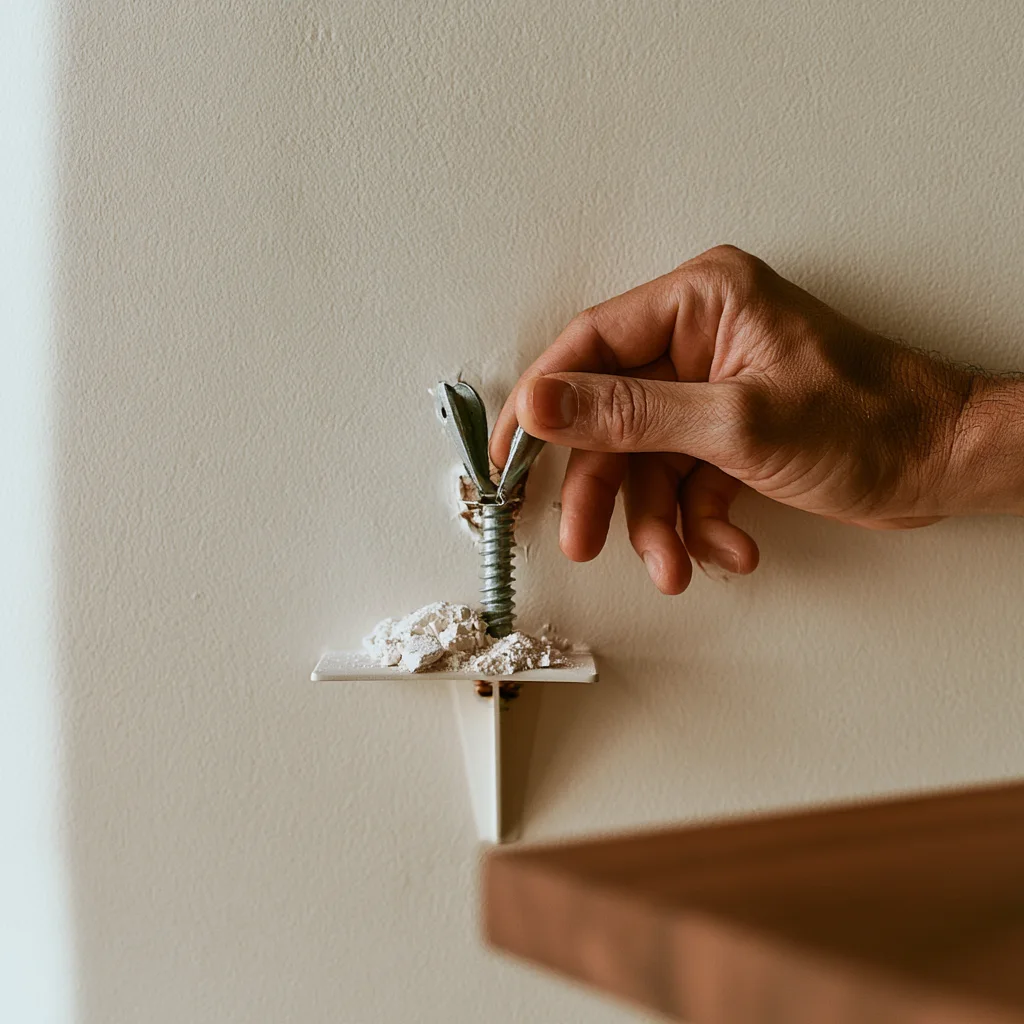
A screw into a stud carries more than any drywall anchor, and two of them will hold a loaded shelf without any anchors at all.
Studs sit at 16 or 24 inch centres in most homes. Measure from a corner, then confirm with a magnet, which finds the screws in the plasterboard.
A magnet costs almost nothing and is more reliable in old walls than an electronic detector.
Mark every stud you find with a pencil before you commit to a height. Studs decide the shelf length as much as the wall does.
A shelf that spans two studs at 16-inch centres wants to be at least 20 inches long so both brackets land on timber.
That constraint decides the shelf you buy, which is why it belongs here rather than at the shop.
Then Find a Wall That Takes It
Only now does placement come into it. The wall decides which fixings are available, and that decides where the shelf can go.
This is the reverse of how bedroom shelf ideas are usually presented, and it is the order that actually works.
Working out what your wall is
- Knock it. Hollow and light means plasterboard on studs
- Solid and dull means masonry, plaster over brick or block
- Drill a test hole in an inconspicuous spot and look at the dust
- White powder means plasterboard, grey or red grit means masonry
- If the drill bit stops dead about an inch in, you have found a stud
Masonry needs a masonry bit and a plug, and it holds far more than plasterboard once fitted correctly.
Use the hammer setting on the drill for brick and block, and turn it off for plaster and tile, which crack under it.
Plaster over lath, common in older buildings, is the awkward case. It crumbles, so drill slowly and expect to need a longer fixing.
Masking tape over the spot before drilling stops the surface chipping and keeps the bit from wandering.
Placement, once the wall allows it
Above the bed is the most requested spot and the one that deserves the most caution.
Keep it shallow, keep it light, and fix it into studs if the wall has them. Nothing heavy belongs directly above where someone sleeps.
Set it high enough that you cannot hit your head sitting up in bed. Around 18 inches above the headboard clears most people.
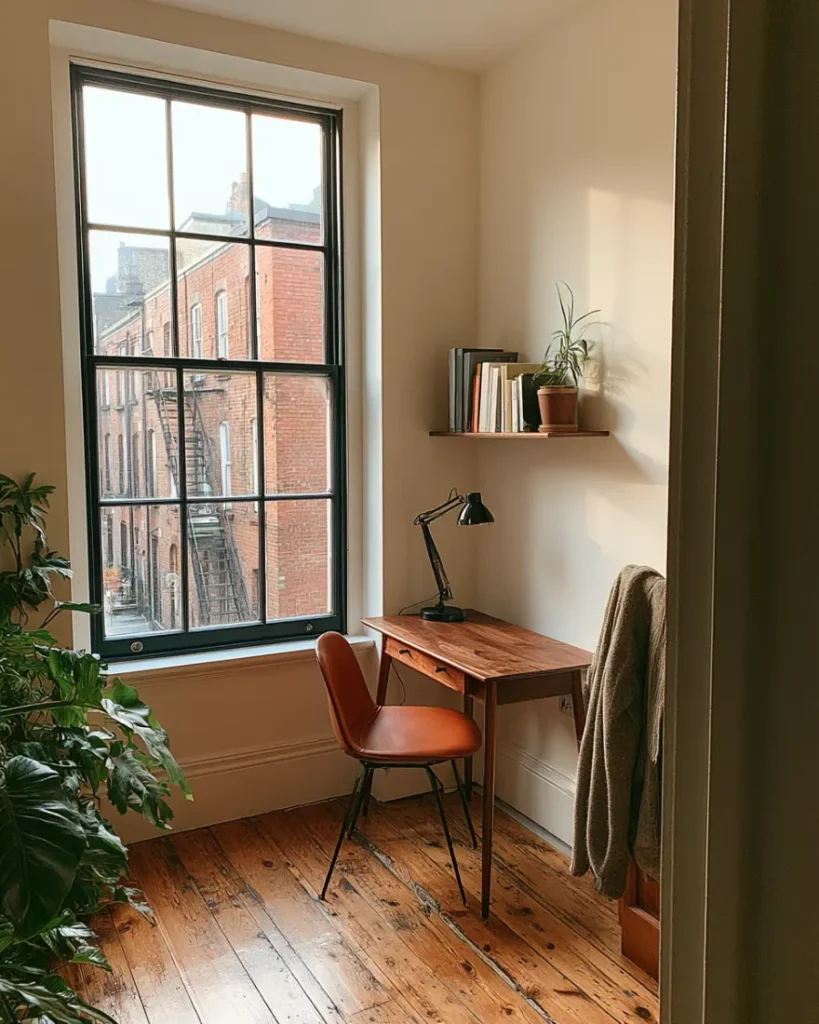
The wall above a desk or dresser is the easier win, because a fall there costs a lamp rather than a person.
Height matters too. Anything above about 60 inches needs a stool to reach, which means it becomes long-term storage whether you planned that or not.
Above a desk, the shelf also does real work, since taking storage off the desk surface is most of the job.
The spots people overlook
- The narrow strip between a wardrobe and the wall
- Above the door frame, which suits things used twice a year
- A corner, where two short shelves meet, and each spans less
- Low along one wall, where a run of baskets replaces a dresser
Corners are structurally kind, because a shorter span sags less and each shelf carries half the load.
They also use a part of the room that furniture cannot, which is the whole reason corner space is worth the awkward cut.
The strip beside a wardrobe is the other one worth measuring, since narrow gaps are where genuinely new storage comes from.
Read more: no drill options that work across a whole rented flat
If You Cannot Drill At All
Renting removes most of the fixings above, which changes what is realistic rather than ruling shelves out.
Plenty of bedroom shelf setups need no wall fixing at all, provided you are honest about what they carry.
What adhesive strips actually hold
Packs commonly rate four pairs at around 16 lb combined, and that is for a flat picture pulling straight down.
On a shelf, where the load pulls outward, treat that number as roughly half. Which means display only, and no books.
Clean the wall with rubbing alcohol rather than a household cleaner, because cleaner residue stops the adhesive from bonding.
Wait a week after painting. Fresh paint has not fully cured, and the strip will take it off with the shelf.
Textured wallpaper and matt emulsion both hold adhesive badly. Halve the rating again on either.
When you take them off, pull the tab straight down and slowly. Pulling outward is what takes the paint with it.
The options that carry real weight without a hole
- A freestanding shelf unit, which carries roughly 30 lb per shelf and needs no wall at all
- A leaning ladder shelf, which needs a wall to rest on and a strap at the top for safety
- A tension pole system, which works between floor and ceiling in a room with a fixed ceiling height
- An over-door shelf, for light items only
Freestanding is the honest answer for most renters with real storage needs, and it works the same way in a closet as on an open wall.
Strap any tall freestanding unit to the wall with a single small anchor if the lease allows one hole. That is a tipping risk rather than a weight one.
If it allows no holes at all, keep the heavy items on the bottom two shelves and nothing above shoulder height.
Making It Not Look Like Clutter
A shelf that holds well can still make a small room read as busy, which is a separate problem with a separate fix.
A bedroom shelf is visible from the door in a way a drawer is not, so what sits on it does more work than its volume suggests.
Three rules that do the work
One category per shelf. Books on one, objects on another, and nothing mixed.
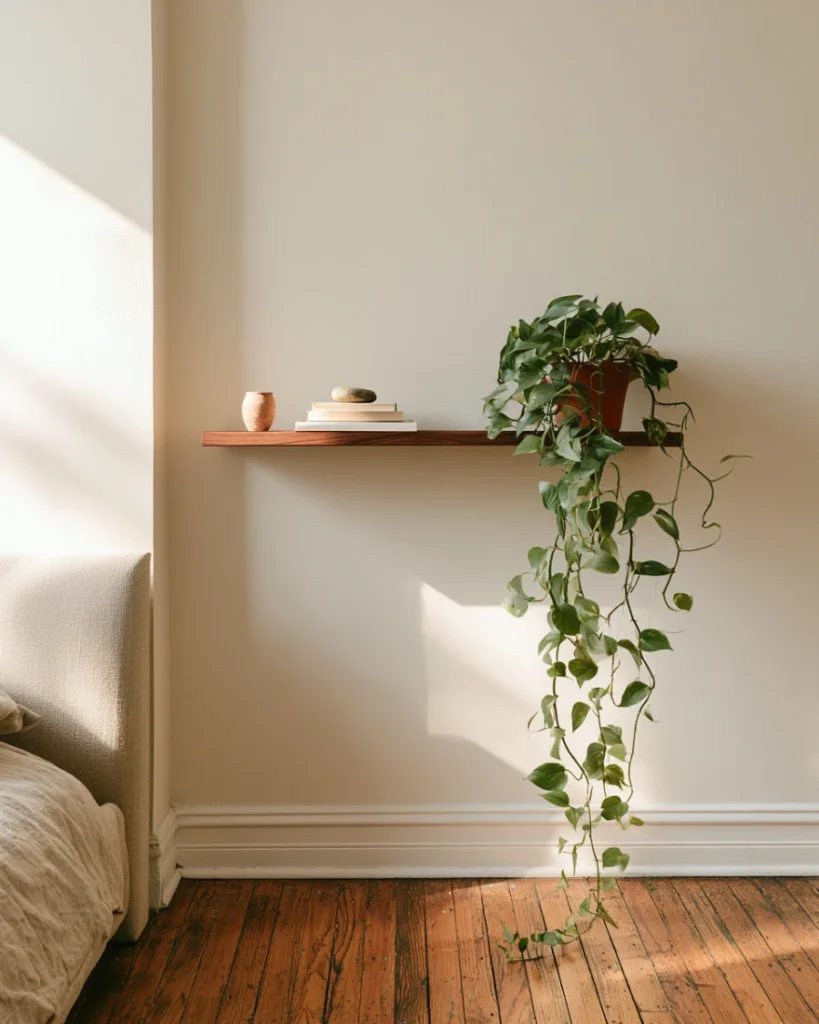
Leave about a third of the surface empty. A full shelf reads as storage, while a two-thirds shelf reads as deliberate.
That empty third is also structural insurance, because it stops you from adding weight the fixings were never sized for.
Vary the heights of what sits on it rather than the quantity. Three objects at three heights look composed, while nine objects at three heights look like a shop.
Books lying flat under an object read as one item rather than two, which is a cheap way to reduce the visible count.
Keep the palette on the shelf to what is already in the room. A shelf of mixed colours reads as busier than the same objects in two tones.
Nothing on a bedroom shelf should need dusting weekly. Anything that does will stop getting dusted and start looking neglected.
Visible object count is what makes a tidy room still feel cramped, and that is a distinct symptom with its own cause.
Read more: deciding what deserves to be on display at all
What Fails, and How You Will Know
Shelves rarely fall without warning. Three signs come first.
- A hairline crack in the paint above a bracket, which means the fixing is pulling outward
- The shelf reading slightly nose-down, which means it has already moved
- Dust or fine white powder on the floor below a fixing
Any of those means take the weight off today and refit properly, rather than waiting to see whether it settles.
The 10-minute check before you drill
- Weigh what is going on the shelf, including the shelf itself
- Double it, because published fixing ratings assume a straight downward pull
- Pick the fixing from the table that covers the doubled figure
- Confirm the wall type with a knock and a test hole
- Find the studs with a magnet and use them if they line up
Every one of those steps costs minutes. Refitting a shelf that has torn out of plasterboard costs an afternoon and a repair.
Check it again after a month of real use. A fixing that is going to move usually does so in the first few weeks.
Push down gently on the outer end. Any give at all means the fixing is working loose and the shelf needs emptying now.
Refitting into the same hole never works. Move across by at least two inches, or fill the hole properly and let it set first.
And if the honest answer is that the wall cannot carry what you own, the storage has to go somewhere else, which usually means the space under the bed rather than above it.
A kitchen shelf is the same calculation with heavier contents, so the load maths there is worth reading before drilling.