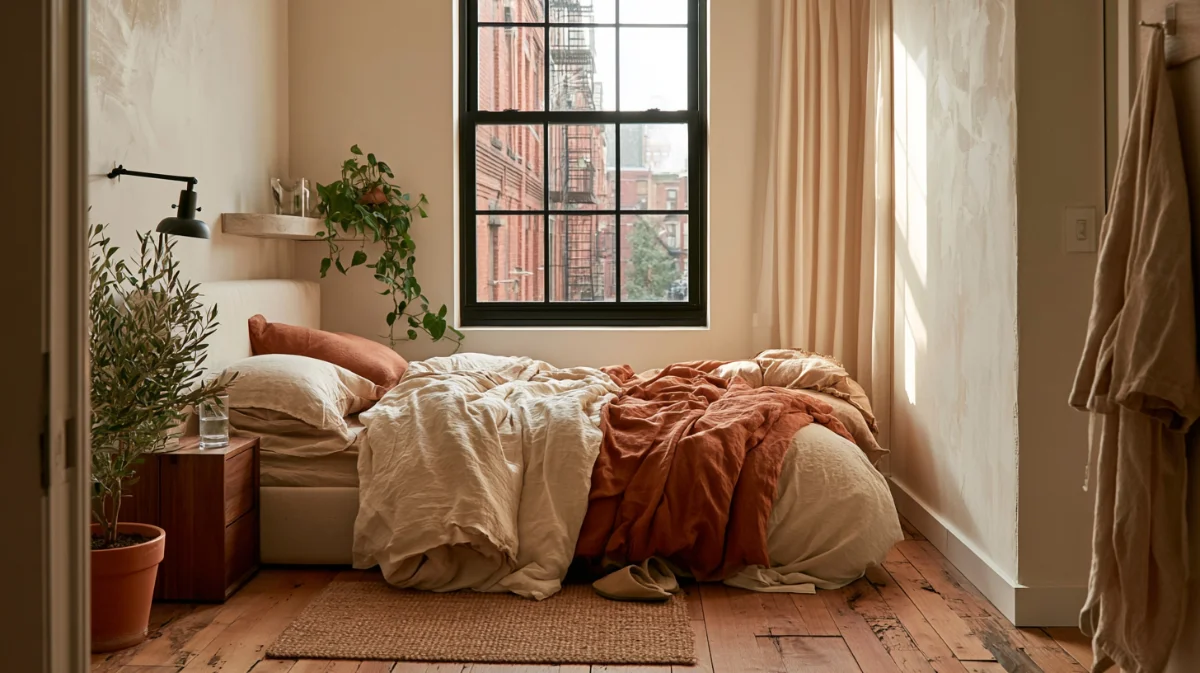


Most minimalist bedroom ideas for small rooms start with buying storage. Start by removing instead. Clear the floor, keep only what the room needs for sleeping and dressing, then buy for what is left. None of the 24 fixes below needs a drill.
The chair has clothes on it again.
There is a bag by the door that never gets put away.
Two of the three things on the nightstand belong somewhere else.
What this guide covers, in order:
- What to take out of the room before you spend anything
- How to pick a bed size that still leaves a walkway
- Under-bed bin heights matched to your actual frame clearance
- No-drill wall and door storage, with the weight limits
- Colour and light changes that cost nothing
- A nightly reset that keeps the floor clear
Work down in that order. With minimalist bedroom ideas, the sequence matters more than any single tip.
Take Things Out Before You Bring Anything In
Every fix below works better on an emptier room. Subtraction is free, it takes one afternoon, and it changes what you actually need to buy.
These five minimalist bedroom ideas cost nothing at all. Do them before you open a shopping tab.
1. Empty the floor completely, then put back only what sleeps here
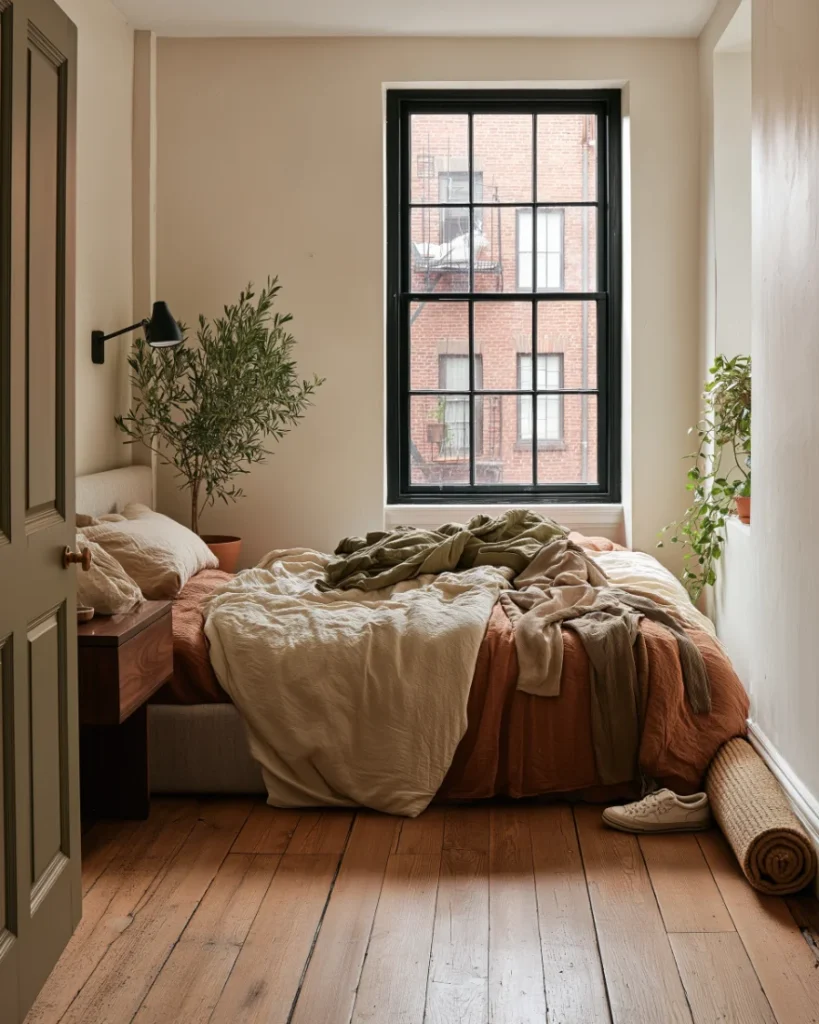
Take everything off the floor. Not most of it. Everything, including what is under the bed and behind the door.
Then put back only what belongs in a bedroom. Most people return about a third of what they pulled out.
What earns a place back on the floor:
- The bed and anything holding it up
- One laundry basket
- Shoes you wear this week, not this season
- A rug, if the floor is cold
Everything else goes to another room, a donation bag, or the bin.
Do it in one sitting. Spread over a week, the pile just moves from the floor to the bed and back again.
2. Run a twenty minute surface sweep
Clear the nightstand, the dresser top and the windowsill in one pass.
Flat surfaces fill faster than floors, and they are the first thing you see when you wake up.
Give each surface one job. The nightstand holds a lamp, a glass and one book. Nothing else lands there.
Set a timer. Twenty minutes covers three surfaces and is short enough that you will actually start.
Read more: keeping a bedside surface clear when there is no drawer
3. Sort clothes by last worn, not by season
Season sorting keeps things you never wear. Sorting by last worn date removes them.
Turn every hanger backwards today. In three months, anything still facing backwards has not been worn.
That one test does more than any folding method, and it costs nothing to start.
Bag what is left facing backwards, then keep the bag outside the room for a month before donating it.
Once the backwards hangers are pulled, the pile needs a decision, not a bigger wardrobe.
4. Pull everything out from under the bed before you buy a bin
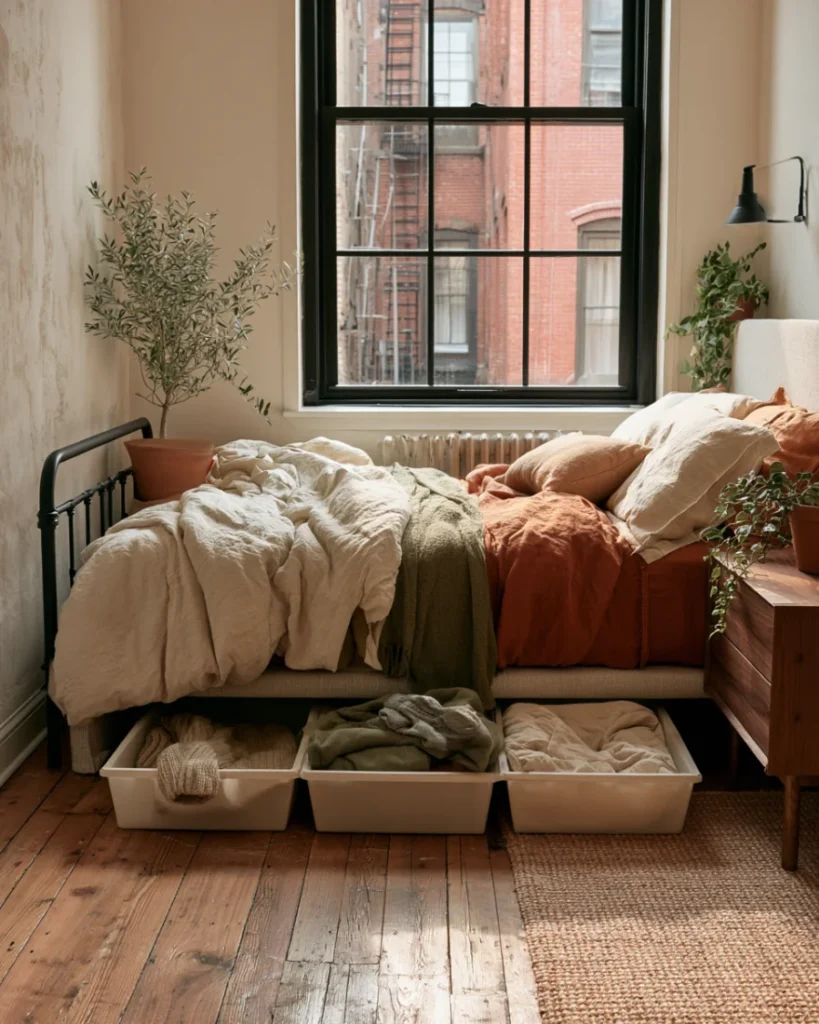
Under-bed space is where a small bedroom usually hides its problem.
Empty it first. Measure the clearance second. Buy bins third, and only for what survived the sort.
Buying bins first is how people end up with storage full of things they were about to throw out.
Photograph the pile once it is out. Being honest about a picture is easier than being honest about a carpet.
5. Set a one-in, one-out rule for this room only
Whole-apartment rules fail. A rule for one room holds, because you can see the whole room at once.
New jumper in, old jumper out, same day.
The rule is not about buying less. It is about the room never gaining net volume.
Consumables are the exception. Toiletries and socks wear out, so they replace rather than accumulate.
Read more: the wider case for owning fewer things
Minimalist Bedroom Ideas for Small Rooms That Start With the Bed
A queen mattress is 60 by 80 inches, which works out to 33 square feet.
In a 10 by 10 room the bed alone takes a third of the floor. In a 70 square foot room it takes closer to half.
Nothing else in the room can be fixed until that number is right. The bed is the constraint, and the rest of the minimalist bedroom ideas here work around it.
6. Measure the walkway before you choose a bed size
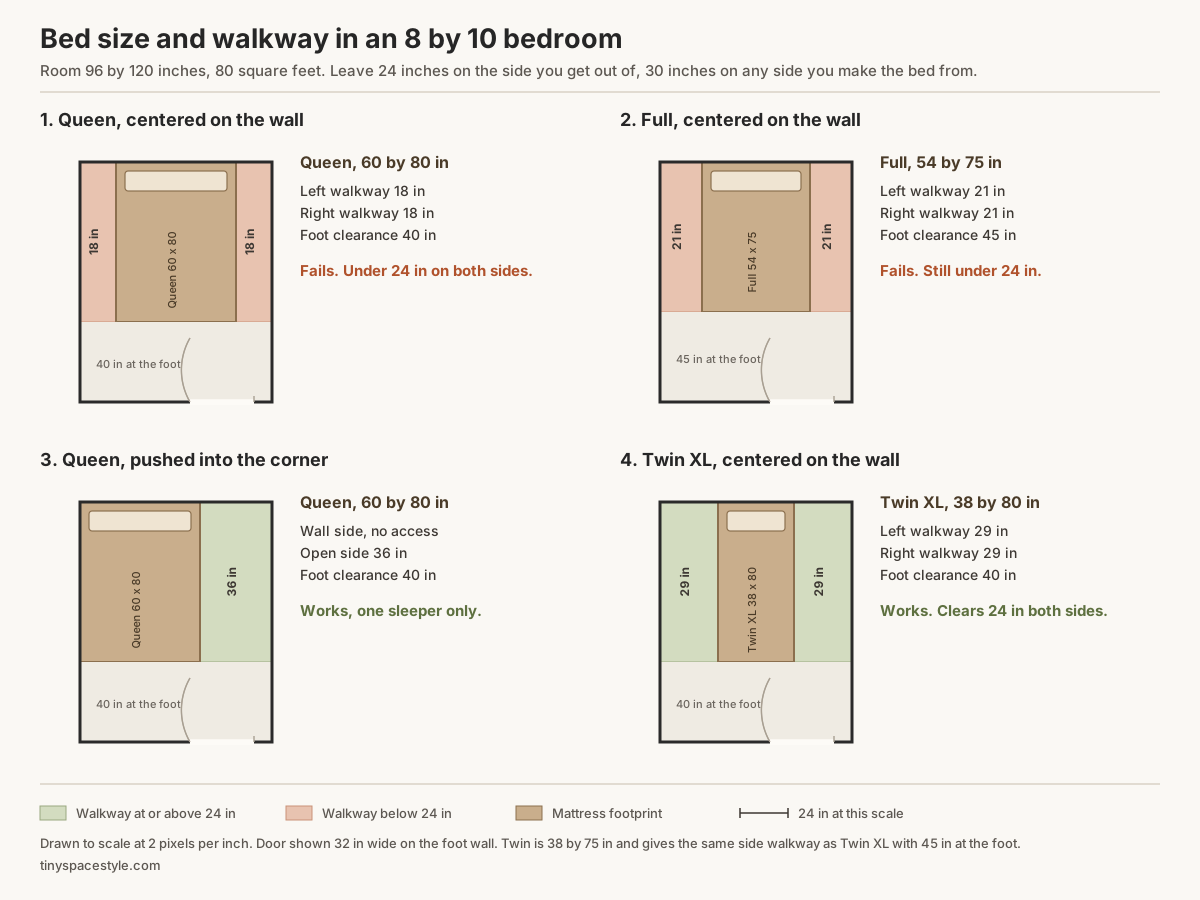
Pick the mattress that leaves a walkway, not the largest one that fits between the walls.
Standard mattress footprints:
- Twin, 38 by 75 inches
- Twin XL, 38 by 80 inches
- Full, 54 by 75 inches
- Queen, 60 by 80 inches
Leave 24 inches of clear walkway on the side you get out of, and 30 inches on any side you make the bed from.
A full bed with a real walkway beats a queen you have to shuffle around.
Measure corner to corner before you shop. Radiators, wardrobe doors and skirting eat the walkway you thought you had.
Mark the footprint on the floor with masking tape and live with it for a day before ordering anything.
For reference, US residential code sets 70 square feet and 7 feet in any horizontal direction as the minimum for a habitable room, so a perfectly legal bedroom can be smaller than most bed-plus-walkway advice assumes.
7. Push the bed into a corner if only one person sleeps in it
Two sides against walls frees one continuous strip of floor instead of two narrow channels.
It only works for a single sleeper. Whoever is on the wall side has to climb over the other person.
Keep the head end clear even in a corner, so the bedding can still be changed from somewhere.
Read more: what changes when two people share the room
8. Match bin height to your actual frame clearance
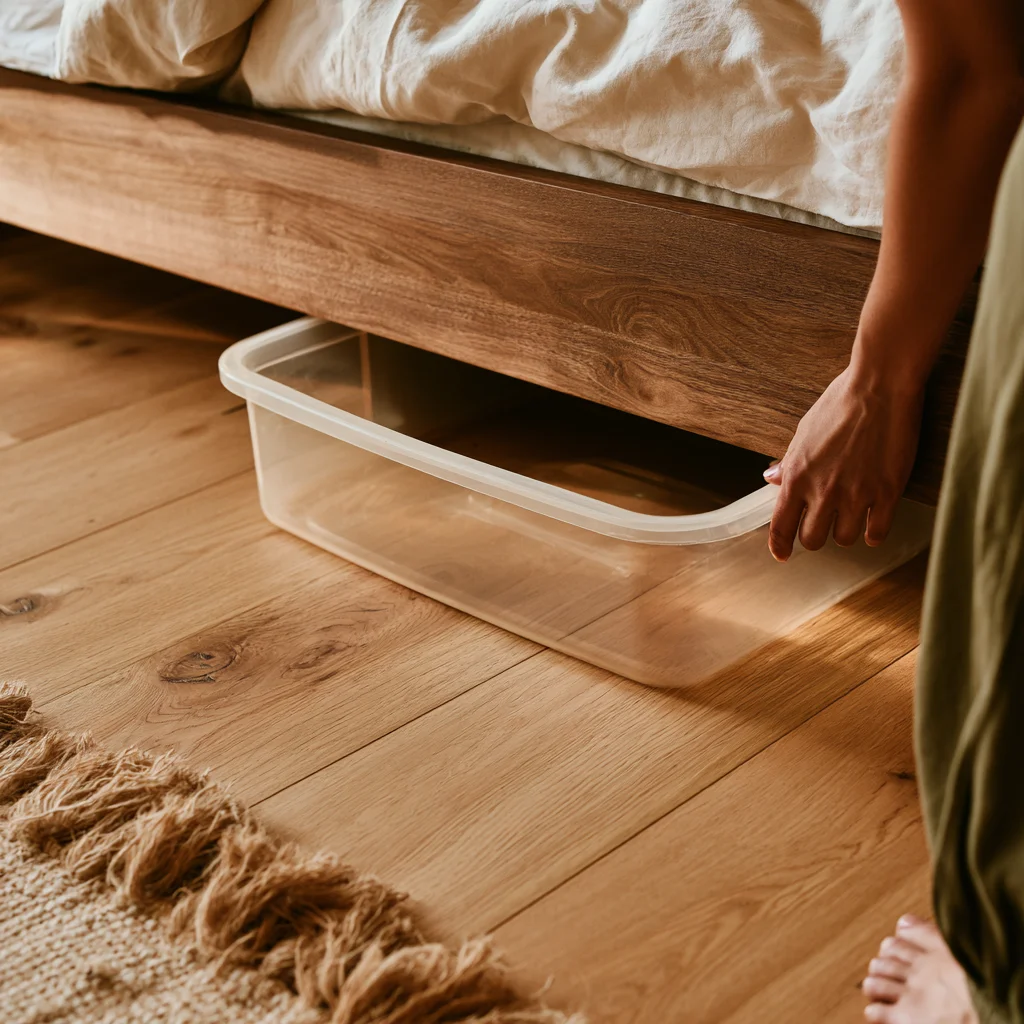
Measure floor to the underside of the frame. That number picks the bin, not the other way round.
Typical clearance bands:
- Platform frames, roughly 3 to 6 inches
- Standard metal and wood frames, roughly 7 to 13 inches
- Divan and storage beds, often under 3 inches, with built-in drawers instead
Buy the bin one inch shorter than the clearance, never equal to it.
Lids need room to clear the rail, and carpet lifts the bin higher than the tape suggests.
Measure at the lowest point of the frame, which is usually the centre support rail rather than a corner leg.
Read more: sorting under-bed storage by what fits at each height
9. Add risers only if the frame can take the load
Risers add roughly 3 to 8 inches depending on the model. They also raise the centre of gravity.
Solid wood and welded steel frames handle them. Thin bolted frames and slatted bases flex and can crack.
Check the joints before you lift the bed, not after.
Rubber-topped risers grip better than bare plastic and stop the frame walking across a hard floor.
10. Replace the headboard with something flat against the wall
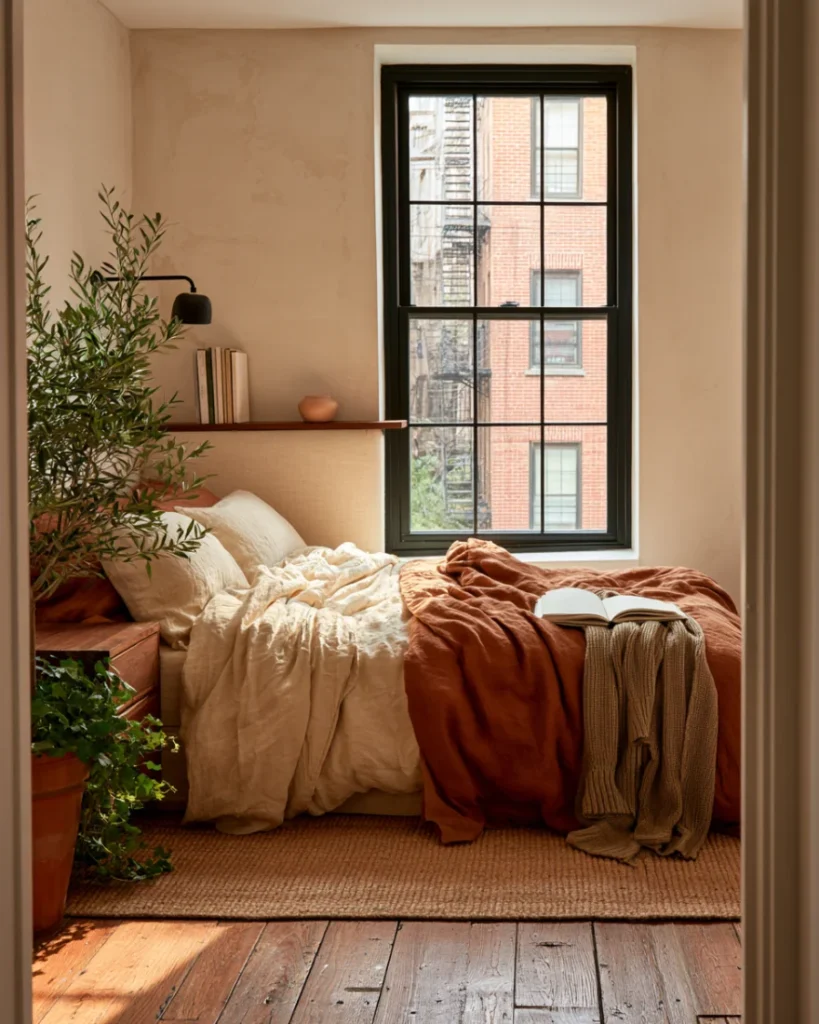
A headboard adds 3 to 5 inches of depth to the largest object in the room and holds nothing.
A picture ledge or a hanging behind the bed does the same visual job at almost no depth.
On a tight wall, those few inches are the difference between a walkway and a shuffle.
Keep any ledge behind the bed shallow, around 3 inches, so nothing heavy sits directly above your head.
Read more: what a shelf above the bed can and cannot hold
Wall and Door Storage That Leaves No Holes
Renting rules out most storage advice. These five hold real weight and come off without patching.
Weight is the part people skip. A hook that fails at 2 am takes a strip of paint with it.
| Method | What packs usually rate | Rough cost | Best for |
|---|---|---|---|
| Adhesive picture strips | Up to about 16 lb across four pairs | $8 to $12 | Light shelves, hooks, art |
| Tension rod | 20 to 30 lb spread across the span | $10 to $18 | Second closet rail, curtains |
| Over-door hook rack | 15 to 25 lb | $10 to $20 | Bags, robes, worn-once clothes |
| Over-door organiser | 20 to 40 lb spread | $12 to $25 | Shoes, small folded items |
| Freestanding shelf unit | About 30 lb per shelf | $30 to $60 | Books, bins, a plant |
Ratings vary by brand and by wall surface. Read the pack, then stay under the number it gives you.
Spread load beats point load every time. Two hooks carrying 5 lb each are safer than one carrying 10 lb.
11. Swap the nightstand for a six-inch floating shelf
A 6-inch deep shelf holds a phone, a glass, a book, and a small lamp. That is everything a nightstand actually carries.
It frees the floor on both sides of the bed, which is exactly where a small room reads as blocked.
Go to 10 inches only if you stack books on it.
Fix it at mattress height plus roughly 6 inches. That is close enough to reach a glass without sitting up.
Add a small hook underneath for a charging cable, so the cable stops living on the floor.
12. Use adhesive strips well under their rating, not near it
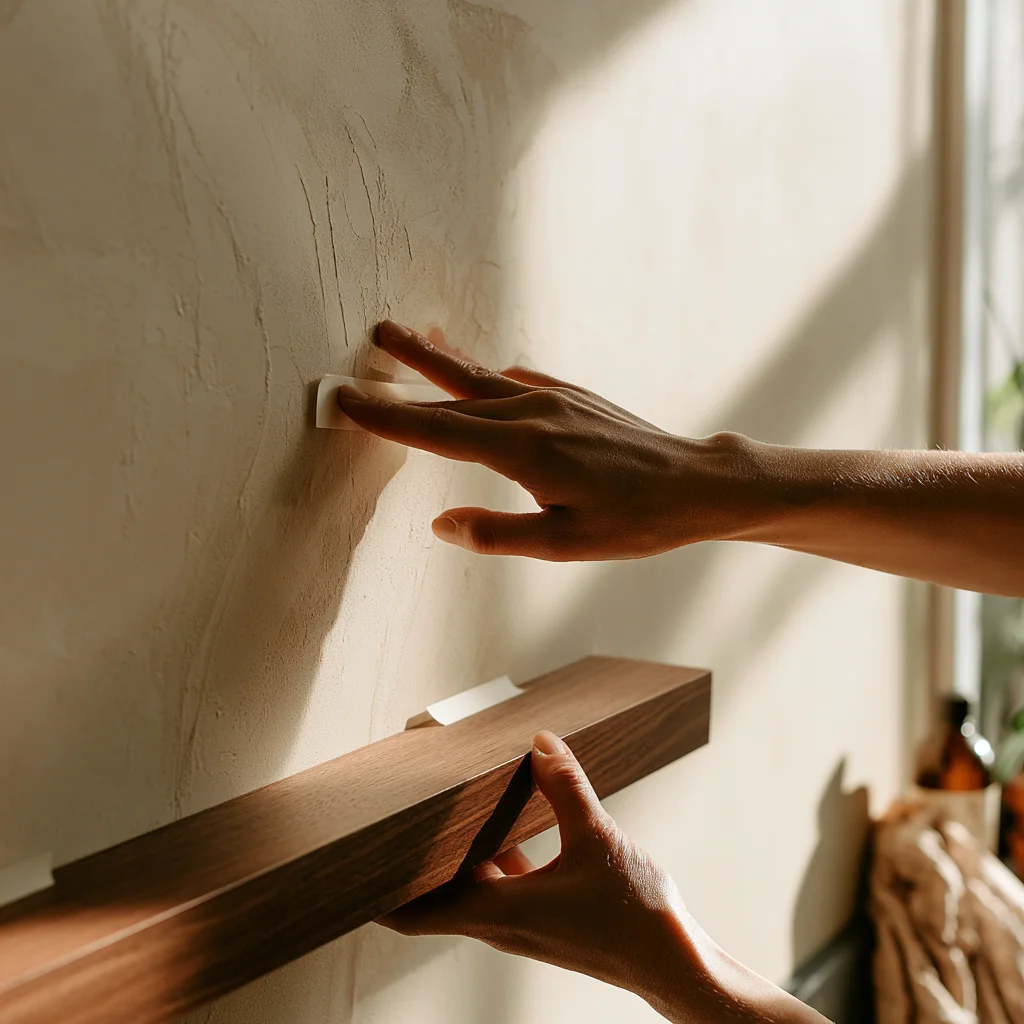
Strips usually fail from a bad surface or a shear load, not from weight alone.
Wipe the wall with rubbing alcohol first, not a household cleaner. Cleaners leave a residue that stops the adhesive bonding.
Halve the rated weight on textured walls, and wait a week after painting before mounting anything.
Among no-drill minimalist bedroom ideas, this is the one people get wrong most often.
When you take them off, pull the tab straight down and slowly. Pulling outward is what takes the paint.
13. Hang the organiser on the bedroom door, not the closet door
An over-door organiser on the bedroom door uses a surface that carries nothing else.
On the closet door it competes with the clothes behind it. On the bedroom door it competes with nothing.
Check the door still clears the frame first. Thick doors and tight frames stop it from closing.
Foam-lined hooks stop the whole rack rattling every time the door shuts, which matters more at night than it sounds.
Shoes are the usual first tenant, and there are better places for them than the bedroom floor.
14. Put a tension rod in the closet for a second hanging row
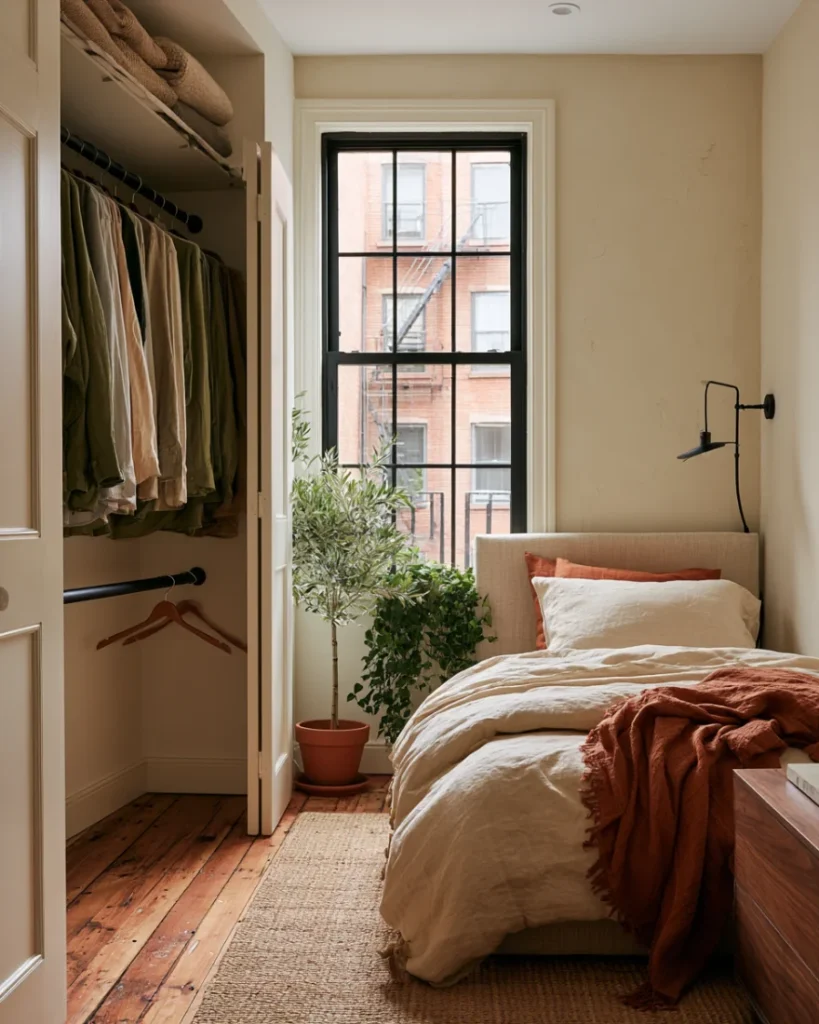
Most closets waste the bottom half of the hanging space.
A tension rod hung below the main rail doubles capacity for shirts and folded trousers.
Before buying one, check:
- The side walls are solid, not hollow panel
- The gap below the main rail is at least 30 inches
- The rod diameter suits the span, since wider spans need a thicker rod
Read more: what to do when the room has no closet at all
A spring rod is fine for shirts. For coats or anything heavy, use a freestanding frame with a fixed rail.
If the closet is beyond saving and there is a spare box room next door, converting that room instead is the bigger move.
15. Mount a picture ledge instead of a bookshelf
A 3-inch ledge holds books face out, art, and a small plant at a fraction of the depth.
Shallow is the point here.
A 10-inch shelf on a 9-foot wall makes the room feel narrower than a bare wall would.
Two ledges stacked about 12 inches apart hold more than one deep shelf and still leave the wall reading flat.
Make the Room Read Bigger Without Moving Furniture
These five change nothing structural. They change how much visual information the room carries, which is most of what makes a small room feel small.
Perceived size is doing a lot of work in minimalist bedroom ideas. A tidy room that still reads busy has a colour problem, not a storage problem.
16. Cut the palette to one neutral and one accent
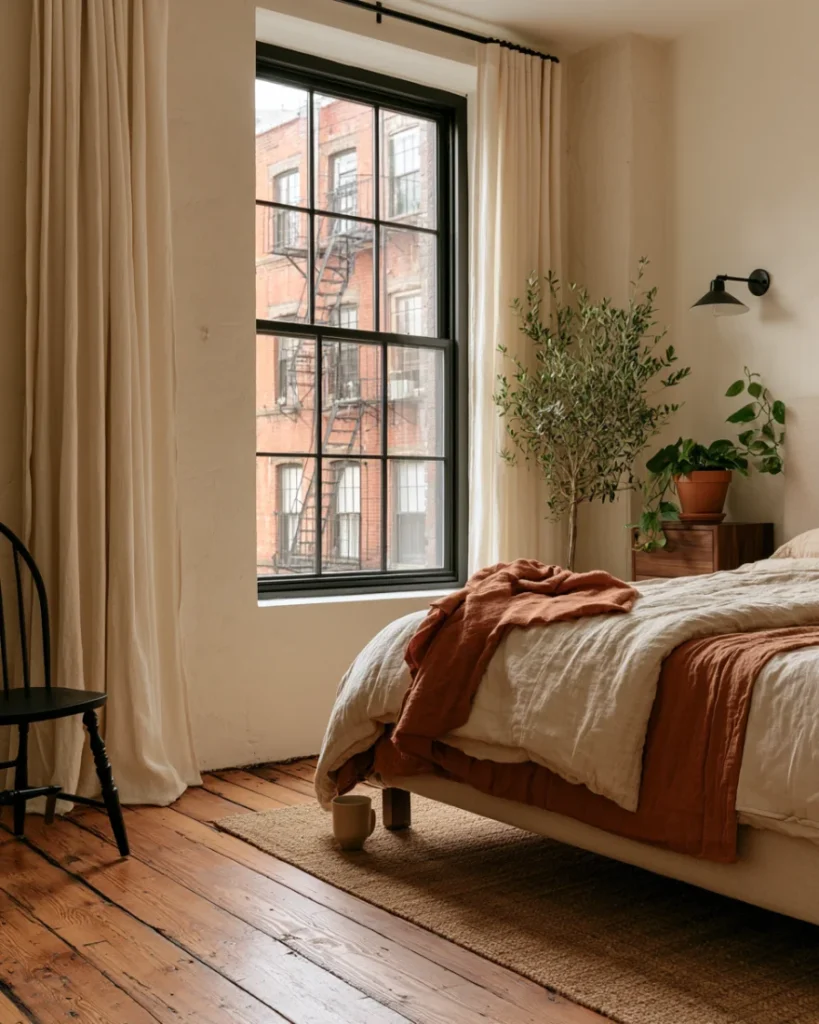
Count the colours in the room right now: walls, bedding, curtains, rug, furniture.
Above three and the room reads busy no matter how tidy it is.
Start with the bedding. It is the largest single surface and the cheapest thing to change.
Patterns count as colours. A patterned duvet, curtain and rug read as three even when they share a shade.
Pick the accent from something already in the room rather than buying into a new palette.
17. Hang curtains at the ceiling line, not the window frame
Mounting the rod within a few inches of the ceiling pulls the eye up and makes the wall read taller.
Run the panels to the floor, not to the sill. A short curtain cuts the wall in half at exactly the wrong height.
Rods are cheap. Bracket height is the free part of this change, so get it right the first time.
18. Swap heavy blackout panels for linen or sheer
Thick dark panels turn a small bedroom into a box, especially with only one window.
If you need real darkness to sleep, put a blackout blind behind a light curtain rather than using one heavy panel for both jobs.
Light linen still cuts glare. It just does it without absorbing the whole room.
19. Put one full-length mirror opposite the window
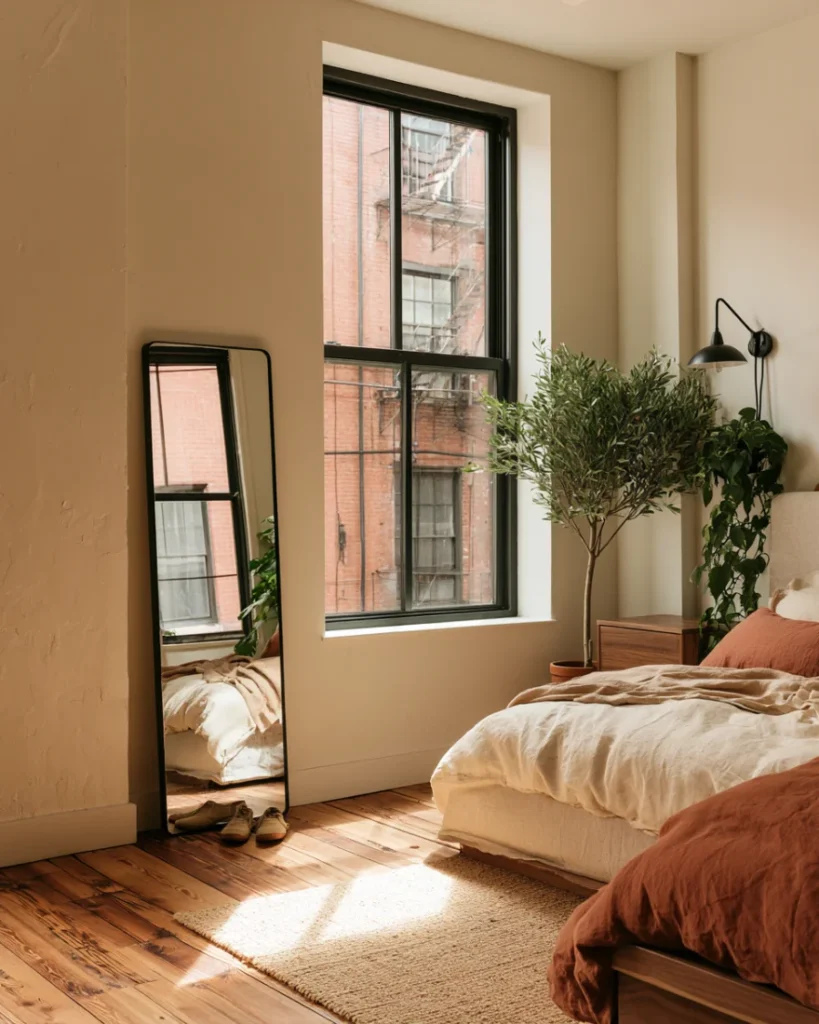
One mirror, positioned to catch the window, is the cheapest of the minimalist bedroom ideas here.
Opposite the window, it throws daylight back across the room. On the wrong wall it reflects a cupboard.
One is enough. More than one just adds surfaces to keep clean.
Leaning it costs nothing and avoids a fixing, but check the base cannot slide on a hard floor.
20. Leave the largest wall empty
Every wall covered makes a room feel packed. One deliberately bare wall gives the eye somewhere to rest.
This is the hardest idea here to follow, because an empty wall feels like wasted storage.
Pick the wall you see first from the doorway. That one decides how the room feels on entry.
It is not wasted. If a desk also has to live in here, plan the wall around the desk first and leave a different wall clear.
Minimalist Bedroom Ideas for Small Rooms That Survive a Bad Week
Anything that only works when you have energy does not really work. These four hold when the week goes badly.
Most minimalist bedroom ideas fail here rather than at setup. The room is fine for nine days and gone by the twelfth.
21. Give the laundry chair a real replacement
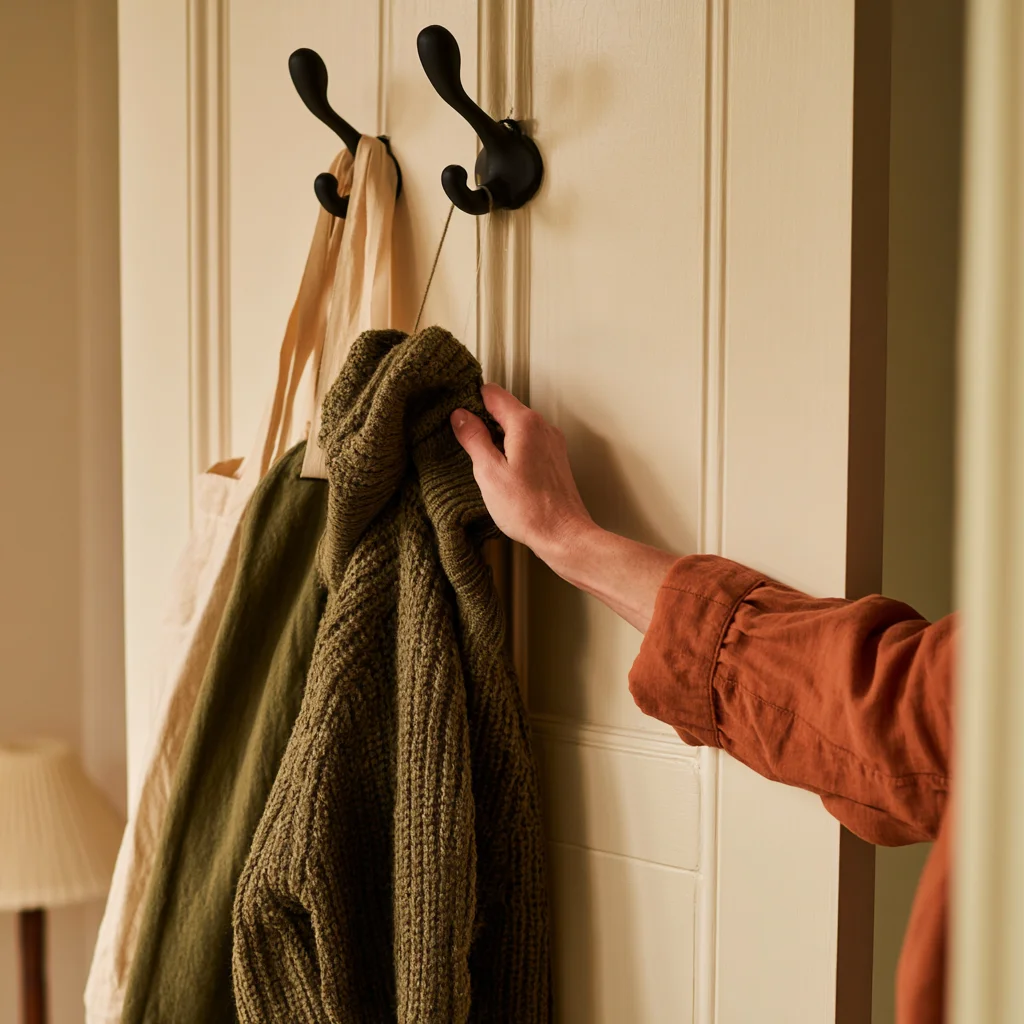
The chair collects clothes because worn-once items have no correct home.
Two hooks on the back of the door fix that. Worn once goes on a hook, not on the chair.
Then take the chair out of the room. A surface that exists will be used.
Two hooks, not five. Five becomes a wall-mounted version of the same chair.
22. Put closed storage where the mess actually lands
Watch where things pile for a week. That spot is telling you something.
Put a lidded basket there instead of fighting the habit. An open basket in that spot just becomes the pile with extra steps.
Lids do the real work here. A closed lid ends the decision, while an open one keeps it open all week.
Small things need their own home, or they migrate to the nightstand: a shallow tray for chains that tangle in a drawer, a divided insert for the products you use every morning, and a shelf elsewhere in the flat for spare sheets and towels.
23. Run a five-minute reset before bed
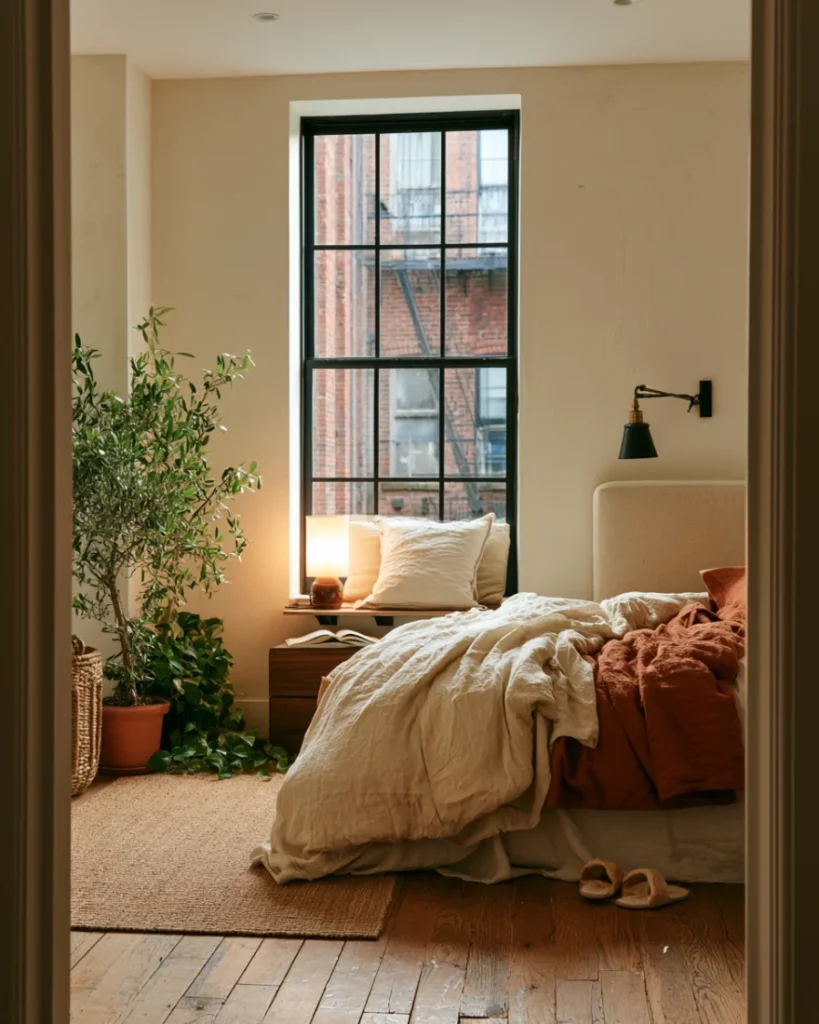
Five minutes, same time every night, no decisions required.
The order that works:
- Floor first, everything off it
- Nightstand second, back to lamp, glass and book
- Hooks third, worn-once items hung up
- Laundry last, into the basket rather than onto a chair
Done nightly, the room never reaches the state that needs a whole Saturday.
Attach it to something you already do, like the kettle boiling or the phone going on charge.
24. Re-run the floor test once a month
Set a monthly reminder. Empty the floor, put back only what belongs, and note what tried to come back.
Anything that returns twice in a row does not have a home yet. That is the thing to fix, not the mess itself.
Once a month is enough. More often and the test becomes another chore the room has to survive.
If the monthly test keeps failing, a structured month across the whole flat works better than repeating it in one room.
Key takeaways
- Empty the floor before buying any storage. Most rooms take back about a third of what came off.
- Measure frame clearance first, then buy bins one inch shorter than that number.
- Leave 24 inches of walkway on the side you get out of, 30 inches on any side you make the bed from.
- Clean the wall with rubbing alcohol before any adhesive mount, and stay well under the rated weight.
- One neutral, one accent, one mirror, one empty wall.
Common Questions About Small Minimalist Bedrooms
How small is too small for a bedroom?
Most US jurisdictions set 70 square feet, with no horizontal dimension under 7 feet.
Below that, it is not a legal habitable room, though plenty of people sleep in smaller box rooms.
Does minimalist mean white walls and nothing on them?
No. It means fewer competing surfaces, not fewer things you like.
One neutral base, one accent and one clear wall does the work. Colour is not the problem. Count is.
What should I buy first for a small bedroom?
Under-bed bins, once the clearance is measured. They are cheap, and they use space that is already sitting there.
After that, two door hooks and one over-door organiser. Everything else can wait a month.
Do these ideas work in a studio?
The bed-level ones do. The room-level ones change, because the sleeping area has to share with everything else.
Zoning a studio is a different job, and starts with the layout rather than the storage.
Can I do this in a rented room without losing the deposit?
Every fix on this list is reversible. Nothing here needs a drill, a bracket, or a repaint.
Adhesive strips are the only real risk, and that risk is removal technique rather than the product.
How do I keep it minimal without the room feeling cold?
Texture rather than objects. Linen, wool, jute and wood add warmth without adding count.
One plant does more for a small bedroom than five decorative items.
Final Thoughts
None of this needs a landlord, a drill or a free weekend.
Pick the floor test and one bed-level fix. Do both this week, then live with the room for seven days before buying anything.
Seven days is long enough for the room to show you what it actually does, rather than what you planned for it.
If the floor stays clear for that week, the rest of these minimalist bedroom ideas for small rooms will hold. If it does not, the problem is volume rather than storage, and starting when the room already overwhelms you is the better place to begin.