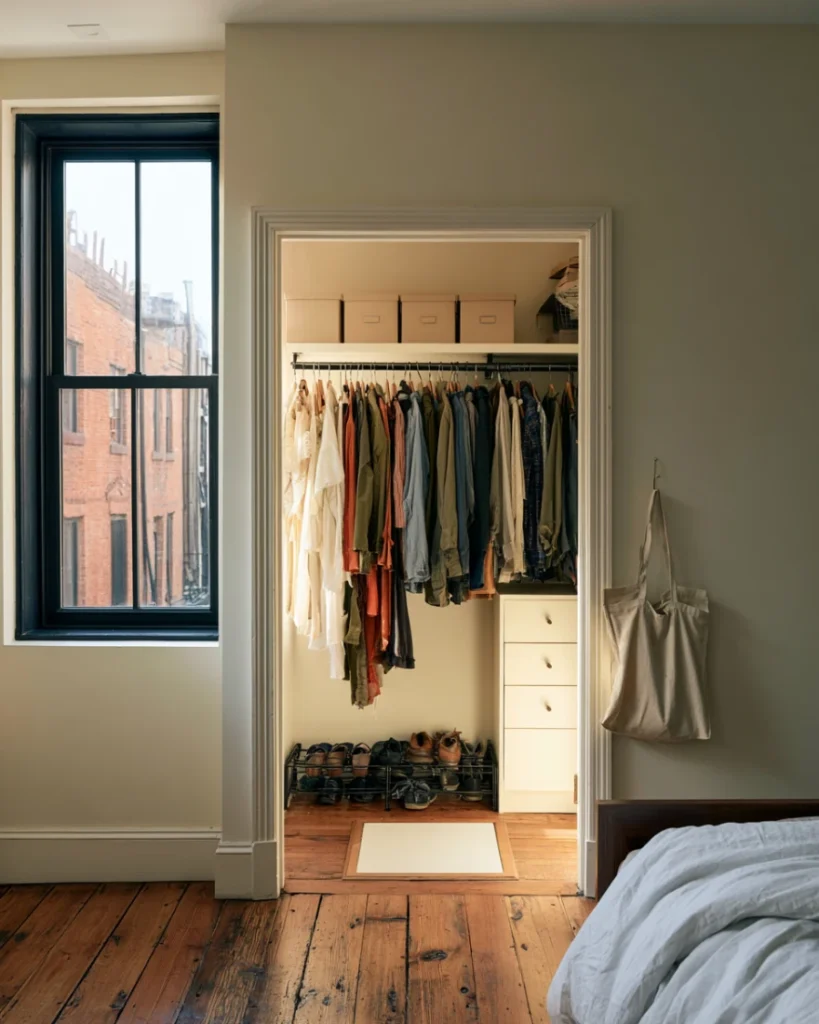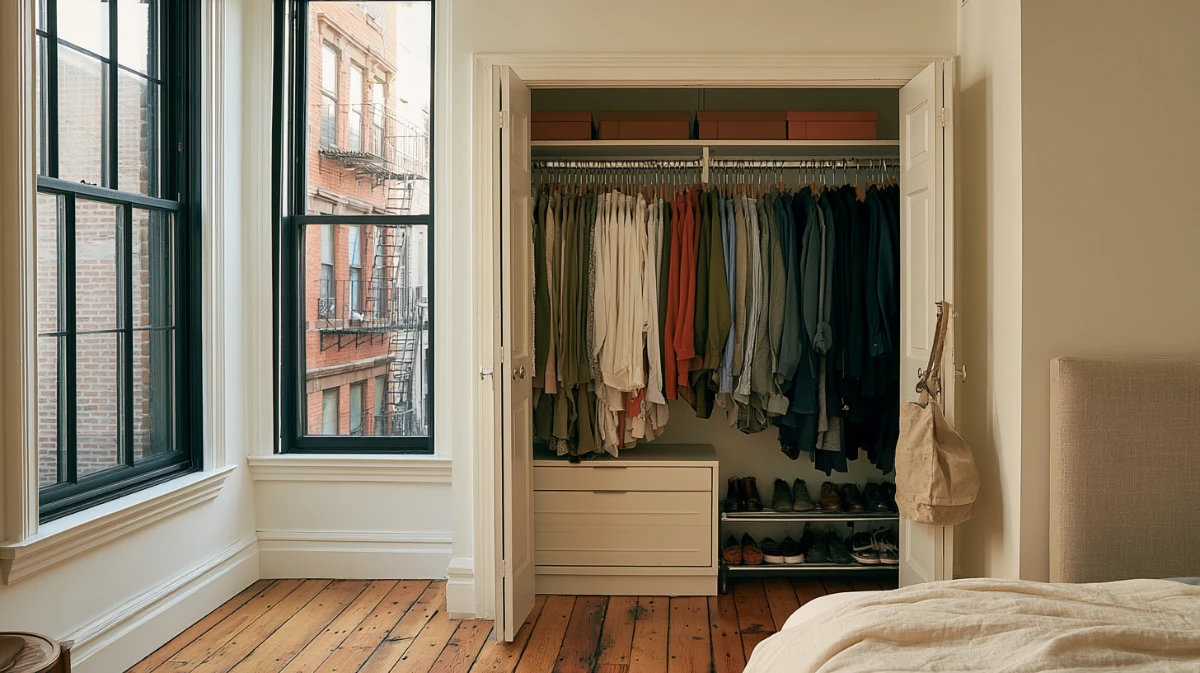


Small closet organization ideas work best when you stop treating the closet as a box and start treating it as five height bands. A standard reach-in is 24 inches deep and about 80 inches tall.
Most people use two of those bands well and waste the other three completely.
Measure the height from floor to the underside of your shelf before anything else. That single number decides which of the 22 fixes below apply to you.
Work Out What You Actually Have
A reach-in closet is a fixed volume. You cannot add to it, so the whole job is deciding what each vertical band does.
The standard numbers are settled. A single rod sits at 66 inches, and a double-rod setup puts the top rod at roughly 80 inches with the lower at 40.
On depth, the rod needs at least 12 inches of clearance from the back wall so hangers do not bunch against it.
Those numbers are what make the bands below real rather than arbitrary. They come from garment lengths, not from convention.
| Band | Height from floor | What it holds well | What ruins it |
|---|---|---|---|
| Floor | 0 to 12 in | Shoes, one low drawer unit, boots | Loose bags and anything soft |
| Low | 12 to 40 in | A second rod, drawer units, stacked bins | One tall pile of folded clothes |
| Rod | 40 to 66 in | Everything worn weekly | Long coats you wear twice a year |
| Above rod | 66 to 80 in | Lidded boxes, out of season | Loose stacks and odd shapes |
| Ceiling gap | 80 in and up | A second shelf, rarely used items | Anything heavy |
Read down that table, and one thing usually stands out: most small closets use the rod band and the floor, and treat the other three as nothing.
The 22 fixes below are grouped the same way, so you can skip to the band you are wasting.
Most small closet organization advice mixes all five bands into one list, which is why so much of it does not apply to your closet.
The Floor: Five Fixes for the Worst Band
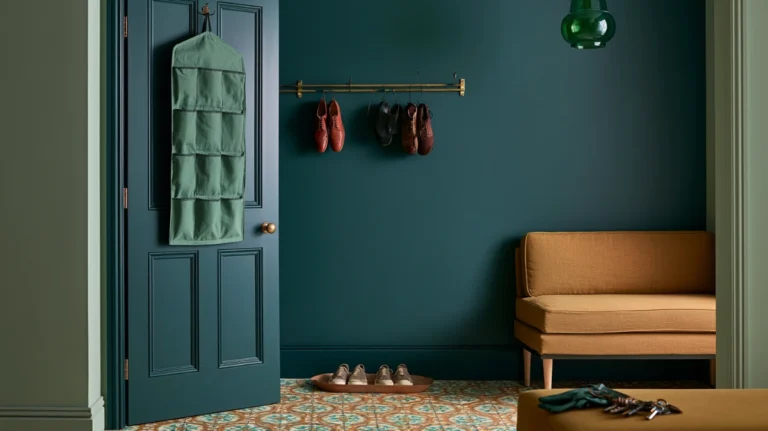
The closet floor collects whatever has no home elsewhere, which makes it the fastest band to improve and the fastest to lose again.
Nothing goes on the floor loose. Everything on the floor is inside something with a defined edge.
That single rule does more for small closet organization than any product in this band.
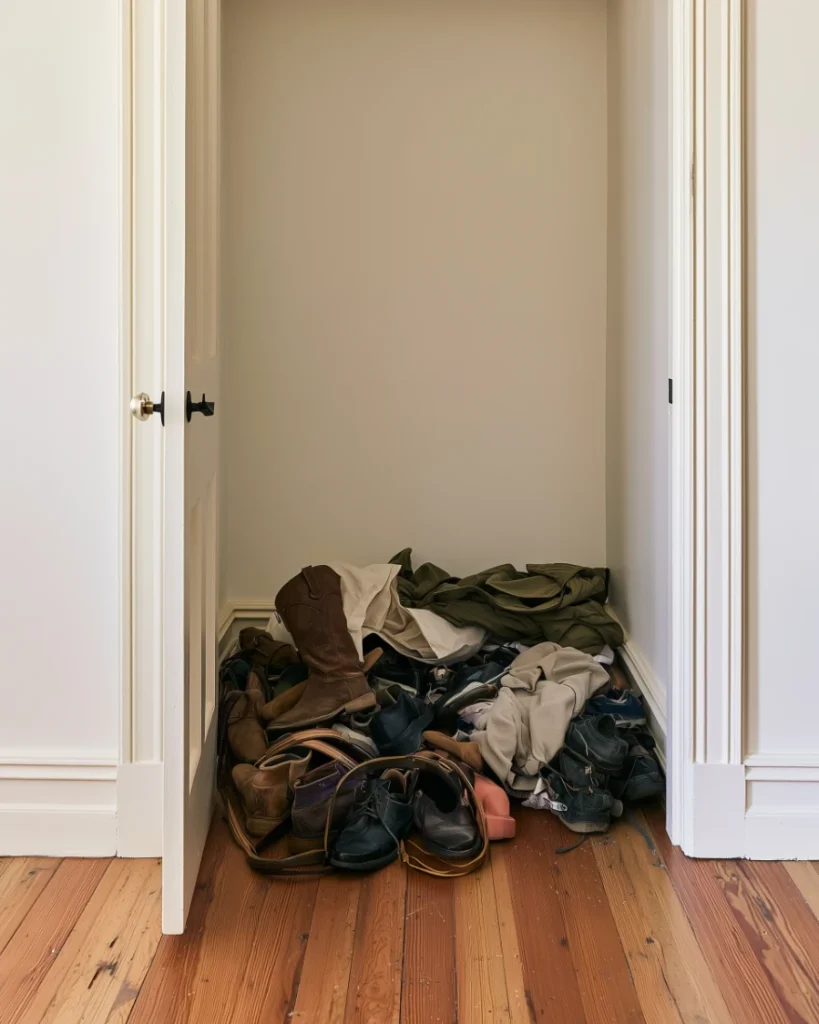
1. Take everything off the floor before you buy a single thing
Empty it completely, including the corners you have to kneel to reach.
You will find shoes you forgot, at least one bag inside another bag, and something that belongs in a different room entirely.
Vacuum the floor while it is empty. It is the only time you will get to it, and dust on a closet floor transfers to everything stored there.
Sort into three piles before anything goes back:
- Belongs in this closet
- Belongs elsewhere in the flat
- Out, today, no negotiating
- Repair or alter, with a one-month deadline
Only then measure what is left, because that measurement decides what you buy.
2. Match the shoe rack to your actual shoe count, not to the space
Count pairs before you shop. A rack that holds more than you own becomes a shelf for things that are not shoes.
A two-tier rack fits under most low rods at around 14 inches tall. A three-tier runs closer to 21 and will foul a rod set at 40.
If the count is high enough that no rack fits, the shoes need to leave the closet, and there are better places for them in a small flat.
Read more: the full four-session version of that sort
3. Put boots in the corner, upright, with a former inside
Boots are the awkward case because they are tall enough to eat the low band and soft enough to collapse.
A rolled magazine or a cheap boot former keeps them upright, which stops them taking twice their footprint.
Corner placement matters too. Boots in the middle of the floor block access to everything behind them.
Tall boots can also hang from clip hangers on the rod if the floor is genuinely full, though the floor is usually the wrong place for footwear anyway.
4. Use one drawer unit, not a stack of loose bins
Stacked bins require unstacking. A three-drawer unit at around 25 inches tall gives the same volume with none of the lifting.
Measure the width of your closet opening, not the closet itself. A unit that fits the interior but not the doorway is a returned unit.
Leave two inches of clearance on each side so it can be pulled out to clean behind.
Fabric drawer units are lighter and cheaper, but they sag once loaded. A rigid frame holds its shape, and its drawers keep sliding.
5. Leave one square foot of floor genuinely empty
A full floor has nowhere to put something down while you look for something else.
One clear square foot is the difference between a closet you use and a closet you excavate.
It also stops the slow creep, because a full floor makes one more bag feel like no change at all.
Mark it if you share the closet. An unmarked empty square gets filled by whoever gets there first.
The Low Band: Four Ways to Use 12 to 40 Inches
This is the band most small closets waste completely. Under a single rod at 66 inches, there is roughly four feet of dead air.
Everything here is about putting a second working surface into space that currently holds nothing.
Of all the small closet organization ideas here, the four in this band return the most volume for the least money.
6. Add a second rod at 40 inches
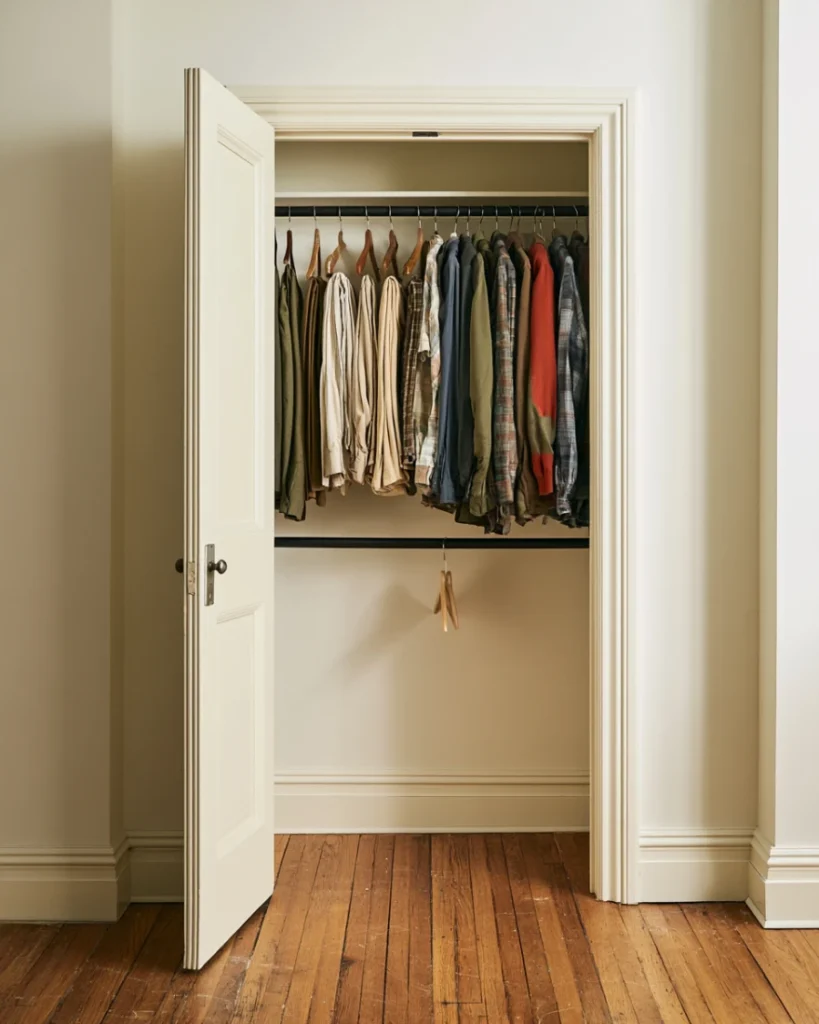
This is the single highest-value change in a small closet. It roughly doubles hanging capacity for shirts, blouses, and folded trousers.
It only works if the clothes above are short. Measure your longest garment on the upper rod first; if it hangs past 40 inches, the lower rod cannot go there.
A tension rod works for shirts. Anything heavier needs a fixed rail into the side walls.
Check the side walls before ordering. A hollow panel will not hold a loaded rail, and a tension rod needs solid contact at both ends.
Spans over about four feet sag under weight. Two shorter rods beat one long one in a wide closet.
7. Hang a fabric shelf tower instead of stacking on the floor
A hanging tower turns the low band into five or six shelves without a single fixing.
Keep it to one side rather than the middle, so the rod above it still carries a usable run of hangers.
Folded knitwear and jeans suit it. Anything that creases badly does not.
One garment type per shelf. A tower with mixed contents becomes the same problem the floor had, just raised off the ground.
8. Put the drawer unit under the short-hang side
If you have a double rod, the lower rod side gets the drawers and the long-hang side stays clear to the floor.
Splitting the closet into a short side and a long side is what makes both bands work at once.
Most reach-ins are wide enough for a 24-inch long-hang section, and the rest is doubled.
Count your long garments first. If you own four dresses and two coats, 24 inches of long hang is plenty.
If you own twenty, the closet is telling you it is not a double-rod closet, and you should stop trying.
9. Keep the low band shallow
Anything deeper than about 14 inches in this band means reaching past the front row to find the back row.
A 24-inch deep closet takes a 14-inch drawer unit with room for the doors to clear.
The remaining strip at the back is not wasted. It is what lets you slide things sideways rather than lift them out.
Depth is the constraint people ignore because it is invisible from the doorway. A deep bin looks efficient and behaves like a black hole.
Rough depths that work in a 24-inch closet:
- Drawer units, up to 14 inches
- Shoe racks, 10 to 12 inches
- Hanging towers, 12 inches
- Shelf boxes above the rod, up to 16 inches
The Rod Band: Five Fixes for the Space You Already Use
This band already works, which is why the gains here are about density rather than discovery.
The goal is more garments in the same run, without the compression that makes you stop seeing what you own.
Density has a ceiling. Past it, small closet organization stops helping, and the wardrobe itself is the problem.
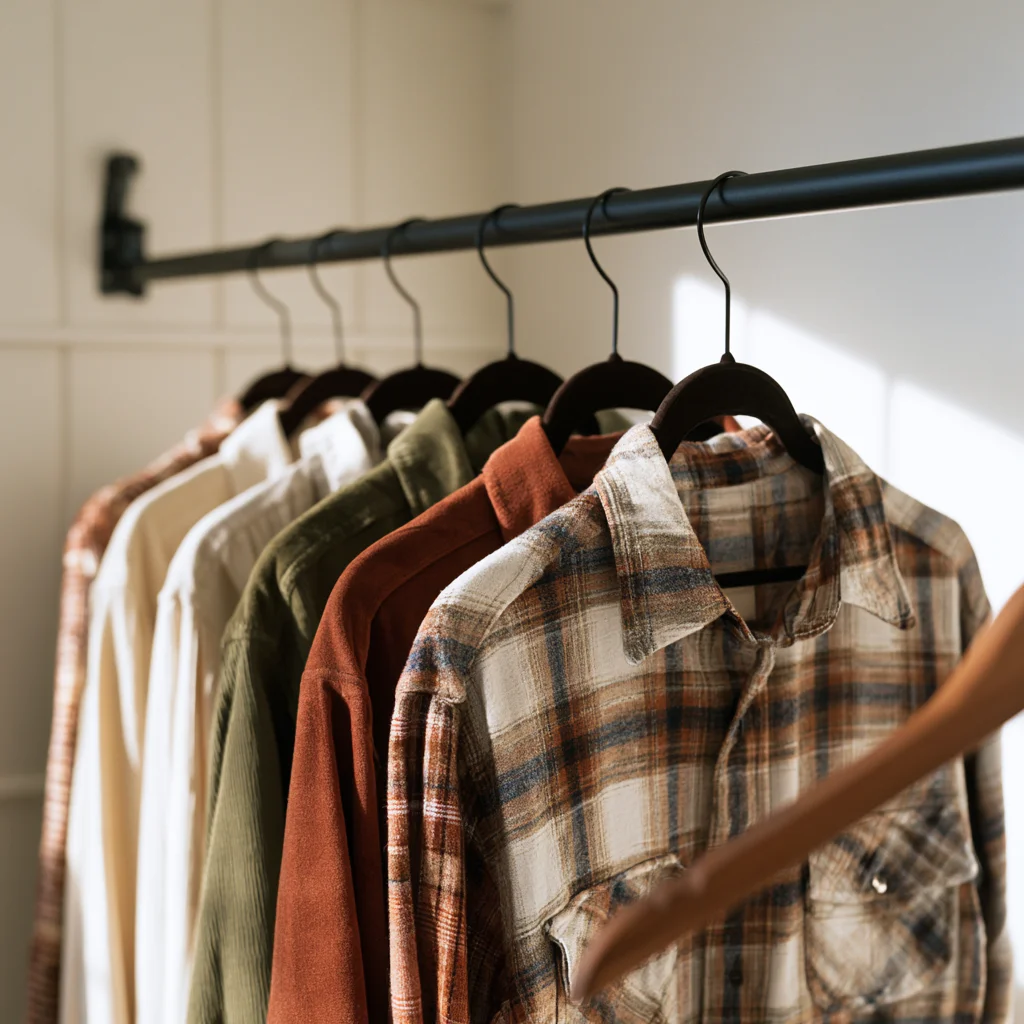
10. Switch to slim hangers and count the gain
Velvet or slim plastic hangers are about a quarter of an inch thick against roughly half an inch for a moulded plastic one.
On a 36-inch rod, that is the difference between roughly 55 garments and roughly 70.
Buy them all at once and in one colour. A mixed rail reads as clutter even when it is tidy.
Wooden hangers are the exception worth keeping. They hold shoulder shape on jackets and coats, and those are the garments that lose it.
11. Leave one inch between hangers
Clothes packed tight do not get worn, because you cannot see them without pulling three others out.
One inch of gap is the practical minimum for anything you want to actually browse.
If one inch means things do not fit, that is a volume signal rather than a storage one.
The wardrobe needs cutting rather than compressing, and last-worn dates decide that faster than any folding method.
Read more: what a shelf above the rod can actually carry
12. Sort by length, then by type
Put the longest garments at one end and work down to the shortest. The bottom line of the rail becomes a diagonal instead of a jumble.
That diagonal is what frees usable space underneath the short end, which is where the drawer unit goes.
Within each length group, sort by type. Length first is what creates the space; type second is what makes it findable.
Colour sorting inside type is optional and mostly aesthetic. It looks good, and it does not create a single inch of space.
13. Use cascading hooks only for the things you wear together
Cascading hooks multiply capacity vertically, but they make the bottom garment invisible.
They work for outfits worn as a set and for trousers by colour. They fail for anything you pick individually.
Two garments per hook is the practical limit. Three and the bottom one may as well be in storage.
Where cascading hooks genuinely work:
- Trousers grouped by colour
- A suit with its matching pieces
- Anything you always wear as a set
- Off-season items you are not browsing
14. Reserve the centre of the rod for what you wear weekly
The middle of the rail is the easiest reach. Everything worn weekly goes there.
The ends take occasion wear and anything seasonal that has not yet moved out.
This is a free change, and it survives because reach is a physical constraint rather than a habit.
If two people share the rail, split it left and right rather than interleaving. Shared rails fail on findability, not capacity.
Above the Rod: Four Fixes for the Band Everyone Fills Badly
The shelf above the rod is usually a heap. It is above eye level, so nothing there is inspected until you move house.
Everything in this band goes in a container with a flat top and a defined footprint.
Flat tops are the whole trick. A soft bag up here means the space above it is unusable.
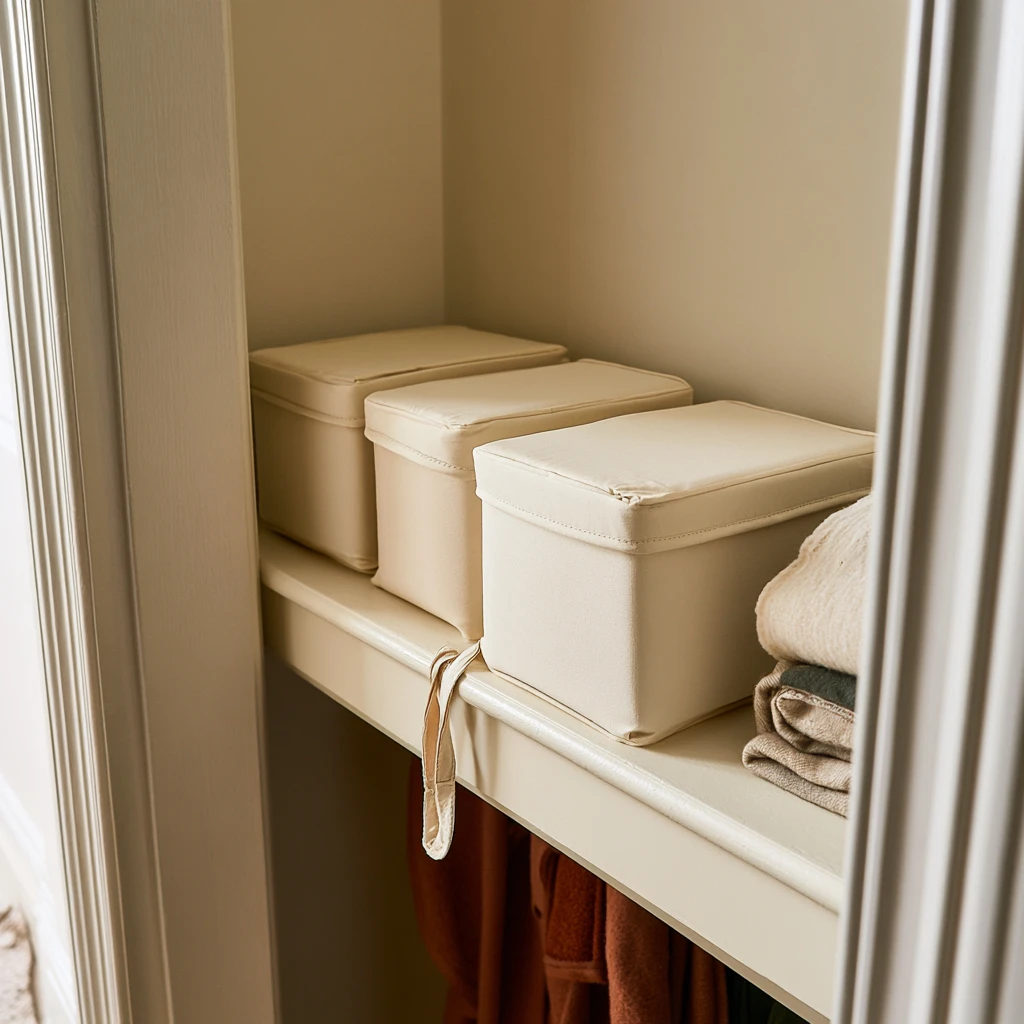
15. Use matched lidded boxes, not loose stacks
Matched boxes stack square, hold their shape, and stop the shelf becoming an avalanche.
Buy one size and buy four. Graduated sets do not stack, and you will end up with the odd one on the floor.
Label the front face at eye level from below, since that is the only face you will ever see.
What belongs in a box on this shelf:
- Out of season clothing
- Spare bedding, if there is nowhere better
- Occasion wear worn once or twice a year
- Anything sentimental you are keeping deliberately
16. Store only out of season up here
This band is for things with a date attached: winter coats in July, summer linen in January.
Spare bedding is the other legitimate tenant, though a linen closet handles it better if you have one.
Anything without a season does not belong above the rod, because you will never think to look for it.
Swap the boxes rather than adding to them. Winter comes down, summer goes up, and the total volume stays fixed.
If the swap keeps getting bigger each year, the volume is arriving faster than it leaves, and that is a buying pattern rather than a closet problem.
17. Add a second shelf if the gap is over 16 inches
A single shelf with 20 inches above it is one shelf and a lot of air.
A second shelf splits it into two usable levels. Bracket it into the side walls rather than the back, which is often just plasterboard.
Keep the upper level for the lightest things you own. Weight at 80 inches is how shelves come down.
A wire shelf is easier to fit than timber and lets you see what is on it from below, which matters at that height.
18. Keep vacuum bags for genuine bulk only
Vacuum bags work on duvets, coats and knitwear. They crease everything else badly enough to need ironing.
They also make a stack that is heavy and rigid, so they belong on the lower of two shelves rather than the upper.
Do not use them for anything you will want inside three months. Reopening one costs more time than the space saves.
Check them after a month. A bag that has reinflated has a failed seal, and the contents have been creasing under pressure the whole time.
The Door and the Side Walls: Four Overlooked Fixes
The back of the door is the only surface in a closet that currently holds nothing at all.
The side walls are the second. Both take weight, and neither costs you any floor.
These four are the small closet organization ideas people skip because the surfaces do not look like storage.
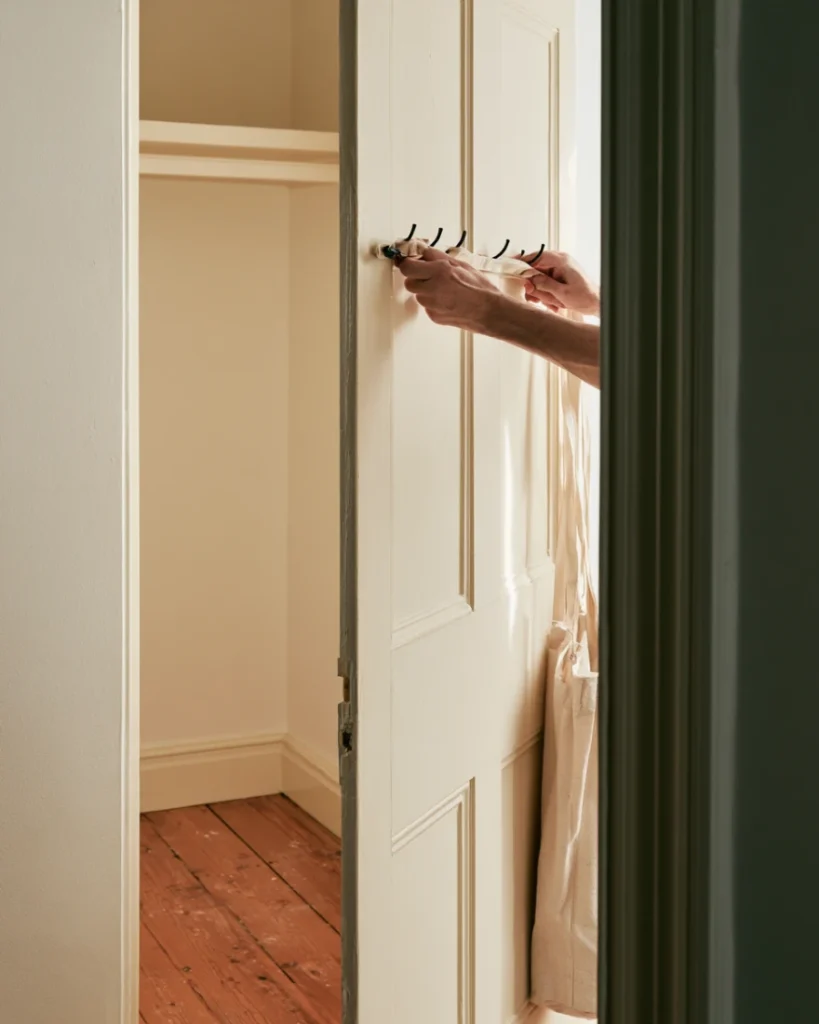
19. Fit an over-door organiser sized to the door, not the closet
Measure the door width and the clearance behind it when closed. A full organiser needs about 4 inches, and many closets do not have it.
If the door will not close, a slim two-pocket version still holds a surprising amount.
Hollow-core doors take hooks over the top edge but not screws. Check before drilling anything.
Over-door hooks also rattle every time the door shuts. Foam-lined ones cost slightly more and stop the noise entirely.
20. Use the side walls for anything flat
Adhesive hooks on a side wall hold belts, scarves, bags and hats without taking a single inch of hanging run.
Clean the wall with rubbing alcohol first and stay well under the rated weight.
Side walls in a reach-in are often the only genuinely solid surface in there, since the back is frequently plasterboard over nothing.
Chains and small pieces need their own shallow container rather than a hook, because anything that tangles stops being worn.
Read more: how the whole room changes once the closet holds its share
21. Mount a mirror inside the door if the room has none
A door mirror turns the closet into a dressing area and frees the wall space a freestanding mirror would take.
Adhesive mirror tiles work on a hollow door where a heavy mirror will not.
Check the door swing clears the bed. In a tight bedroom, this is the constraint that decides it.
A mirror also makes a small closet feel less like a cupboard, which is worth something on a dark morning.
Position it so it catches whatever light the room has rather than facing a blank wall.
These small closet organization ideas cost almost nothing individually. Together they change what the closet can hold by a third or more.
22. Keep a donation bag on a hook, permanently
One hook, one bag, on the inside of the door. Anything you try on and reject goes straight in.
When the bag is full, it leaves the house. No sorting session required, because the sorting already happened.
A rejected garment is at its easiest to give up in the ten seconds after you have taken it off. That window closes fast.
This is the only fix here that keeps working without you, which makes it the one worth doing first.
Before you buy anything, measure these five
- Floor to the underside of the shelf, which tells you if a second rod fits
- Closet depth from back wall to the closed door, usually 24 inches
- The opening width, which is narrower than the interior
- Your longest hanging garment, from the hanger hook to the hem
- The gap between the shelf and the ceiling
What Changes in Six Months
A closet reorganised in one afternoon drifts in a predictable order, and knowing the order tells you what to check.
The floor goes first, usually within a month. Then the shelf above the rod. The rod itself holds longest, because the physical gap between hangers makes overcrowding visible.
The monthly check
Open the door and look at the floor only. If anything is loose on it, put it away and stop there.
Two minutes, once a month, and the floor band never needs redoing.
Checking the floor only is deliberate. A full audit every month is a chore you will abandon by March.
The order things drift back, in practice:
- Floor, within about a month
- Shelf above the rod, within a season
- Door organiser, once something has no other home
- The rod itself, last, because crowding is visible
When to redo the bands
When the season turns, or when the one-inch gap between hangers has closed.
That gap is the honest measure. It closes slowly, and by the time it is gone you have usually stopped seeing half the rail.
Redoing the bands takes about an hour once the system exists, against the afternoon the first pass costs.
That is the real return on small closet organization done by height. The second time is always fast.
If the closet is genuinely too small no matter how the bands are used, the answer is outside the closet, and under-bed clearance is the next place to look.
For a room with no closet at all, the whole problem starts somewhere different.
And if there is a spare box room next door, converting it is a bigger move than any organiser.