

Small bedroom organization ideas fail when they are applied to the wrong zone. A room has five ways of going wrong and each one has a different cause. Find the symptom that matches your room, fix that zone, and leave the other four alone.
Most people organise the zone that is easiest to see rather than the one that is broken. That is why the room looks better for a fortnight and then goes back.
The five symptoms below are diagnostic. Read them, pick the one that matches, and skip the other four entirely.
Most small bedroom organization advice hands you twenty ideas and leaves the diagnosis to you. This does it the other way round.
First, Work Out What the Room Can Actually Hold
Before diagnosing anything, get the capacity number. A bedroom is a fixed volume, and most of them are already at the limit.
Three measurements give you the whole picture, and all three are arithmetic rather than opinion.
It takes about five minutes with a tape measure, and it changes what the rest of the article means for your room.
Hanging capacity
At one inch per garment, which is the minimum spacing that lets you actually see what you own, a rod holds one garment per inch of run.
A 36-inch rod holds about 36 garments. Doubled, it holds about 72. That is the whole calculation.
Measure the usable run rather than the closet width. Brackets, side walls, and the door frame all eat into it.
Bulky coats need closer to two inches each, so a winter wardrobe reduces the number further.
Write the number down. It is the only figure in this article you will need again.
If your count is well above that number, no organiser will help, and the wardrobe needs cutting rather than compressing.
Under-bed capacity
Multiply the mattress width by its length by your frame clearance, then divide by 1,728 for cubic feet.
| Bed | Footprint | At 7 in clearance | Realistic bin count |
|---|---|---|---|
| Twin | 38 by 75 in | 11.5 cubic feet | 5 to 7 bins |
| Full | 54 by 75 in | 16.4 cubic feet | 7 to 11 bins |
| Queen | 60 by 80 in | 19.4 cubic feet | 9 to 13 bins |
The realistic count is lower than the raw volume because you need access down at least one side. A bed packed solid to the wall is storage you will never open.
Clearance is the variable that moves this number most. Two extra inches of frame height adds roughly a third to the volume.
That is why risers are worth considering before bins are, if the frame can take them.
Drawer and shelf capacity
There is no useful published figure here, so measure it yourself. Fill one drawer properly, count the items, multiply by the number of drawers.
That count is the real number, and it is usually a third lower than people guess.
Do the same for any shelf. Fill one shelf to a height you can still see over, count it, multiply.
What to record while you are measuring:
- Total rod run in inches
- Hanging garment count
- Frame clearance in inches
- Items per drawer, times the number of drawers
A drawer packed to the top does not count. If you cannot see the bottom layer, that layer is not storage, it is a burial.
The capacity test, in five minutes
- Measure your total rod run in inches, doubling it if you have two rods
- Count your hanging garments
- Measure frame clearance and work out the under-bed volume
- Count what genuinely fits in one drawer, then multiply
- If your possessions exceed the total, the room is over capacity, and no fix in this article will hold
Symptom One: The Floor Never Stays Clear
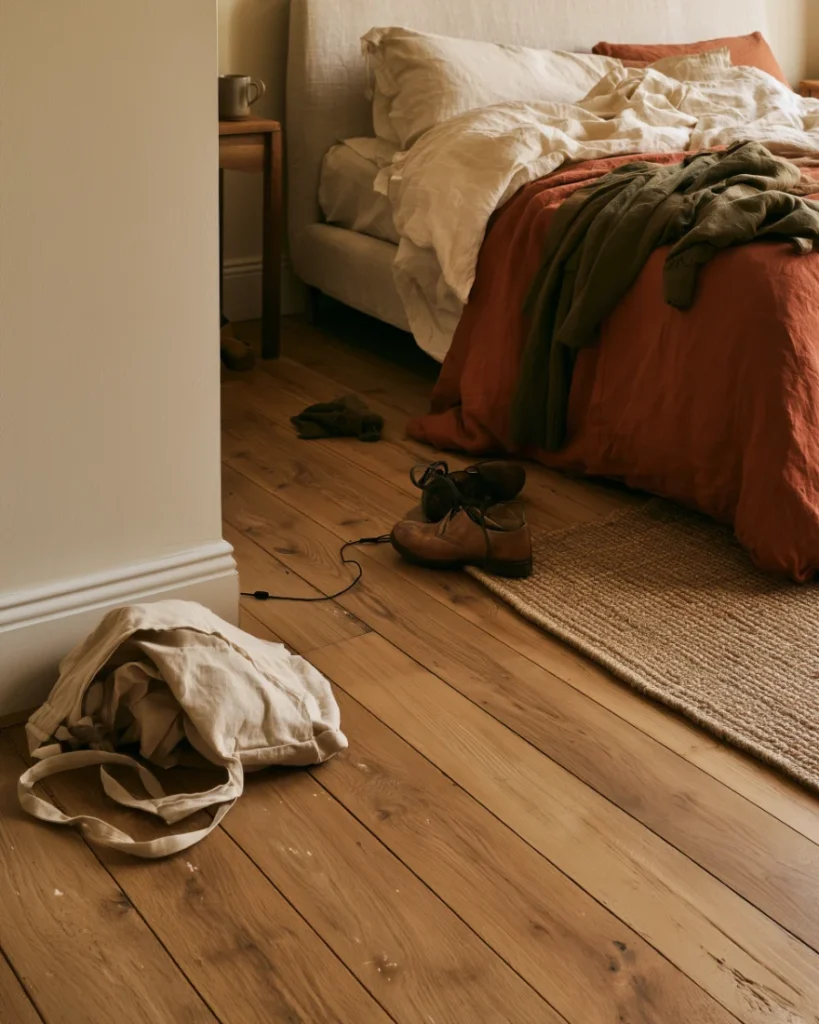
You clear it, and within a week there are bags, shoes, and a pile beside the bed again.
This is the symptom most small bedroom organization guides address, and the one where the visible problem is least likely to be the real one.
What this actually means
The floor is not the problem. The floor is where things land when something else has no home.
Track what is on it for a week. It is almost always the same three categories: worn-once clothes, bags, and whatever came into the room last.
Write them down rather than trusting memory. The pattern is usually narrower than it feels.
What lands on a bedroom floor, in order of frequency:
- Clothes worn once and not yet dirty
- Bags, both the one in daily use and the empties
- Shoes taken off at the door and carried in
- Anything that came into the room and had no zone
- Laundry that did not reach the basket
Read more: a shoe pile is its own category and its own fix
The fix
Give each of those three categories a named home within arm reach of where it currently lands.
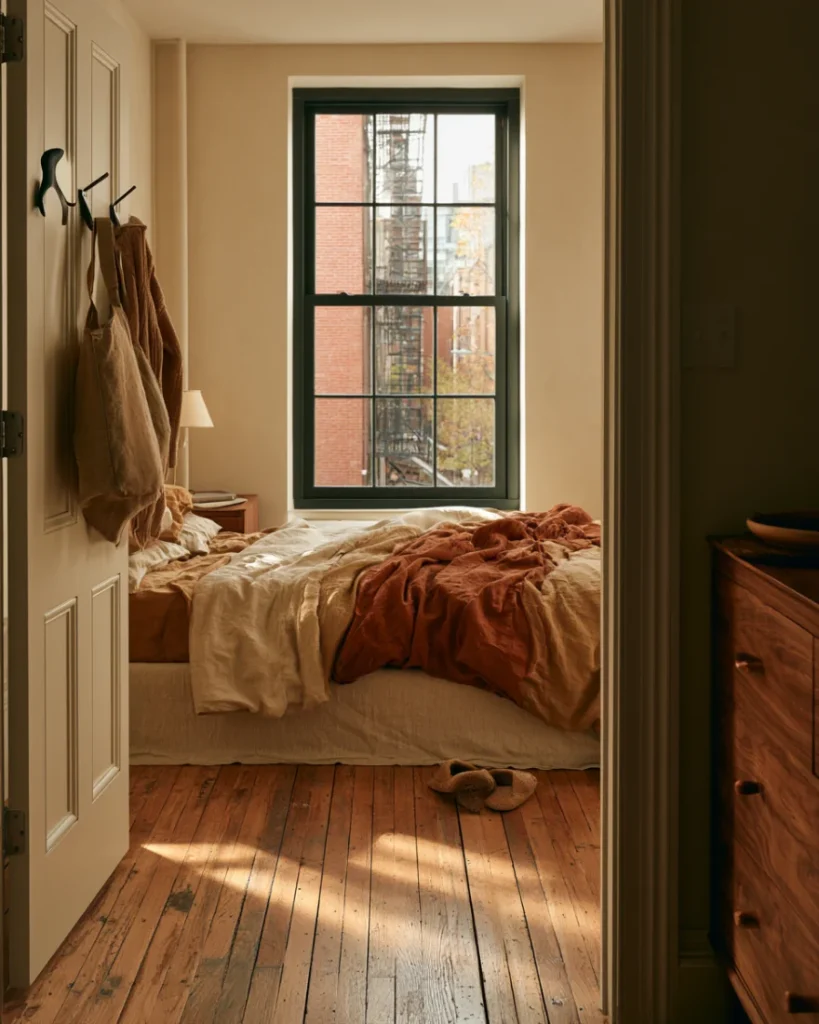
Two hooks on the back of the door handle: worn-once clothes and bags between them. That is most of the floor pile solved for the price of two hooks.
Two hooks, not six. Six becomes a wall-mounted version of the same pile.
Then remove whatever the pile was landing on. A chair that exists will be used, whatever else you provide.
If the chair has to stay, put something on it permanently. A folded throw occupies it and stops the pile starting.
Check again after two weeks. If the floor is clear, the diagnosis was right, and you are done with this symptom.
If it is not, the categories landing there are different from the three you assumed, and the week of tracking was worth repeating.
The rest is usually under-bed overflow that has migrated out, and clearance decides what will actually go back under there.
Symptom Two: Everything Is Put Away, and You Still Cannot Find Anything
The room looks organised. Getting dressed still takes ten minutes of opening things.
No amount of small bedroom organization fixes this one, because the storage is already working. The mapping is not.
What this actually means
You have storage without zones. Things are put away in whatever space was free rather than in a place that means something.
This is the failure mode of a room that was tidied rather than organised, and it is the most common of the five.
The tell is that you know the room is tidy and still open three things looking for one item.
The fix
Assign every category one zone and never split it. Socks live in one place, not in a drawer and a basket and a bag.
Sort by frequency inside each zone. Daily items at the front and at hand height, monthly items high or low.
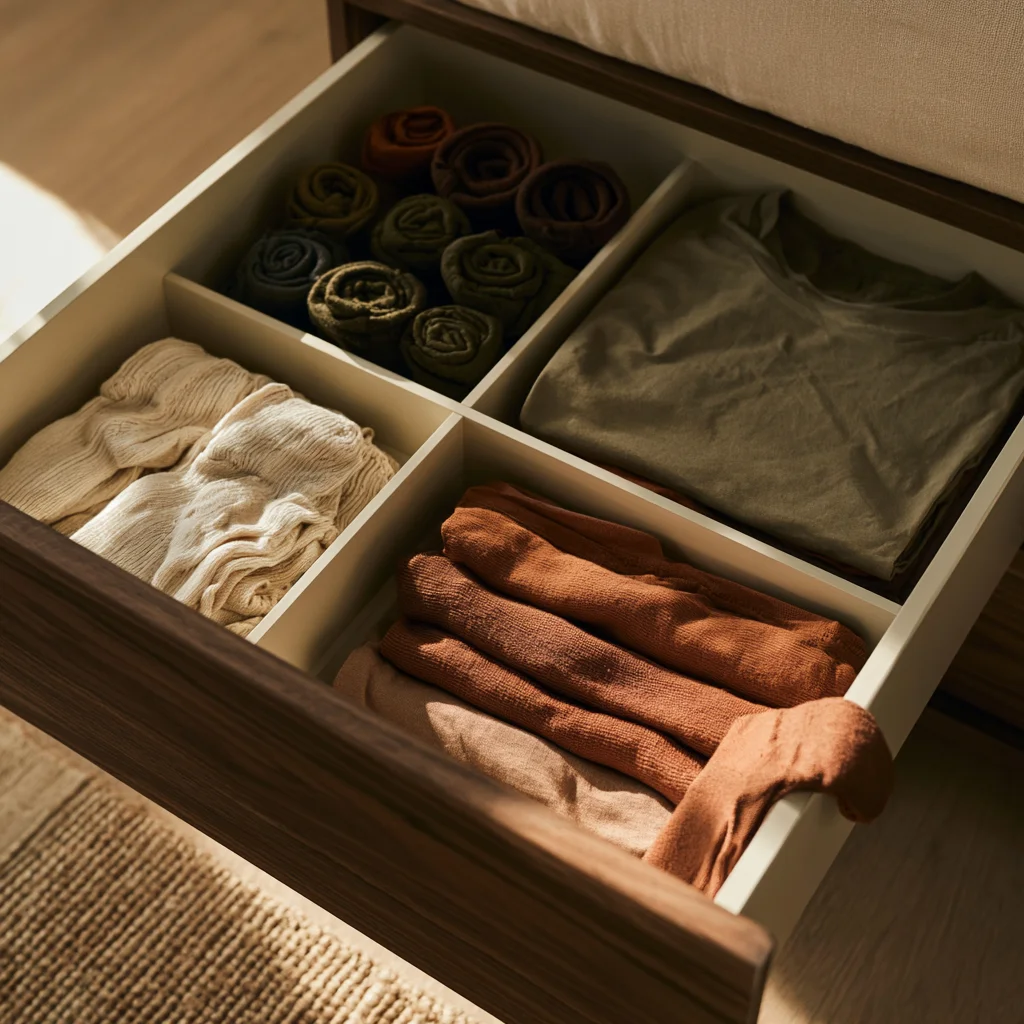
A zone you can name out loud is a zone that works. If you have to think about where something goes, it does not have a zone yet.
Zones worth naming in almost every bedroom:
- Sleep, meaning the bed and the bedside surface
- Dress, meaning the closet and the dresser
- Transit, meaning bags, keys, and whatever is leaving with you
- Out of season, wherever that lives
- Laundry, both clean and worn once
Symptom Three: The Surfaces Refill Within Days
The nightstand, the dresser top and the windowsill are covered again by Wednesday.
Surfaces are the fastest failing zone in a bedroom and the cheapest to fix properly.
What this actually means
Surfaces refill because they are the path of least resistance and because they have no defined job.
An undefined flat surface will always be used as one, and the things that land on it are usually pocket contents and things in transit.
Transit items are the giveaway. They are not clutter exactly, they are things with nowhere to wait.
The fix
One job per surface, and one container for the transit items.
A single tray by the door catches keys, cards, and change. Without it, those land on whatever surface is nearest the door.
Then give every other surface exactly one job, out loud, and remove anything that does not serve it.
A nightstand holds a lamp, a glass and one book. A dresser top holds one tray or nothing at all.
The bedside surface is the fastest to refill of all, and it needs a rule rather than another organiser.
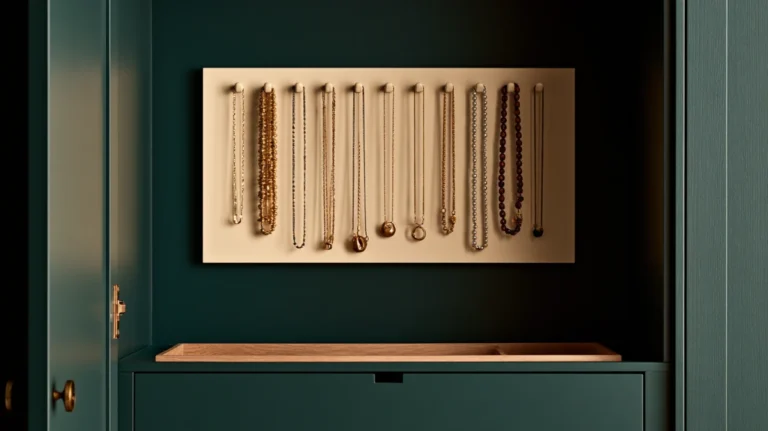
Small items that tangle or scatter need their own shallow containers, since anything with a chain will not be put away otherwise.
Symptom Four: The Closet Is Full, and You Have Nothing to Wear
The rail is packed. You wear the same six things.
This is a capacity symptom rather than a tidiness one, which is why small bedroom organization products rarely resolve it.
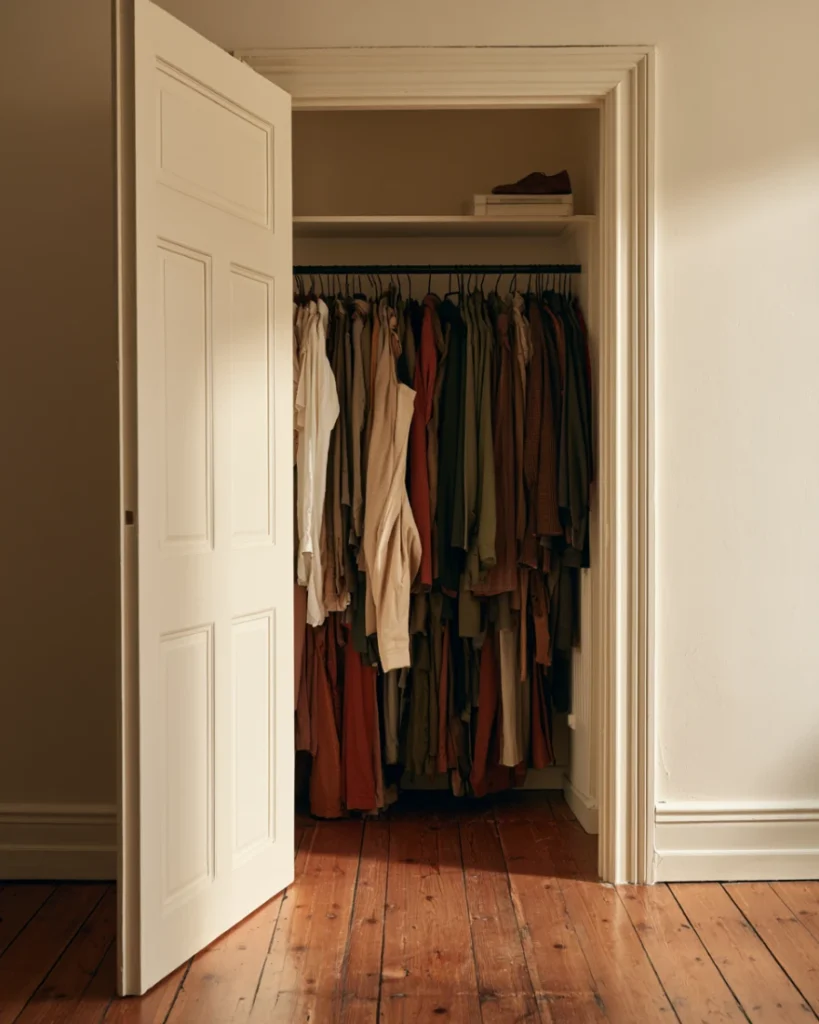
What this actually means
Compression. Past about one inch of spacing per garment, you stop being able to see individual items, so you default to whatever is at the front.
The closet is not too small. It is holding more than it can display.
Test it by pulling six garments out at random. If two of them surprise you, compression is confirmed.
The six things you actually wear are almost always at the two ends of the rail, where access is easiest.
Two ways out of compression, and what each costs:
- Add a second rod, which roughly doubles the run for short garments
- Move out-of-season items elsewhere, which is free
- Switch to slim hangers, worth roughly a quarter of the run
- Reduce the count, which is the only permanent answer
The fix
Either reduce the count or increase the run. Those are the only two options, and the second is usually cheaper.
A second rod at 40 inches roughly doubles the run for shirts and folded trousers, and the closet works best split into height bands.
If doubling the run still leaves you compressed, the count is the problem, and no amount of hardware will change that.
Symptom Five: It Is Tidy, and the Room Still Feels Cramped
Nothing is out of place. The room still feels like it is closing in.
This is the symptom people misread most often, because the room passes every tidiness test you could apply to it.
What this actually means
This is visual load rather than clutter. The room is carrying more separate things for your eye to process than it has space for.
The underlying mechanism is well studied: multiple stimuli in the visual field compete for neural representation by suppressing each other, which is a neural correlate of the visual system having limited processing capacity.
In practical terms, a tidy room with fourteen visible objects reads as busier than an untidy one with four.
Count what is visible from the doorway. Every separate item, including books, plants, frames and anything on a shelf.
Above about ten, most small rooms start reading as busy no matter how neat they are.
Photograph the room from the doorway and count from the photo. A photograph flattens the room and makes the count obvious in a way standing there does not.
The fix
Reduce the number of separate visible things rather than moving them around.
Closed storage instead of open. One large object instead of three small ones. One empty wall left deliberately bare.
Patterns count too. A patterned duvet, a patterned curtain and a patterned rug read as three separate demands on the eye.
This is the only one of the five symptoms where the fix is subtraction rather than reorganisation.
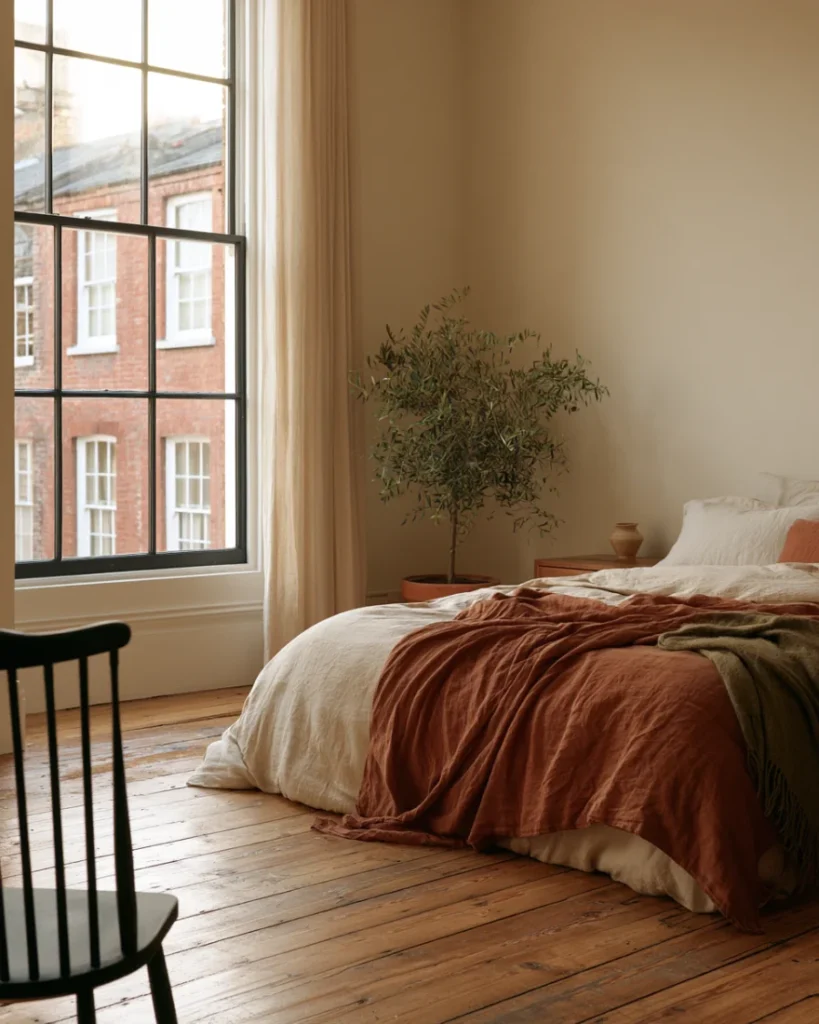
This is where a pared-back approach does more than any storage product, and cutting the palette and the object count is most of it.
The Three Fixes That Only Work at Room Level
These are the ones no single-zone article covers, because they are about the room as a whole rather than any one part of it.
They apply whichever symptom you matched, and they are the part of small bedroom organization that stays true across every room shape.
Furniture that does two jobs
An ottoman with storage, a bed frame with drawers, a bench at the foot of the bed with a lid.
The test is whether it does both jobs well. A storage ottoman you have to clear before sitting on does one job badly, twice.
Measure the open position, not the closed one. A lid that needs 20 inches of swing will not open against a bed at 18 inches away.
Dual-purpose furniture worth the money, and what usually goes wrong:
- Storage ottoman, fails when you have to clear it to sit
- Bed frame with drawers, fails if the drawer side faces a wall
- Bench with a lid, fails without swing clearance
- Headboard with shelving, fails when it adds depth you cannot spare
Read more: what a wall can carry before you commit to shelves
The order you tackle the room
Floor, then closet, then surfaces, then drawers. Always that order, because each one creates space for the next.
Starting with drawers is the classic mistake. They are satisfying, they are hidden, and they change nothing about how the room feels.
The closet comes second because it holds the highest volume, and emptying it frees the space every other zone needs.
The full four-session version of that order runs across one twenty-minute block and three hours.
Deciding what leaves the room entirely
Some categories do not belong in a bedroom at all and are only there because they arrived and stayed.
Paperwork, tools, hobby materials, anything for a different room. Moving them out is free, and it changes the capacity number.
Do this before buying anything at all. It is the only intervention here that increases capacity rather than using it better.
Spare bedding is the usual grey area, and it belongs in a linen store if you have one.
Read more: starting when the whole room feels like too much
Start With the Symptom, Not the Product
Pick the one symptom that describes your room most accurately and fix that zone only.
Fixing all five at once is a Saturday that produces a room which looks different and behaves the same, because the actual cause never got identified.
Give it two weeks. If the symptom returns, the diagnosis was wrong rather than the fix.
Go back to the list and pick the next closest match. Two wrong diagnoses are normal and still much faster than reorganising everything.
Keep the capacity number from the top of this article. When a symptom keeps returning, that number usually explains why.
If more than three of the five describe your room, this is a volume problem rather than an organisation one, and the buying pattern is upstream of all of it.
And if the room has to work for two people, every one of these five symptoms behaves differently, since shared rooms fail on findability rather than capacity.