

Declutter your room in four sessions rather than one attempt: twenty minutes on the floor, an hour sorting into four boxes, an hour on surfaces and drawers, an hour on the closet. Then deal with the maybe box.
Nearly every room decluttering stall occurs at the same point, and it is not the wardrobe or the paperwork.
It is the pile of things you could not decide about, sitting in the middle of the floor at 10 pm.
Session One, Twenty Minutes: Get the Floor Back
This session buys you working space. Nothing else can happen while the floor is occupied.
The first twenty minutes decide whether you declutter your room this month or think about it again in March.
Twenty minutes, a timer, and no decisions harder than which room something belongs in.
What comes off the floor
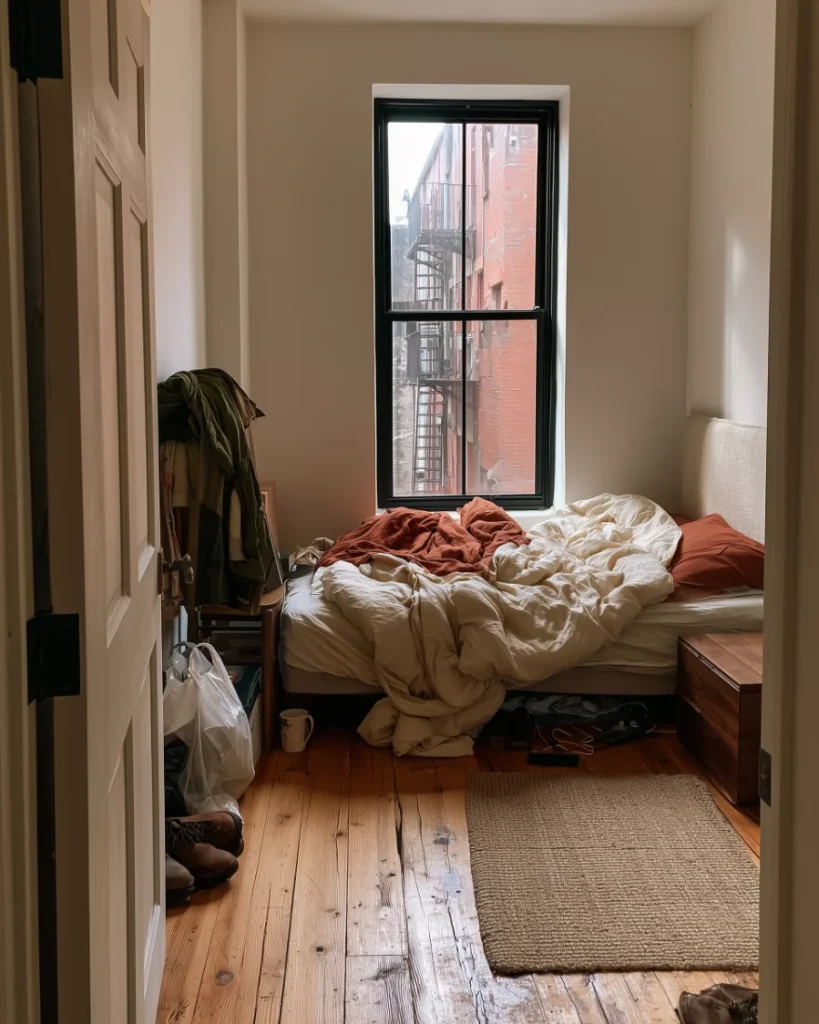
Everything. Bags, shoes, laundry, boxes, the chair with clothes on it, anything stored under the bed.
Sort into three destinations only: another room, the laundry, or a single holding pile on the bed.
Do not open anything. A box opened in session one becomes an hour you did not have.
The three destinations in full:
- Another room, carried out now and dropped just inside the door
- Laundry basket, everything textile that is not clean
- The bed, one pile, everything you cannot place in five seconds
The bed pile is deliberate. It forces session two to happen, because you cannot sleep around it.
If the pile genuinely will not fit on the bed, that is useful information about volume rather than a reason to stop.
Why twenty minutes and not an afternoon
A room declutter that starts with a full day off gets postponed until a full day appears.
Twenty minutes happens on a Tuesday. It also proves the room can look different, which is most of the motivation problem.
The floor is also the highest visual return in the room. Nothing else changes how a space feels as fast.
A clear floor reads as calm even with a full wardrobe behind a closed door.
That is also why the closet waits until session four. Behind a door, it costs you nothing for another week.
If even twenty minutes feels like too much right now, that is a different problem with a different fix, and starting when the room already overwhelms you is the better place to begin.
Set the timer where you can see it. Without one, the twenty minutes becomes two hours, and then it never happens again.
Stopping on time is the part that makes session two happen at all.
Decision point: stop here for today if the floor is clear. Carry on only if you still have energy, not because the pile on the bed looks urgent.
Session Two, One Hour: The Four Box Sort
This session decides what stays. It is the only session where anything actually leaves the room.
Session two is where you declutter your room rather than tidy it, and the difference is whether volume goes down.
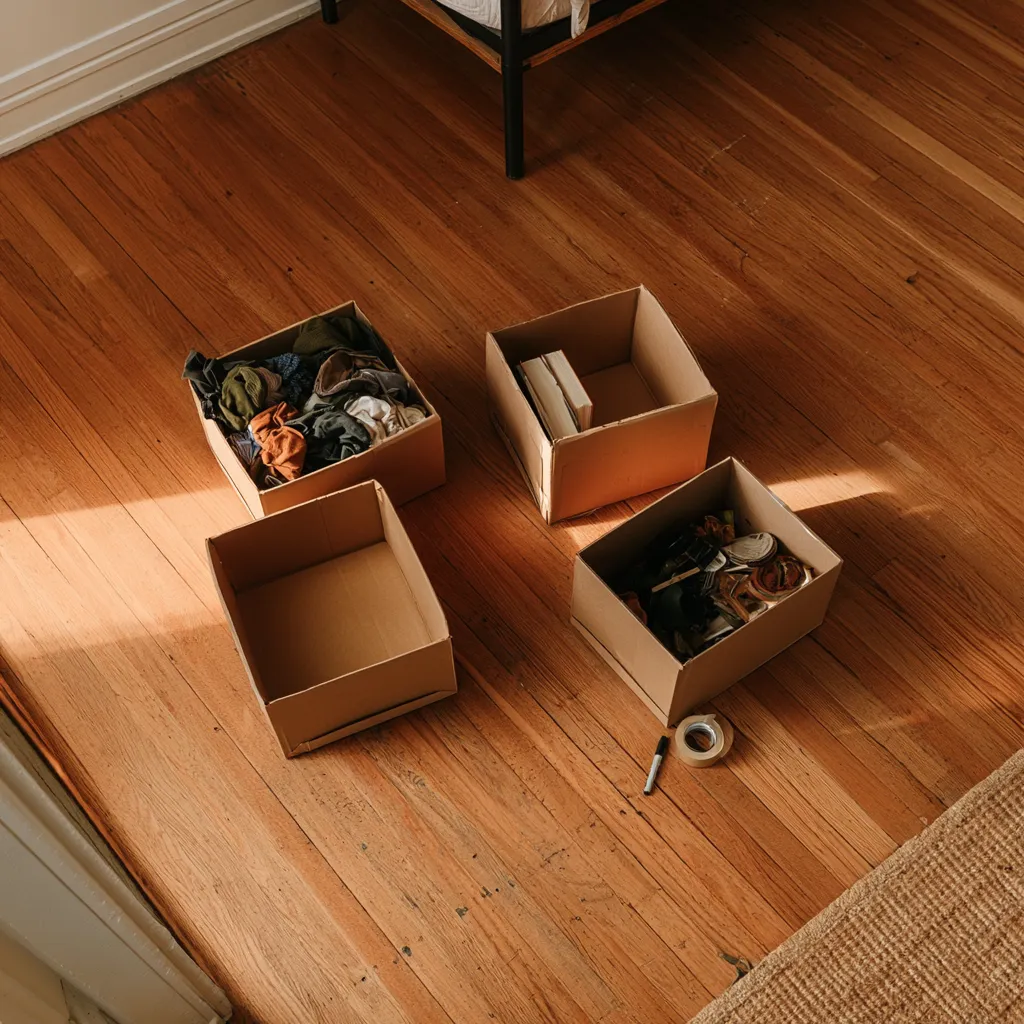
Four boxes, labelled before you start. Labelling afterwards is how boxes become storage.
Any boxes will do. Laundry baskets, carrier bags, four squares of floor marked with tape.
What matters is that there are exactly four. Three is not enough for the maybe problem, and five invites a second maybe.
The four boxes, and what each one means
- Keep, meaning it has a home in this room and you can name the home
- Elsewhere, meaning it belongs in the flat but not in here
- Out, meaning donate, sell or bin, decided today
- Maybe, meaning you cannot decide, and which gets a date written on it
The test for the keep box
Naming the home is the whole test. Not a vague area, a specific place.
"The second drawer" passes. "Somewhere in the wardrobe" does not, and that item goes to maybe.
This one rule removes most of the arguing, because it converts a feeling into a question with a yes or no answer.
Two things cannot share a home either. If the second drawer is already spoken for, this item goes to maybe.
That constraint is what keeps the keep box honest. Without it, everything has a home in theory.
Expect the keep box to be much smaller than you assumed and the elsewhere box to be much larger.
Most bedroom clutter is not bedroom clutter. It is kitchen, office, and bathroom items that drifted in.
Carry the elsewhere box out at the end of the session, not during it. Leaving the room mid-sort is how an hour becomes three.
Drop things just inside the correct room rather than putting them away. Putting away is a different job for a different day.
Handle each thing once
Pick it up, decide, put it in a box. Do not put it back down to think about.
Things put down to think about end up in the same place they started, which is how a four-hour declutter produces a room that looks identical.
If you genuinely cannot decide within about five seconds, it is a maybe. That is what the box exists for.
Five seconds sounds harsh, and it is not. Anything that takes longer is a decision about your past rather than about the object.
The maybe box is there precisely so those decisions do not have to be made at 10 pm on a Tuesday.
Gifts, inherited things, and anything bought expensively but never used all belong there by default.
Those three categories are where guilt does the deciding, and guilt is a bad sorter.
Deferring them is not avoidance. It is refusing to make a sentimental decision while tired and surrounded by mess.

Read more: what to do when you cannot get started at all
Clothes are their own session
Do not open the wardrobe during session two. Clothes have their own volume and their own emotional weight.
They also have a better method than four boxes, since sorting a wardrobe works on last-worn dates rather than categories.
Decision point: the out box leaves the house today or tomorrow. If it is still in the room in a week, session two did not happen.
Session Three, One Hour: Surfaces, Then Drawers
This session is about the horizontal planes that refill fastest.
Surfaces first, drawers second. Drawers are hidden, so they are lower value and higher effort.
By now the two sessions that genuinely declutter your room are behind you. What follows is refinement.
That matters for pacing. If you stop after session two, the room is already substantially better.
Give every surface one job
A nightstand holds a lamp, a glass, and one book. A dresser top holds nothing, or one tray.
Surfaces without a defined job become the new floor within about two weeks.
Write the job down if you share the room. An undefined surface will be defined by whoever gets there first.
Shelves are the exception, because they can hold more than one category if the categories are visibly separated, and depth is what decides how much they really take.
The bedside surface is the one that refills fastest of all, and it needs a rule rather than a container.
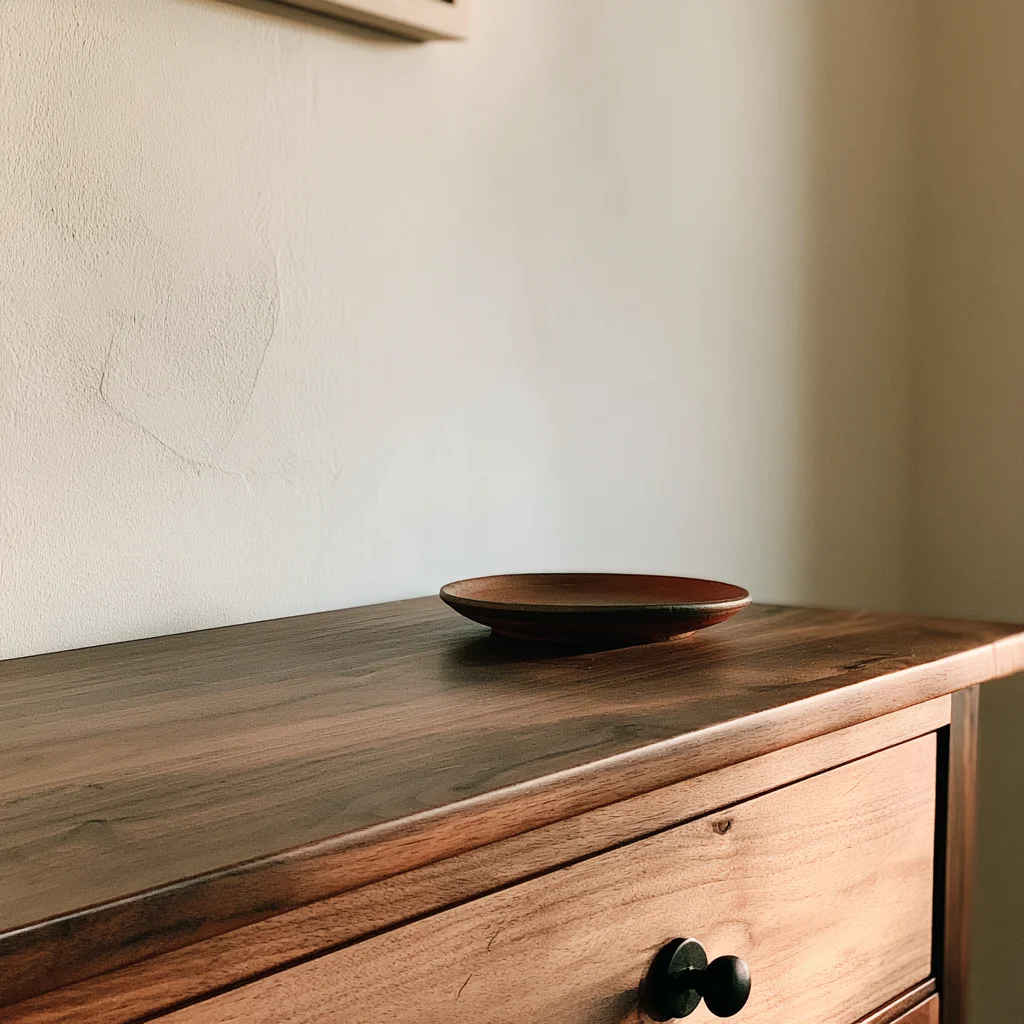
The small things that have no home
Every room has a category of small items that migrate: cables, hair ties, receipts, jewellery, half-used cosmetics.
These need a container each, not one drawer that holds all of them.
The five that migrate in almost every bedroom:
- Charging cables and adapters
- Hair ties, clips and elastics
- Receipts, cards and loose paper
- Jewellery, especially anything with a chain
- Half-used cosmetics and samples
Give each one a named container and the surfaces stop refilling within a fortnight.
Chains and earrings in particular need their own shallow tray, because anything that tangles will not be put away.
The same goes for daily cosmetics, where a divided insert beats a bag every time.
Drawers, one at a time
Empty one drawer completely, wipe it, and put back only what belongs in this room.
Then stop and do the next one another day if you need to. Drawers are the least urgent part of any room.
Dividers help, but only after the drawer has been emptied. A divider added to a full drawer just organises the overflow.
The broader system, once the room is clear, is a place for everything rather than a container for everything.
Do the drawer you open most often first. That is the one where a fix is felt daily rather than noticed once.
Deep drawers are worse than shallow ones for the same reason a deep cabinet is. Things stack, and the bottom layer disappears.
Decision point: if the surfaces are clear and one drawer is done, that is a full session. Drawers can wait.
Session Four, One Hour: The Closet
This session is last on purpose. It is the highest volume and the highest resistance.
Everything comes out. A closet sorted in place is a closet rearranged, not decluttered.
The closet comes last because by now you have had three sessions of practice at deciding, and the decisions get much faster.
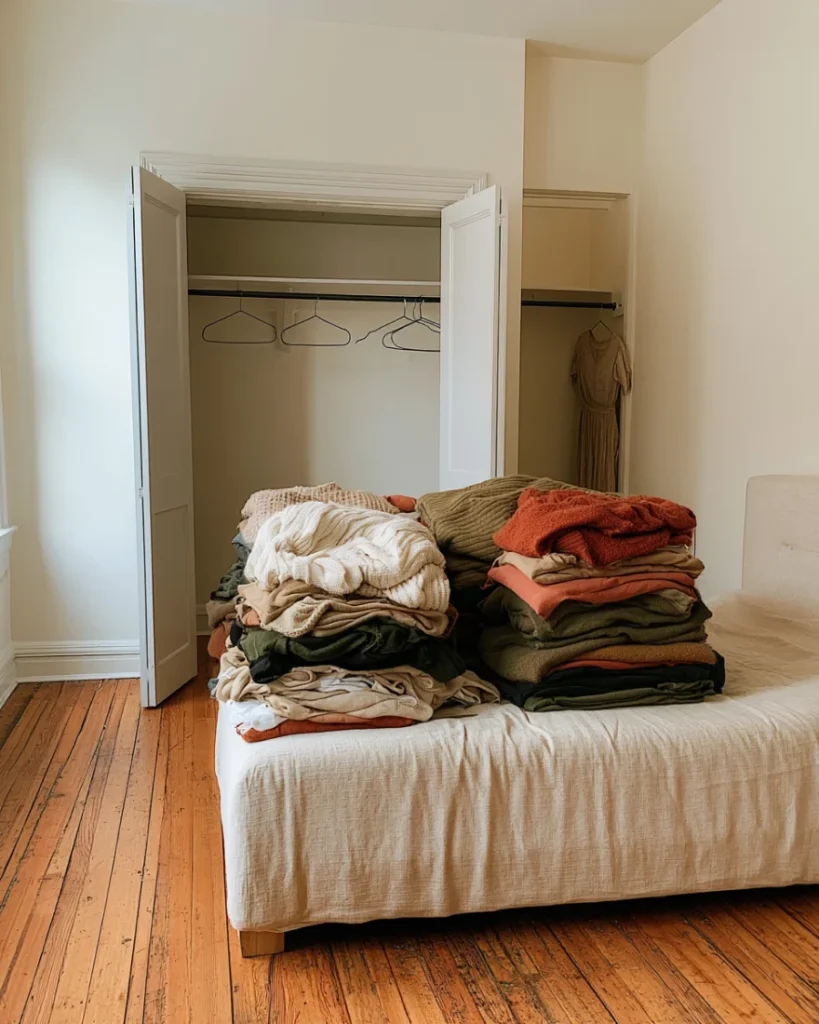
Work through it in this sequence
- Hanging clothes first, they are fastest to judge
- Folded stacks second, which is where duplicates hide
- Shoes third, paired and checked for wear
- The floor of the closet last, which is usually not clothes at all
- The shelf above, which is usually nothing you have thought about in a year
The closet floor and the top shelf are where the real volume sits. Most people never reach either.
Expect the closet to take longer than the estimate. An hour clears the rail; the floor and the shelf are a second hour.
Split it if you need to. The rail alone is a legitimate stopping point.
Try things on if you are unsure about fit. Guessing from the hanger is how clothes stay for another three years.
Anything that needs a repair goes in one bag with a date. If the repair has not happened in a month, the bag goes out.
Read more: A closet system that survives the next six months
What goes back in
Only what fits with room to move a hanger. A packed rail means clothes are not seen, and a second rail or a shelf system usually solves it.
Shoes almost never belong on the closet floor, since they take the space the bulky items need.
Seasonal and occasional items move under the bed instead, where the clearance decides what will actually fit.
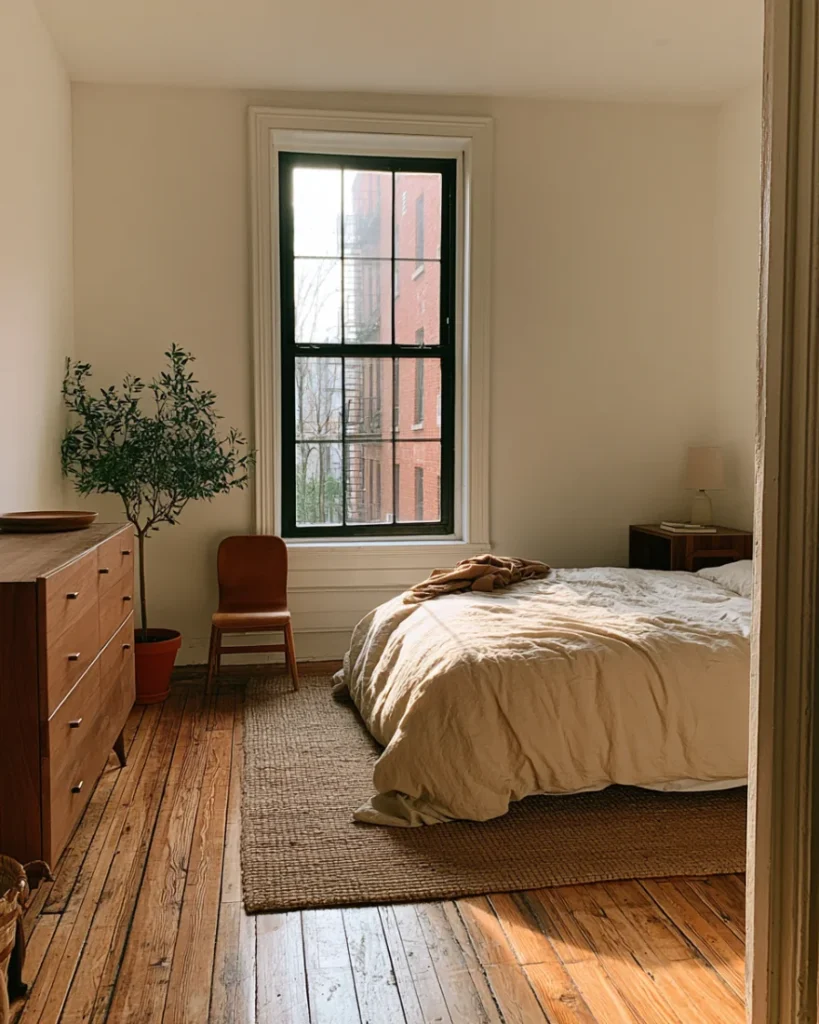
Decision point: if the rail has space and the floor of the closet is clear, you are done with the sessions. What is left is the maybe box.
The Maybe Box, Which Is Where This Always Stalls
The maybe box is not a failure of the method. It is the method working, because it lets you declutter your room without having to finish every decision.
What breaks is what happens next, which is usually nothing.
The box sits in the hallway, gets opened for one thing, and is back in the room within a month.
Three rules stop that, and they take about two minutes to set up.
- A date written on the outside, six months out
- The box stored outside the room it came from
- Taped shut, so opening it is a deliberate act
Write a date on it
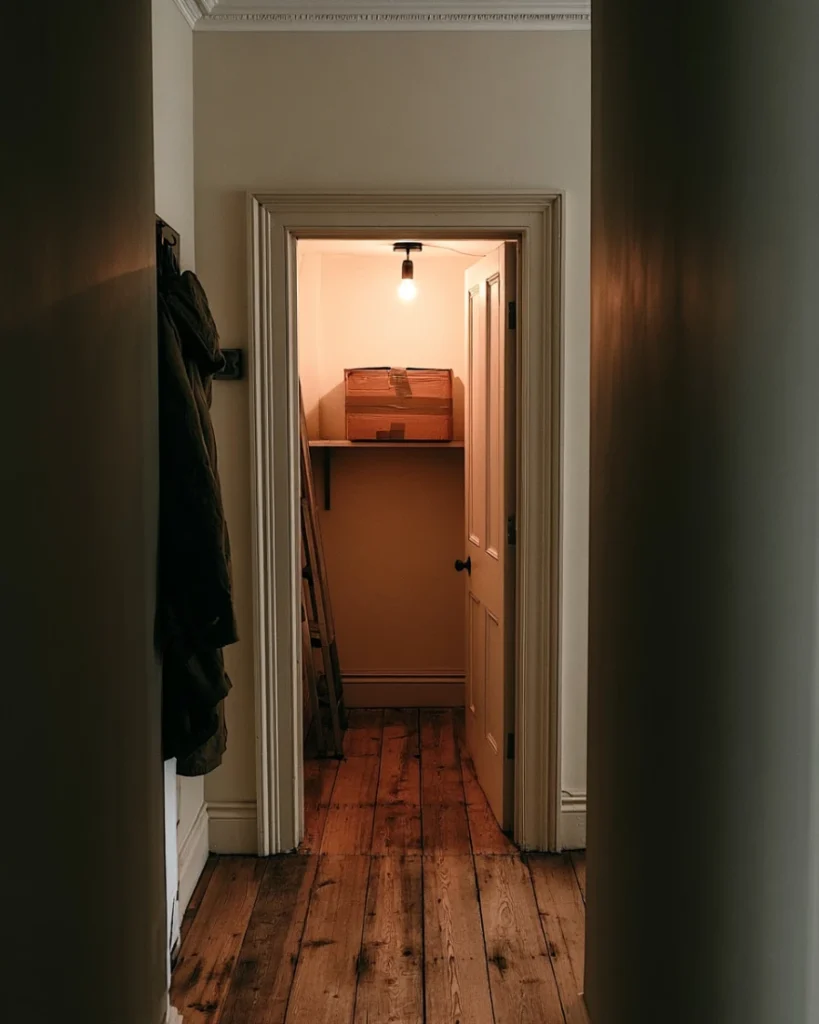
Tape the date six months from today on the outside of the box, then put it somewhere out of the room.
A cupboard, the top of a wardrobe, under a spare bed. Not in the room you just cleared.
On that date, anything you have not gone looking for leaves without being opened.
Why unopened matters
Opening the box restarts every decision you already deferred, and it restarts them with six months of nostalgia attached.
If you needed something in there, you would have gone and got it. That is the entire test.
Write a rough list of the contents on the outside before you tape it shut. That way you can check without opening.
If you find yourself reading that list often, the box is doing its job, and the items are genuinely wanted.
One maybe box per room, not per category. Two boxes become an archive, and an archive never gets a date.
The exception
Documents, anything with sentimental weight from a person rather than a period, and anything genuinely expensive.
Those three get decided rather than deferred, because the six-month rule is not designed for them.
Files and photos are a separate job with a separate method, and the digital pile has its own version of the maybe box.
What to Do With What Is Left
This is the section most guides skip, and it is why our boxes sit in hallways for months.
Most advice on how to declutter your room says donate and stops there. Where things actually go varies a lot by category.
Donation is not a single answer. Different categories have genuinely different destinations and different odds.
Choosing wrong means the bag comes back, or it becomes a charity shop disposal cost rather than something anyone reuses.
| What you are getting rid of | Where it actually goes | Worth knowing |
|---|---|---|
| Wearable clothes and shoes | Charity shop or a clothing bin | Reuse happens before waste data is collected, so donation is genuinely the best route |
| Worn, stained or torn textiles | Textile recycling, not the charity shop | Charity shops sort these out and pass them on, which costs them money |
| Books | Charity shop, a street library, or a specialist buyer | Textbooks and cookbooks move fastest, fiction slowest |
| Electronics and cables | Council e-waste point or a retailer take-back | Almost never accepted in a normal donation bin |
| Furniture | Reuse charity that collects, or council bulky waste | Upholstered items usually need a fire label to be accepted |
| Paperwork | Shred, then recycle | Keep only what has a retention period attached to it |
Read more: living with fewer things so the boxes stop refilling
The number worth knowing
The EPA puts the US recycling rate for all textiles at 14.7 percent, with clothing and footwear specifically at 13 percent, and landfills received 11.3 million tons of textiles in a single year.
Donation falls outside those figures entirely because reuse occurs before anything is counted as waste.
So the figure is not an argument against donating. It is an argument against assuming a recycling bin will handle worn textiles.
That is the practical takeaway. Giving something to a person or a charity shop is a different act from putting it in a recycling bin, and only one of them reliably works.
Get it out of the house this week
Book the collection, or put the bags in the car boot today. An out box in the hallway is still clutter, just relocated.
Before you drop anything off, check:
- Clothes are clean and dry, or they get binned on arrival
- Electronics have been wiped of personal data
- Furniture with upholstery still has its fire label
- Books are not damp, which contaminates a whole box
- You have kept nothing back to think about again
One trip, one afternoon, and the room is genuinely finished rather than staged.
Photograph the room when it is done. It is the reference you will want in four months when it starts drifting.
Compare the photo to the room monthly. Drift is gradual and almost invisible without a fixed reference point.
Most rooms drift back through one specific surface rather than everywhere at once. The photo tells you which one.
Fix that one surface and the monthly session stays at twenty minutes instead of becoming session two again.
Then run session one again, twenty minutes, once a month. It is the whole maintenance cost of a room that stays clear.
Do that, and you will not need to declutter your room properly again for a year or more.
And if the room refills within a few months, the sessions were never the problem, since volume arriving is a buying pattern rather than a storage failure.
A whole-flat version of these four sessions runs across a structured month with a different focus each week.
And once the room is clear, keeping it that way is a design question rather than a sorting one, which a pared-back bedroom answers well.