

Nightstand organization goes wrong because people treat a nightstand as storage when it is really the surface you operate on in the dark, half asleep. It has three jobs: getting into bed, waking at 3 am, and getting up.
Anything that does not serve one of those three moments belongs somewhere else. That test settles almost every item without a single container.
Clear the surface completely first. Twenty minutes, including the drawer, and the sorting takes care of itself.
Nothing here needs buying. A tray you already own and a cable clip are the entire shopping list.
The three moments
Every object on a nightstand is there for a reason, and the reason is a moment rather than a category.
Most nightstand organization advice sorts by type. Sorting by moment is what tells you whether something belongs at all.
Work out which moment each item serves. Most of what is on the surface will serve none of them.
| Moment | What you need | Where it has to be |
|---|---|---|
| Getting into bed | Book, lamp switch, glasses case, phone on charge | Within arm's reach, sitting up |
| Waking at 3 am | Water, lamp switch, tissues | Findable without light or sitting up |
| Getting up | Phone, glasses, watch | Reachable, and not knocked over half asleep |
| None of the three | Everything else | A drawer, another room, or out |
Why 3 am is the test that matters
The middle of the night is the only time you use a nightstand blind, and it is the moment nobody designs for.
Everything needed at 3 am has to be findable by touch, in a fixed position, with nothing in front of it.
That means the water glass gets the front corner nearest the pillow and stays there. Not the back, not beside the lamp, not wherever it landed.
A glass with a lid or a bottle with a cap solves the knocking-over problem permanently, and it costs almost nothing.
The lamp switch is the other 3 am item. A touch base or a pull cord beats a small rocker switch you have to find.
Keep the space in front of the water and the lamp clear. Those 2 positions are fixed, and everything else works around them.

Read more: why bedside surfaces refill faster than anywhere else in a room
What the surface holds
The surface should hold about four things, and the number matters more than which four.
The list
- A lamp, or a wall light if the surface is small
- Water, in something that cannot spill
- One book, the one you are actually reading
- A small dish for glasses, a watch, and anything from a pocket
- The phone, on a stand rather than flat, if it is your alarm
Everything else is either drawer material or belongs in another room.
A nightstand carrying nine things has stopped being a nightstand and become a shelf that happens to sit beside a bed.
Count what is on yours right now, then count how many you touched in the last week.
Then work down the moments column and see how many survive. That subtraction is the whole of nightstand organization.
The tray boundary
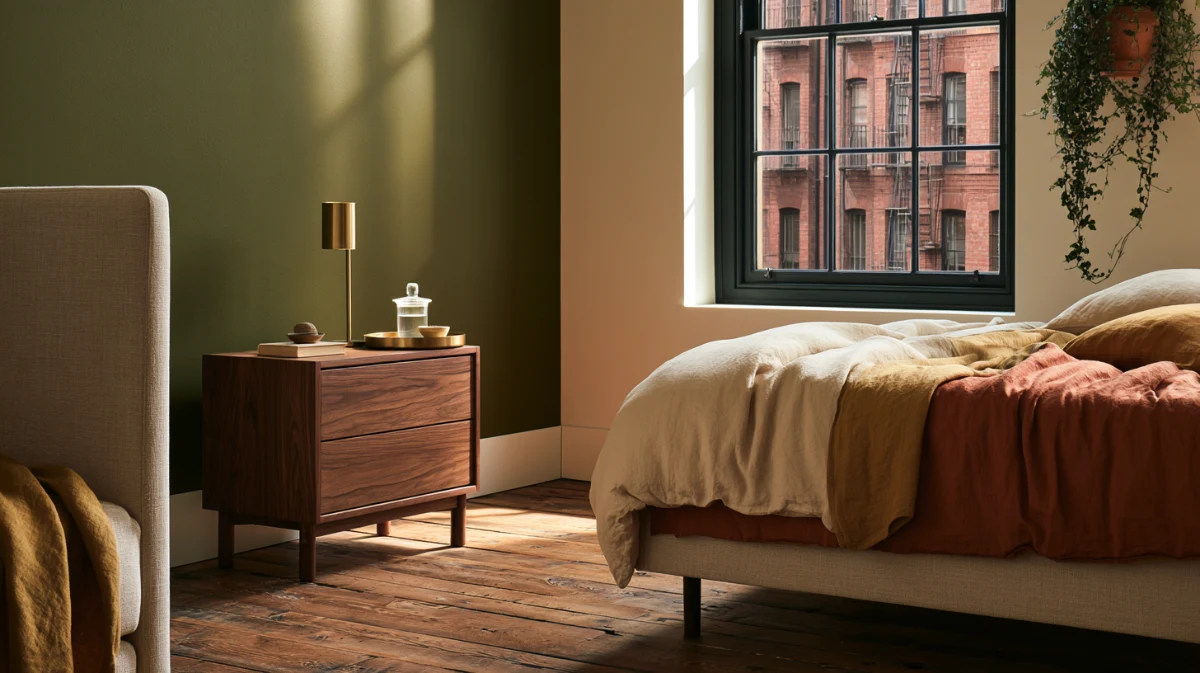
One tray, sized to about two-thirds of the surface, and nothing outside it except the lamp.
A tray works because it makes overflow visible. When something will not fit inside the edge, you notice, which a bare surface never forces you to do.
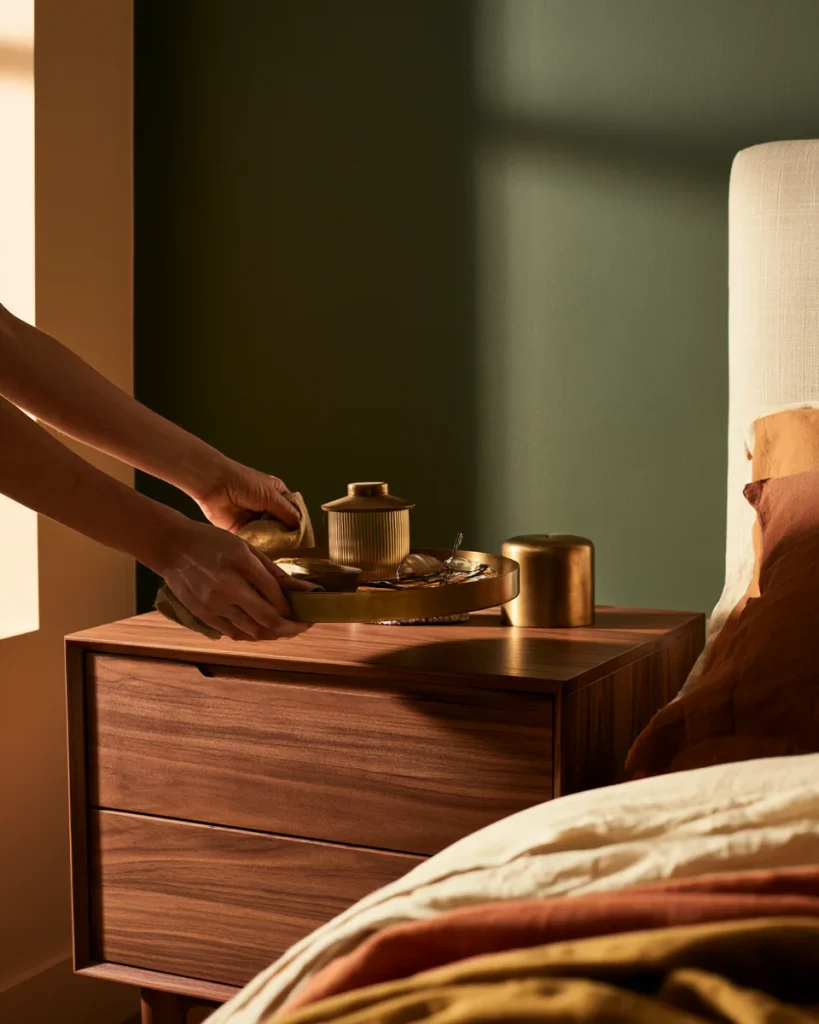
It also lets you lift the whole lot to dust, which is the other reason bedside surfaces get neglected.
Choose a tray with a raised lip rather than a flat board. A lip is what stops a rolling item from going over the edge in the dark.
The one book rule
A stack of five books is a stack of four you are not reading and one you are.
The other four go on a shelf. If there is no shelf, they go under the bed in a bin.
Shelving above or beside the bed absorbs most of this, though what it can hold depends on the fixing rather than the shelf.
A finished book leaves the nightstand the same day. That one habit keeps the stack from ever starting.
A reading light clipped to the headboard frees the whole lamp footprint, which on a small surface is most of it.
Charging, which serves all three moments and belongs to none
Cables are the single biggest source of bedside mess, and this is where nightstand organization stops being cosmetic.
Where the phone actually goes
On the nightstand, on a hard surface, uncovered. The NFPA is explicit that you should charge devices on a hard surface and not under a pillow, on a bed, or on a couch, because trapped heat is what turns a warm battery into a fire.
That single rule is a better argument for a functioning nightstand than any tidiness case.
A stand rather than flat placement also lets air move around the phone and stops you from knocking it off when you reach for water.
Good nightstand organization has a safety component that tidiness advice rarely mentions, and this is it.
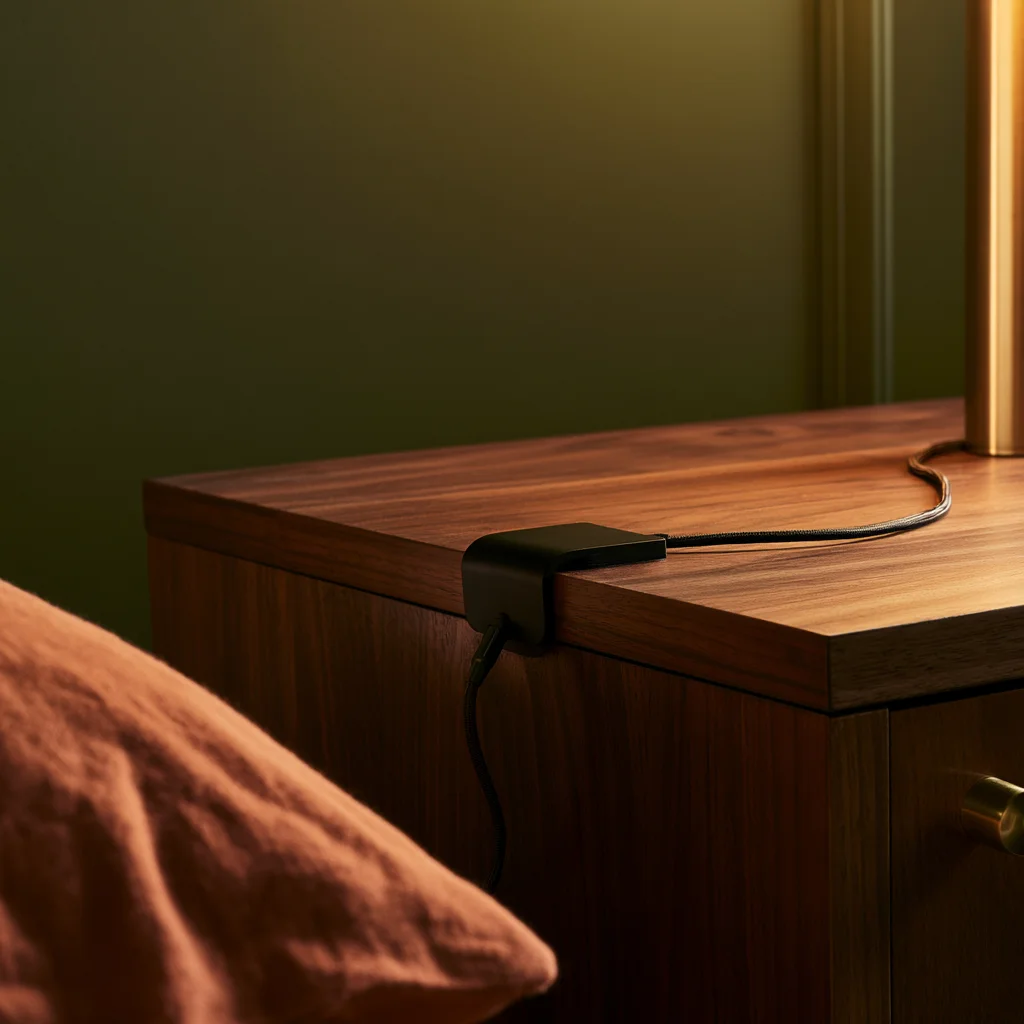
Getting the cables off the surface
- One cable up to the surface, not three
- A clip on the back edge so the end does not fall behind the table
- The plug block on the floor or inside the drawer, never on the surface
- Cable ties within a few inches of the plug rather than halfway along
If 2 people share the room, run one cable each up opposite back corners. Crossing them in the middle is how they tangle.
You do not need to label anything, because with one cable per side there is nothing to tell apart.
A short cable beats a long one here. 2 feet reaches the surface and leaves no slack to tangle.
The bundling technique is the same one that works at a desk, where tying at the plug rather than in the middle is what keeps it tidy.
Read more: storing what comes off the surface under the bed instead
The drawer, if there is one
A nightstand drawer accepts anything and almost never gets emptied, which is how it ends up holding what it holds.
One category per section
Dividers only help after the drawer is empty. Adding them to a full drawer organises the overflow.
Three or four sections is plenty: medication, chargers and spares, personal items, and one deliberately empty for whatever the week produces.
Empty the drawer completely twice a year. It is the single place in a bedroom where things sit unexamined longest.
Expect to find things you last thought about years ago.
What always turns up in a bedside drawer:
- Cables for devices long gone
- Dead batteries nobody wanted to bin
- Receipts and old cards
- Half a pack of something medicinal, expired
- A phone two upgrades ago
The empty section is what stops the surface from filling, because there is somewhere for the unexpected thing to go.
What genuinely belongs in it
- Anything you need at night but not on the surface
- Medication, if it is taken at night and out of reach of children
- A spare charging cable
- Earplugs, an eye mask, hand cream
- Anything that belongs in another room stays in that room
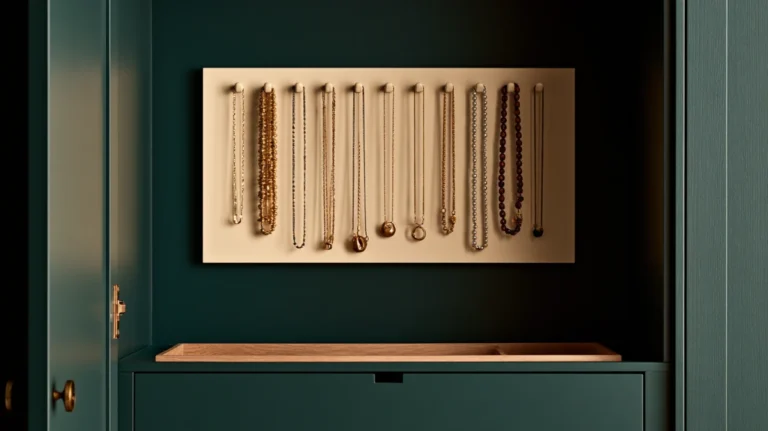
Small items that tangle need their own shallow container rather than a drawer corner, since anything with a chain stops being put away.
When there is no nightstand at all
Plenty of small bedrooms have no room for one, and the three moments still need serving.
What works instead
- A 6-inch floating shelf at mattress height plus about 6 inches, which holds everything on the list
- A bedside caddy that slides under the mattress, for a bed against a wall
- A narrow rolling cart, which doubles as storage and moves out of the way
- A stool or a stacked crate, which costs nothing and is the right height already
Height matters more than type. Match the mattress top plus a few inches, and anything at that height works.
Too low and you reach down in the dark. Too high and you knock things off getting into bed.
Measure the mattress top from the floor before buying anything, because bed heights vary a lot.
A shelf has one advantage a table cannot match. It leaves the floor beneath it clear, which matters in a room where the walkway is tight.
That clear floor is also where storage goes, since the space under a bed is decided by clearance rather than by area.
A shallow shelf is the best of these in a tight room, because depth is what makes a small bedroom feel narrow.

Read more: the same handover problem when a desk shares the room
Why it refills, and the 2-minute fix
A bedside surface refills faster than any other in the house, because it is the last flat thing you touch before sleeping.
Any nightstand organization that survives a month has a 2-minute habit attached to it. Nothing else holds.
Pocket contents, tissues, a second glass, a charger for something else. None of it serves the 3 moments, and all of it lands there.
The morning reset
Give it 2 minutes when you get up, before you leave the room.
Take the glass to the kitchen, put anything not on the list into the drawer, straighten the tray, and square the book.
Doing it in the morning works because the surface is already in your eyeline while you are making the bed.
Evening resets fail here. By bedtime, you are putting things down rather than taking them away.
Take the glass with you when you leave the room. It is the item most likely to sit there all day.
The rule that stops it from coming back
Nothing arrives on the nightstand that does not serve one of the three moments.
Say the moment out loud when you put something down. If you cannot name one, it goes somewhere else.
When the surface fills anyway, the problem is usually upstream in the room rather than at the bedside, and a diagnosis beats reorganising the same objects.
The whole method
- Clear the surface completely, including the drawer
- Sort every item by which of the three moments it serves
- Put back only what serves one, in a tray
- Give the water a fixed front corner you can find in the dark
- One cable up, plug block off the surface, phone on a hard stand
- 2 minutes every morning before you leave the room
Far less goes back than comes off, which is why this works without buying anything.
Give it a fortnight before deciding it is too strict. The 3 am test usually converts people faster than the tidiness argument does.
You notice it the first night you reach for water without opening your eyes, and it is exactly where it was.
The four or five things that came off usually have no home anywhere, and the whole room needs the same sort.