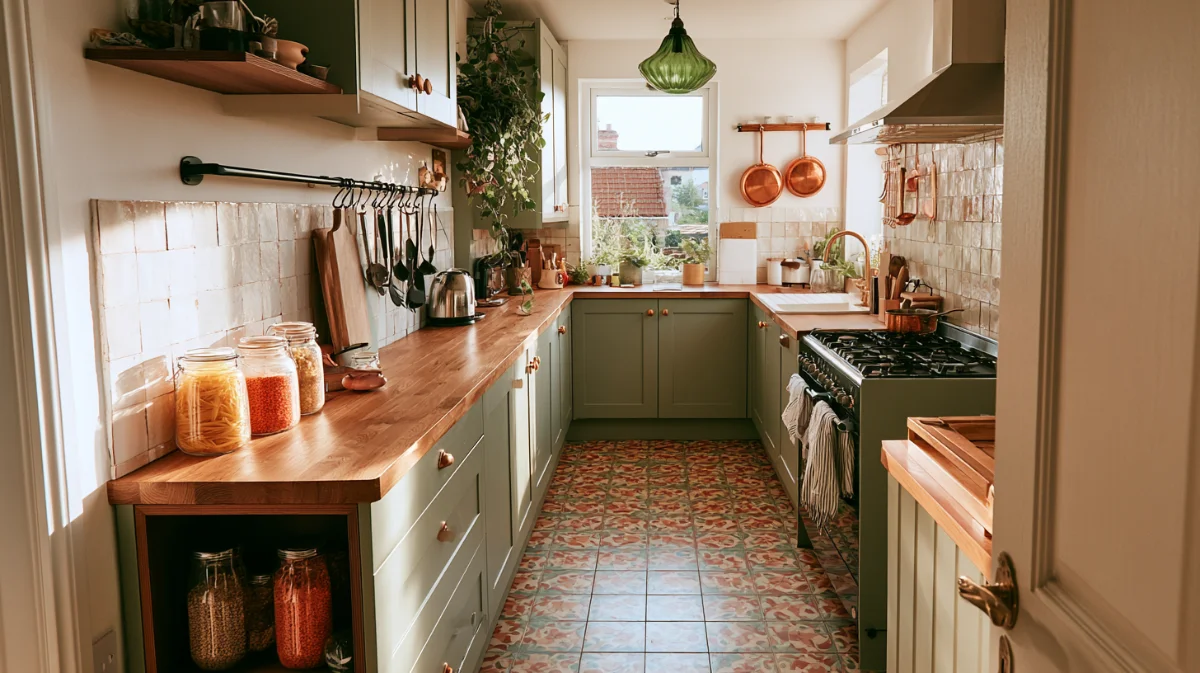


Kitchen counter organization is an arithmetic problem before it is a tidying one. A small kitchen has a fixed number of square inches, and working space takes the first slice.
Five ordinary appliances eat most of what is left. Measure the budget, then decide what earns a place in it.
Nothing below asks you to buy an organiser. It asks you to work out what you can afford to keep out.
Twenty minutes with a tape measure and a calculator, and the decisions make themselves.
Work Out the Budget
Two measurements and one subtraction give you the number.
Measure the run and the usable depth
A standard counter is 25 inches deep, and about 22 of those are usable once you allow clearance at the backsplash.
Measure the total run of clear counter in inches, then multiply by 22.
A 72-inch run gives 1,584 square inches. That is the whole budget for the room.
Measure only the genuinely clear counter. The strip behind a hob and the six inches beside a sink are not usable surface.
Corners count for less than their area suggests, because you cannot reach the back of one without leaning across the front.
Write the number down. Every decision in the rest of this article is measured against it.
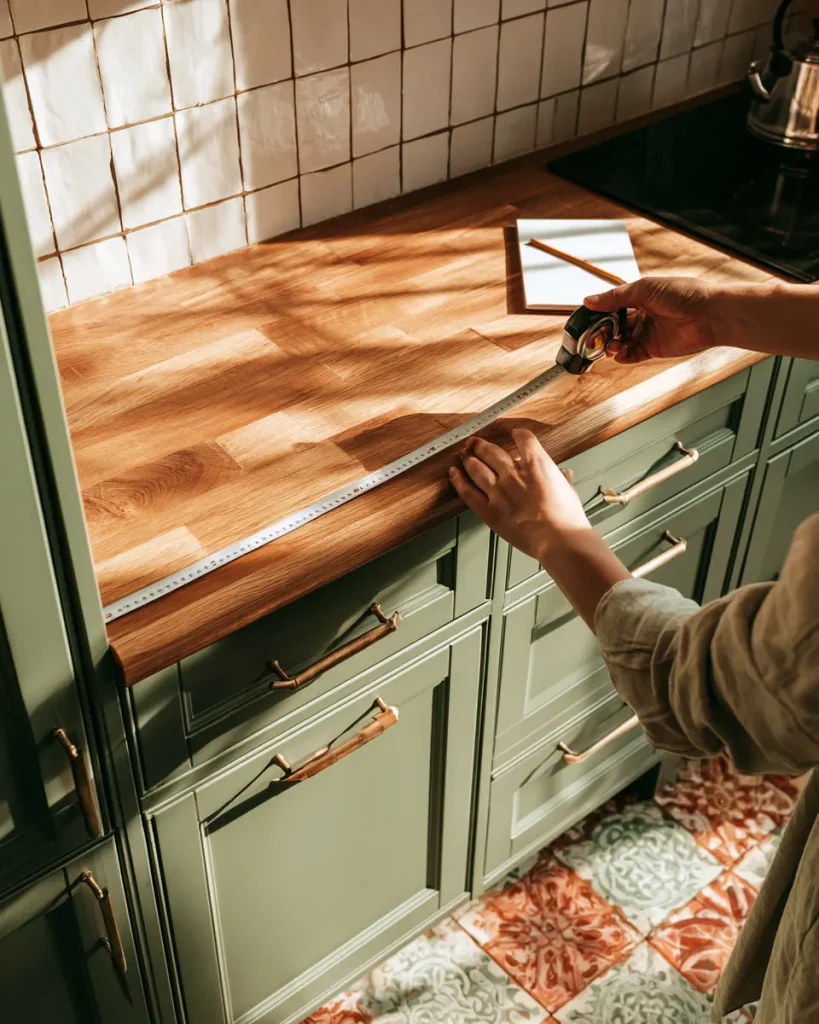
Take out the working area first
You need somewhere to actually chop, which means roughly 18 by 24 inches of clear surface next to the hob or the sink.
That is 432 square inches, and it is not negotiable. Planning guidelines are stricter still, asking for 24 inches of landing space on one side of the sink and 18 on the other, before you have chopped anything.
Take the working area out before anything else gets counted.
If you bake or cook from scratch regularly, take 24 by 36 instead, which is 864 and halves the budget straight away.
On a 72-inch run, that leaves 1,152 square inches for everything you want to keep out.
What things actually cost
Every object on the counter has a price in square inches. Most people have never added them up.
Measure your own rather than trusting the table. Appliance footprints vary by a third between models.
| Item | Rough footprint | Square inches | Share of a 1,152 budget |
|---|---|---|---|
| Microwave | 20 by 16 in | 320 | 28 percent |
| Dish rack | 18 by 13 in | 234 | 20 percent |
| Air fryer | 14 by 13 in | 182 | 16 percent |
| Fruit bowl | 12 in across | 144 | 13 percent |
| Stand mixer | 9 by 14 in | 126 | 11 percent |
| Coffee maker | 8 by 12 in | 96 | 8 percent |
| Toaster | 11 by 7 in | 77 | 7 percent |
| Kettle | 7 by 9 in | 63 | 5 percent |
| Knife block | 5 by 9 in | 45 | 4 percent |
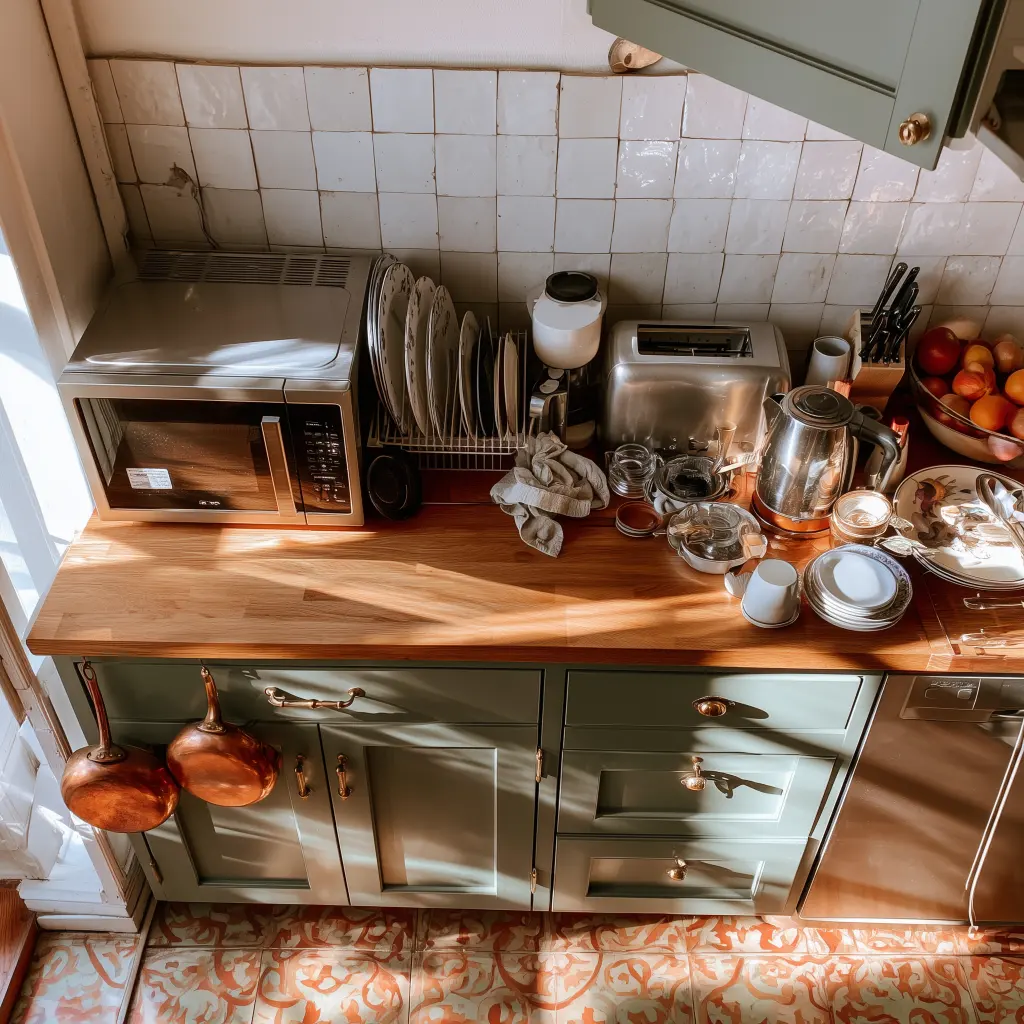
Five ordinary items, a microwave, a coffee maker, a toaster, a kettle, and a dish rack, come to 790 square inches. That is 69 percent of the budget gone.
Add a stand mixer and an air fryer, and you are at 95 percent, with a fruit bowl and a knife block still homeless.
Spend the Budget Deliberately
Once you have the number, the decisions get easy, because they stop being about tidiness and start being about arithmetic.
Kitchen counter organization stops being a matter of taste at this point. Something either fits inside the budget or it does not.
The daily test
Anything permanently out has to be used every day. Not most days.
For most households, that is the kettle and one other thing. Everything else is furniture pretending to be equipment.
Questions worth asking about anything permanently out:
- Did I use it yesterday, and the day before?
- Would fetching it from a cupboard actually stop me using it?
- Is it out because it is used, or because it has nowhere else to go?
- Does it fit anywhere at all, or is it genuinely oversized?
Put the doubtful items in a cupboard for a fortnight. Whatever you fetch more than three times has earned its square inches back.
Most kitchen counter organization advice starts with trays and risers. Those help only after the count is under budget.
An organiser on an overloaded counter is a tidier version of the same problem.
The three big spenders
The microwave, the dish rack and the air fryer are the three items that make or break a small counter.
- A microwave can go on a wall bracket or a shelf, which recovers 28 percent in one move
- A dish rack can be an over-sink model or a rolled mat that puts away, recovering another 20 percent
- An air fryer used twice a week belongs in a cupboard, not on the counter
- A stand mixer used monthly belongs in the lowest cupboard, heavy and out of the way
Moving just the microwave and the dish rack recovers 554 square inches, which is nearly half the budget.
Neither move costs anything if you already own a shelf bracket or a drying mat.
Do those two before considering any other kitchen counter organization change, because nothing else comes close on return.
Where they go instead is a cabinet question rather than a counter one, and the dead depth at the back of a base cabinet is where the room usually is.
What is worth its footprint
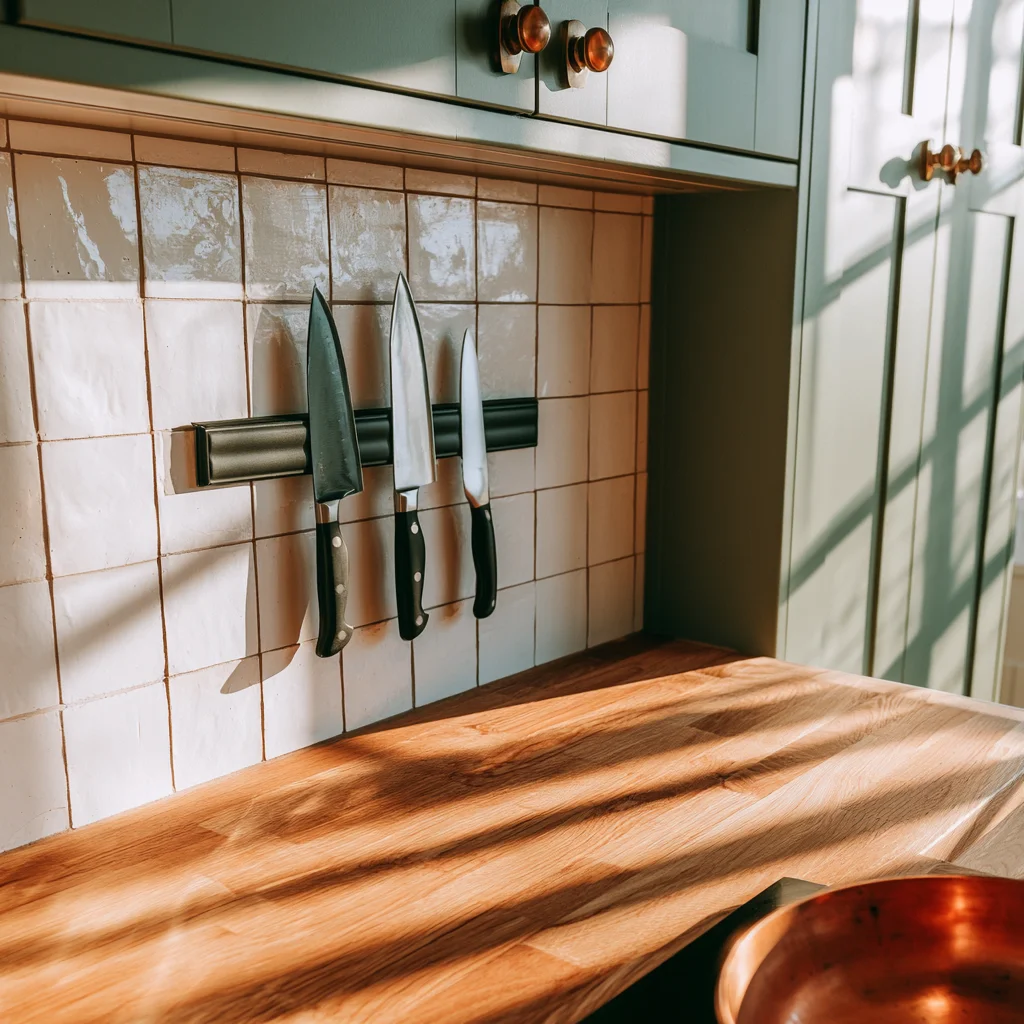
A knife block at 45 square inches is cheap, and a magnetic strip on the wall makes it free.
A kettle at 63 is the best value on the counter for most people, because it is genuinely daily and there is nowhere else for it.
A fruit bowl at 144 is expensive for what it does. A hanging basket does the same job for nothing.
A dish rack is the one people defend hardest, and it is the second most expensive item on the list.
A rolled drying mat costs about 20 square inches while in use and nothing at all once it is put away.
Items worth their footprint in most small kitchens:
- A kettle, if you use it daily
- A knife block, or better, a wall strip for nothing
- One board left flat where you actually chop
- A single crock of the four utensils you reach for
Read more: what a shelf above the counter can carry
The Things That Are Not Even Kitchen Items
Run the audit, and a third of what is on a typical counter has no business being in the kitchen at all.
Post, keys, chargers, school letters, packages. The counter is the first flat surface inside the door, so everything lands there.
Track it for a week and write down what appears. The list is usually shorter and more repetitive than it feels.
Three or four categories account for almost all of it in most households.
What lands on a kitchen counter that is not kitchen equipment:
- Post, opened and unopened
- Keys, cards and wallets
- Chargers and cables
- Shopping still in its bags
- School or work paper waiting on a decision
Give the transit pile a container
One shallow tray, somewhere other than the kitchen, is the whole fix.
The tray has to be nearer the door than the counter is, or the habit will not move.
This is the only fix here that changes behaviour rather than storage, which is why it is worth doing first.
Paper is the category that regenerates weekly, and it needs a route rather than a container.
The homeless items
The rest of the strays are things with no assigned cupboard, so they default to the counter.
Each one needs a named home, and if every cupboard is full, that is a volume problem rather than a counter problem.
Name the home out loud before you put anything away. A vague area is how something ends up back on the counter within a week.
The zone map settles most of it, since every kitchen runs five jobs and each needs a named area.
Read more: where the containers go once they leave the surface
Buying Back Square Inches
Three moves add usable surface without touching a cabinet, and none of them cost much.
Over the sink
A board sized to the sink bowl adds roughly 200 square inches of working surface that disappears when you need the tap.
It is the single best value item in this article & it needs no fixing at all.
Measure the sink bowl inside the rim rather than outside it, since a board that rests on the rim will slide.
The wall above the counter
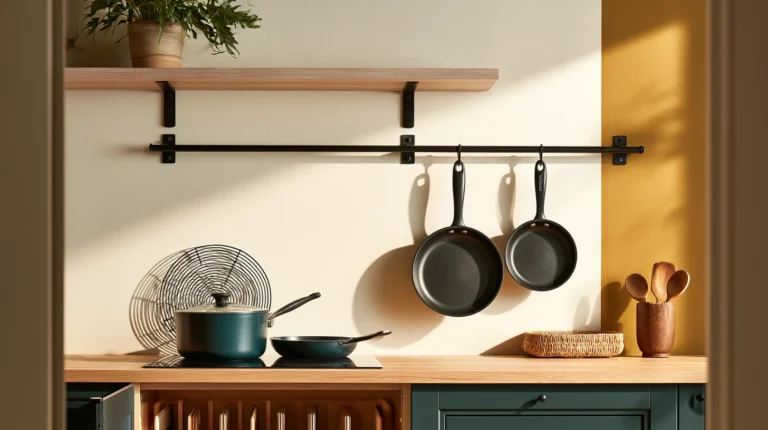
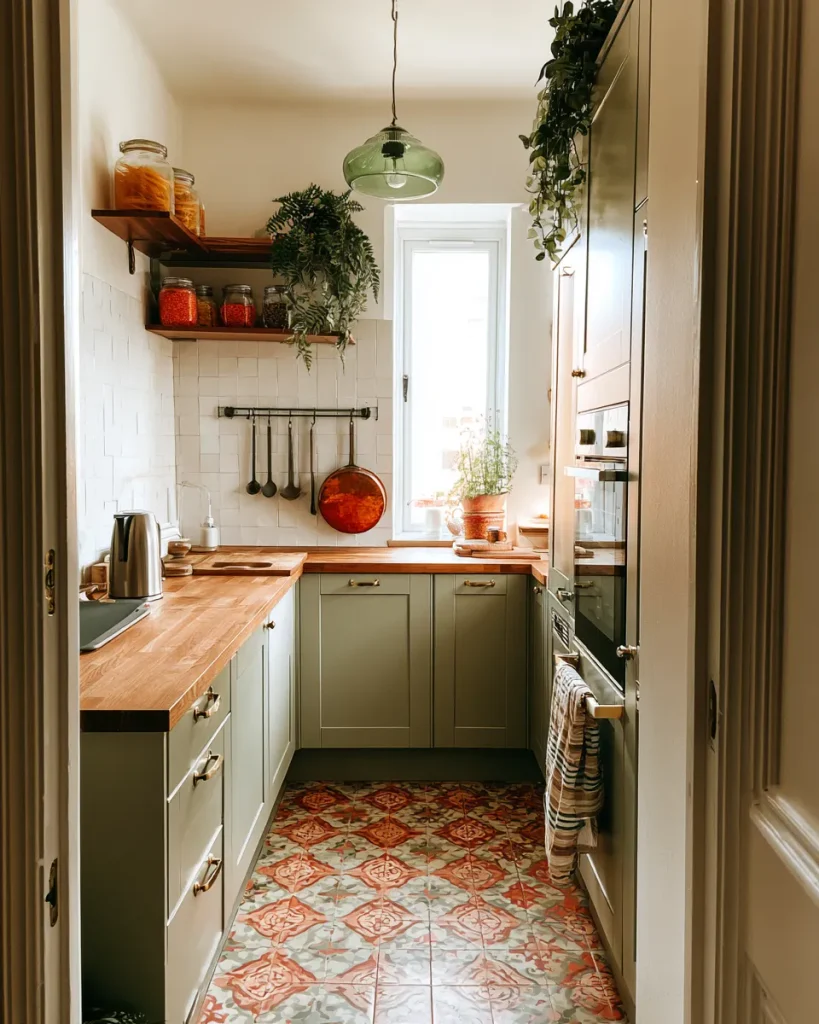
A rail with hooks takes utensils off the surface entirely. A narrow shelf holds oil, salt & a small plant.
Keep anything above a counter shallow, because depth is what levers a shelf off a wall.
Nothing heavy goes above a working area. A shelf coming down onto a chopping board is a different kind of afternoon.
A rail is the better first move in a rented kitchen, because it takes less weight and leaves smaller holes.
A rail carrying six utensils recovers whatever a crock was taking, usually around 40 square inches, and it costs no floor at all.
The gaps
- The slot beside the fridge, if it is 3 inches or more, takes a slim rolling tower
- The side panel of an end cabinet takes hooks or a rail
- The inside of a cabinet door takes a shallow rack for flat items
- A fold-down wall shelf gives you a prep surface that vanishes afterwards
Read more: pans are the other thing competing for surface
Keeping the Budget Balanced
A counter cleared once refills within about a month unless something changes upstream.
The end-of-day sweep
Two minutes, every evening, and only the counter. Everything not on the approved list goes back to its home.
Doing it nightly means it takes two minutes. Doing it weekly means it takes twenty.
Attach it to something you already do, such as the last wipe down after dinner.
Wiping a clear counter takes seconds. Wiping around eleven objects is why the wiping stops happening.
Kitchen counter organization survives on that habit rather than on the original clear-out.
The rule for anything new
A new appliance has to displace an old one, or it does not go on the counter.
Work out its footprint before it arrives. An air fryer at 182 square inches has to take that from something.
Buying without checking is how the budget goes over in the first place, and the space test belongs before the purchase rather than after it.
The whole method in five steps
- Measure the clear counter run and multiply by 22 for usable square inches
- Subtract 432 for a working area you can actually chop on
- Add up the footprints of everything currently out
- Move the microwave and the dish rack first, which is nearly half the budget
- Sweep the counter for two minutes at the end of every day
Most people find they are 30 to 60 percent over budget on the first count, which explains why the counter never stays clear.
It is not a discipline problem. There was never enough surface for what was on it.
Recount every six months, or whenever something new arrives. The budget does not change, but the spending does.
Signs you have drifted back over:
- You move something to chop
- The kettle no longer has clear space around it
- Post has reappeared
- You wipe around objects rather than across the surface
And if the cupboards genuinely cannot absorb what comes off, the pantry is usually holding a third of its volume in things nobody has opened in a year, so sorting by turnover frees the space.
Under the sink is the other place worth checking, where the plumbing dictates the layout more than people expect.