

Under bed storage for dorms works backwards from every guide written for a home bedroom. At home, the clearance is fixed, and you shop for it. In a dorm, you set the clearance yourself.
A twin XL is 38 by 80 inches, which is 21.1 square feet of floor space sitting underneath the bed. What that floor is worth depends entirely on how high you raise the frame.
At the lowest setting, you get about 21 cubic feet. Lofted to 52 inches, you get 91.5. Lofted to 60, you get 105.6, and you can no longer sit up in bed.
The ceiling is the limit rather than the bed, and 52 inches is where it bites. That number decides everything else in this article.
The ceiling sets the maximum, not the frame
Every decision about under bed storage for dorms runs through one measurement. A dorm ceiling is about 8 feet, which is 96 inches.
Subtract a mattress at 8 inches and the seated height of an adult torso at roughly 36. The frame can go to 52 before sitting up stops working.
| Frame height | Sleeping surface | Headroom | Can you sit up |
|---|---|---|---|
| 36 in | 44 in | 52 in | Yes, comfortably |
| 44 in | 52 in | 44 in | Yes |
| 52 in | 60 in | 36 in | Just |
| 60 in | 68 in | 28 in | No |
| 68 in | 76 in | 20 in | No |
Measure your own ceiling before setting the frame, since the 96-inch figure varies by hall and by floor.
The standard loft height at many universities sits right on that boundary. Georgia lists a default of 52 inches of clearance with the mattress top around 62, which leaves 34 inches of headroom.
That is enough to sit against the wall and not enough to sit upright with a laptop. The decision is which of those you need.
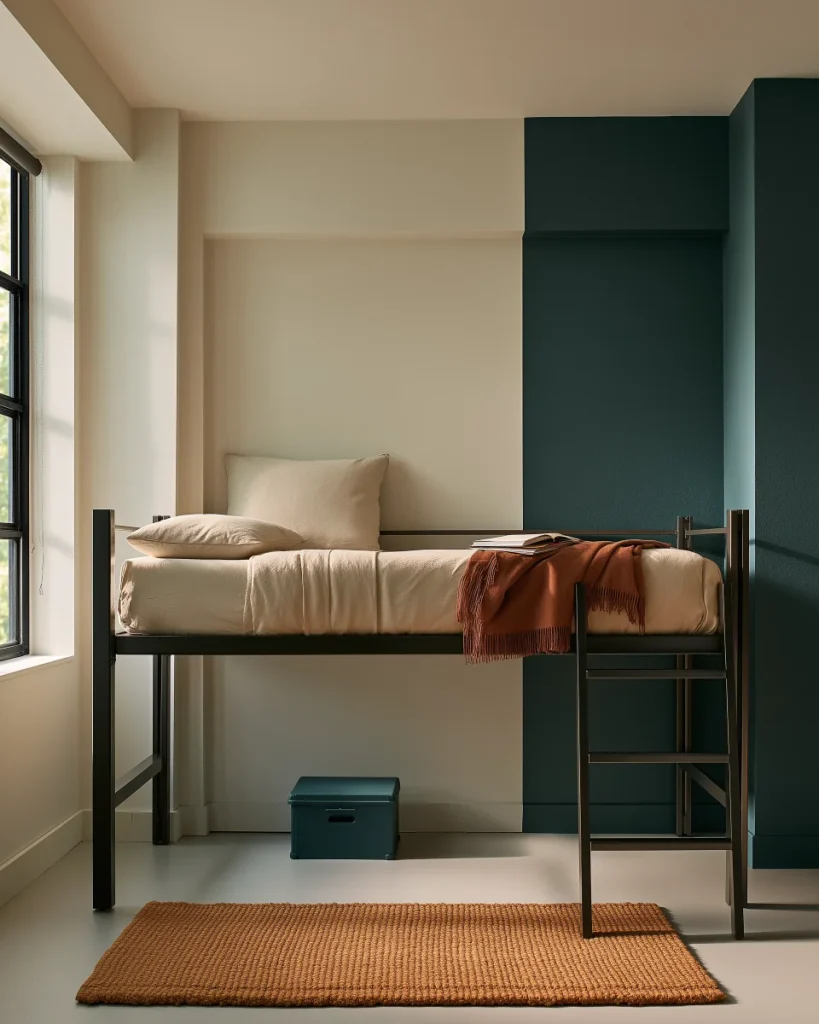
What each height is worth underneath
Multiply 21.1 square feet by the clearance in feet, and you get the volume each notch buys you. That table is the whole case for under bed storage for dorms being a height decision.
| Frame height | Volume underneath | What it takes |
|---|---|---|
| 12 in | 21.1 cu ft | Flat bins and rolling drawers only |
| 18 in | 31.7 cu ft | Standard bins, a small drawer unit |
| 24 in | 42.2 cu ft | A full drawer unit or two crates |
| 36 in | 63.3 cu ft | A dresser, or a chair and a bin |
| 52 in | 91.5 cu ft | A desk and a chair, or a wardrobe |
The jump from 24 to 52 inches is worth 49 cubic feet, which is more than double. That is where a desk moves under the bed, and a whole wall gets released.
What fits into each of those volumes is a separate question with a separate answer, and it comes after the height is set rather than before.
Loft to the highest setting your ceiling allows before buying a single container, since the container should fit the space rather than the reverse.
The height a rail becomes standard
Raising the bed buys volume and adds a fall. That is a real trade rather than a formality, and universities publish where they draw the line.
University of North Dakota Housing puts it plainly. A lofted bed poses a risk because someone asleep cannot recognise falling until it is too late.
Falls from that height can cause minor to fatal injury, and rails are encouraged at any height and especially above four feet.
Four feet is 48 inches, which sits four inches below the 52-inch ceiling limit. So the useful range and the rail range overlap almost exactly.
Fit a rail if the frame goes above 48 inches, and ask the hall office rather than buying one.
What to check before lofting
- Whether your hall allows self-lofting or requires a work request
- Whether the frame uses notches or pins, and in what increments
- Whether a stabilizer bar is required at the top setting
- Whether rails and a ladder are available from the hall office
- Whether the frame must be returned to standard height at check-out
That last one catches people at the end of the year. Several universities require the bed back at standard height before check-out, which is a job you plan for rather than discover.
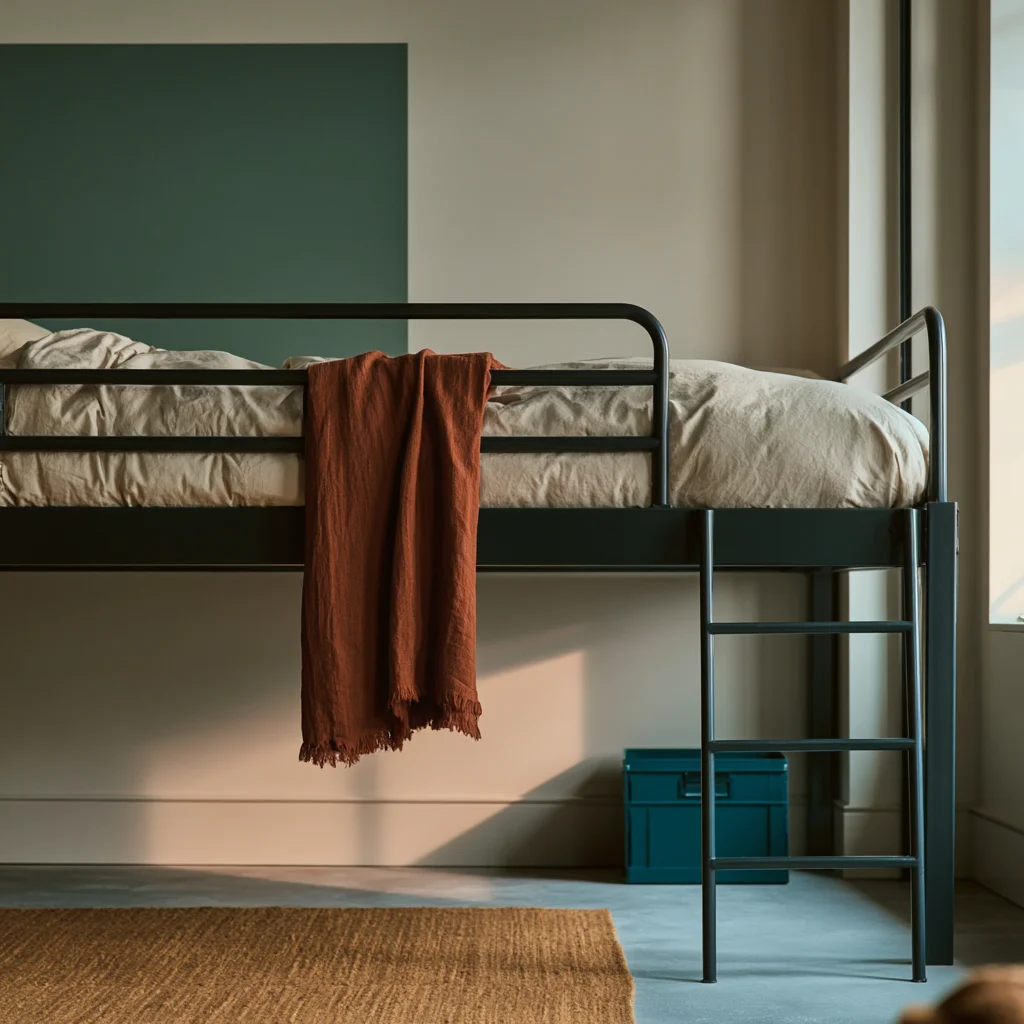
Everything under there leaves twice a year
This is the constraint no home under-bed article has to think about. A dorm empties in May and refills in August, and everything travels in a car.
A car boot holds roughly 14 cubic feet. Fill 91 cubic feet of loft space, and you are looking at six and a half loads, which nobody drives.
| Volume stored | Car boot loads at 14 cu ft | Realistic |
|---|---|---|
| 21 cu ft | 1.5 | Yes, one trip |
| 42 cu ft | 3.0 | One trip with a full car |
| 63 cu ft | 4.5 | Two trips, or a bigger vehicle |
| 91 cu ft | 6.5 | Not without storage or shipping |
Cap what goes under the bed at what fits in one car load, whatever the volume allows.
Run the move-out test at move-in. Everything you put under the bed in August comes back out in May, into the same car that brought it. If a container will not fit in that car alongside everything else, it does not go under the bed.
The gap between what fits and what should go there is the whole point. A lofted bed gives you 91 cubic feet of space and you should be using perhaps 25 of it.
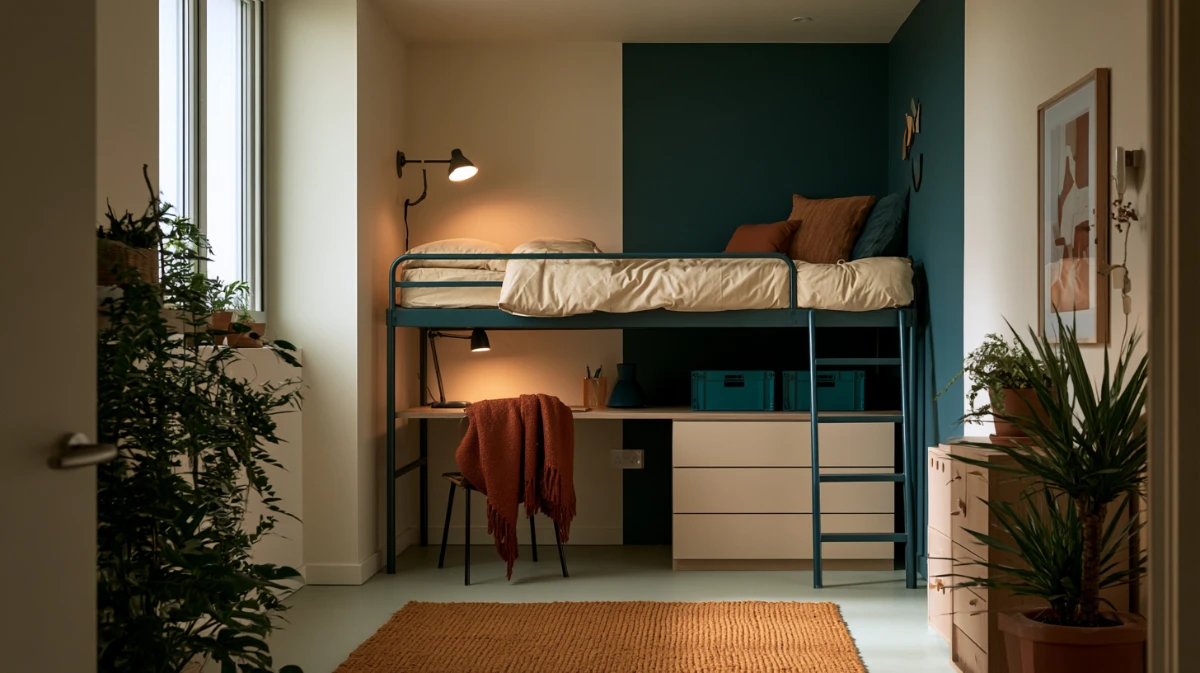
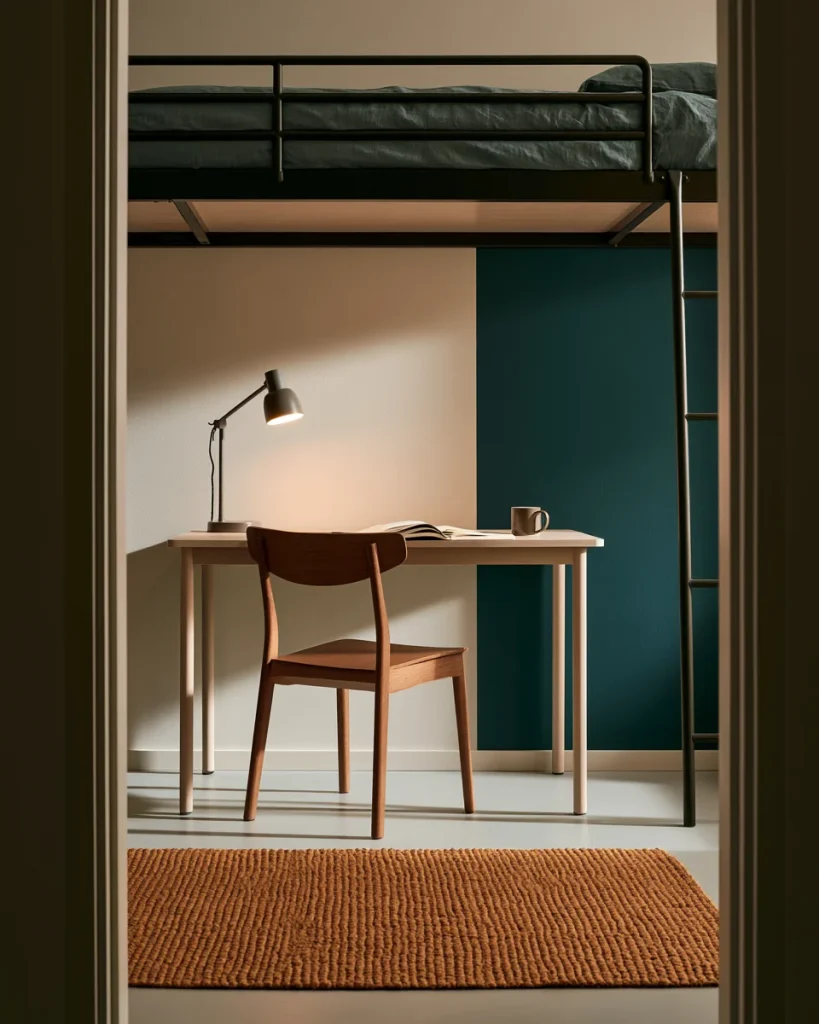
The rest of that volume is better spent on furniture that stays in the room: a desk, a chair, a dresser that belongs to the hall and never moves.
Shoes are the category that lands on the floor by default in a room this size, and they belong in a counted system rather than a pile. Nine storage methods ranked by pairs per square foot settle it.
The same is true of anything folded, since a dorm dresser is small and the volume under a lofted bed is not. The buffer arithmetic behind how much of anything you need applies to a term rather than a household.
What the volume is really for
Under bed storage for dorms is usually pitched as bins, and it is worth more as floor. The best use of 91 cubic feet is not storage at all.
Better uses than boxes, in order
- The desk, which frees an entire wall
- The dresser, which is the second largest object in the room
- A chair and a small side table, creating a seating corner
- A drying rack, which needs floor and no wall
- Boxes last, and only what travels in one car load
Moving the desk under the bed changes the whole room rather than just the storage.
How the rest of a dorm room resolves once the bed is set is the wider version of that layout.
Put the desk under the bed before you put anything in a box, since furniture releases more room than containers do.
Read more: the clearance bands and what each container type survives
Read more: sorting a wardrobe by the reason each item is still there
Two people, one floor
A shared room doubles the belongings and halves the tolerance for anything on the floor. Under bed storage for dorms gets harder with two people, not easier, because the floor is shared and the beds are not.
Both beds should go to the same height, and both should go high.
Mismatched heights waste the room. One lofted and one at 18 inches gives one person a desk underneath and the other a crawl space.
What a shared room needs settled first
- Both frames at the same height, agreed before move-in if possible
- One container style between you, so the two halves stack together
- A line on the floor, since shared floor becomes nobody's floor
- Who takes which side of the room, decided by the door and the window
- What is shared and what is not, written down rather than assumed
The two-person problem is the same one any shared bedroom has, at a smaller scale and with a shorter lease.
What genuinely needs two and what breaks in pairs applies to the furniture already chosen for you.
The rules the hall office has already written
A dorm is not your property, and the storage decisions are constrained before you arrive. Most of the constraints are published in the housing handbook and go unread until something gets flagged.
The constraints that catch people out
- Bed risers, which many halls ban outright, and others cap at six inches
- Cinder blocks, banned almost everywhere as a lofting method
- Self-built lofts, banned at most universities on safety grounds
- Adhesive hooks, allowed but with a named brand and a removal expectation
- Anything blocking a heater, a vent, or the path to the door
Read the housing handbook before buying anything, since the rules are published and the fines are not negotiable.
Photograph the room on the day you arrive, so the check-out comparison is a record rather than an argument.
A desk under a lofted bed has the same constraints as any converted work nook.
The six services a converted space lacks for work apply to a dorm desk in a dark corner.
Nothing fixed to a wall survives a dorm inspection, which pushes the whole solution toward freestanding and under-bed. The options when a room offers no fitted storage at all are the same constraint in a rented flat.
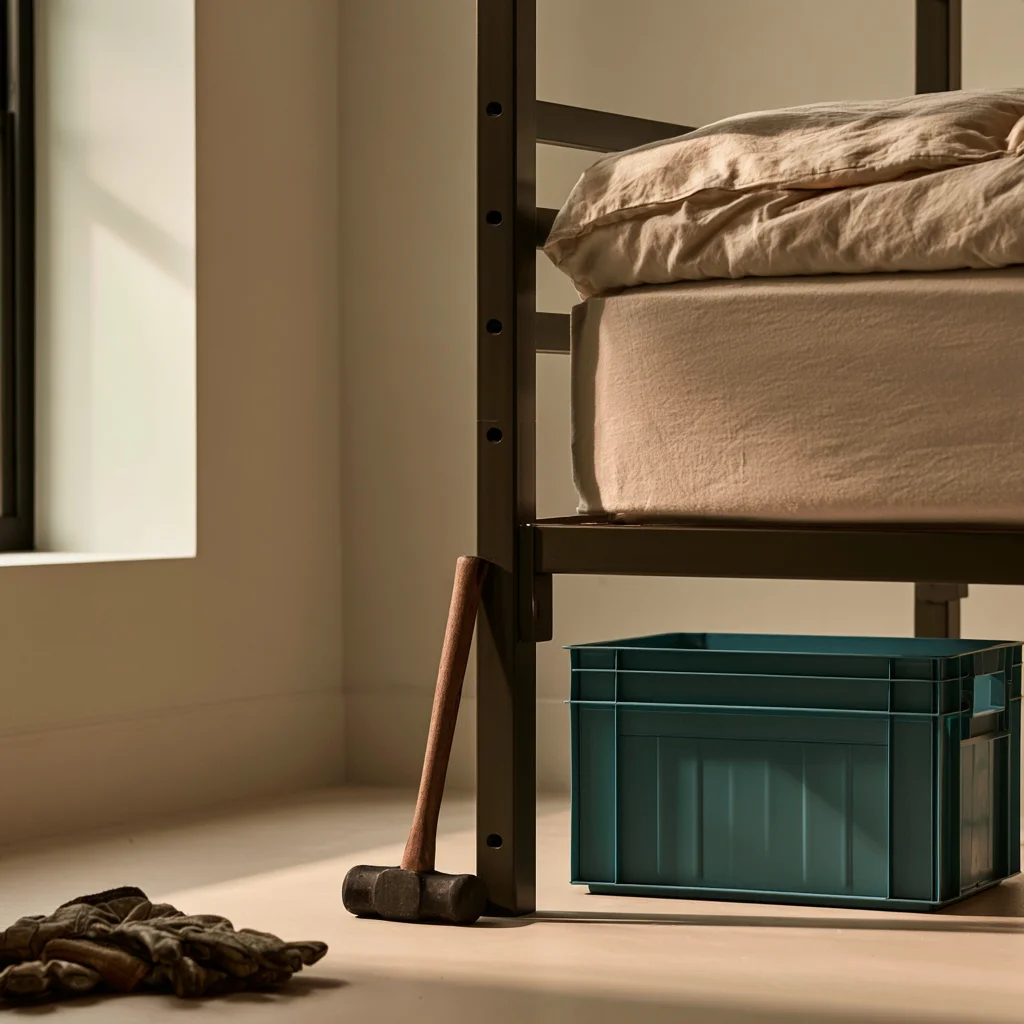
What should never go under a dorm bed?
Two categories cause most of the problems, and both look reasonable at move-in.
Keep these out from underneath
- Anything you need daily, since retrieving it means crouching every time
- Food of any kind, which is a pest problem in a shared building
- Anything damp, including trainers worn that day
- Electricals with a plug, which should not be in a confined, unventilated space
- The suitcase you will need in December, which should be reachable
The suitcase is the one people get wrong. It goes under the bed at move-in, then gets buried, and comes out in a hurry at the worst possible moment.
Keep the suitcase at the front of the under-bed space and pack everything else behind it.
Laundry is the other thing that ends up down there and should not. What a laundry routine needs in a shared building is to cover where it belongs instead.
Read more: the storage a small bedroom is not currently using
Setting it up in order
The height decision comes first because it changes every measurement after it, and the containers come last because they should fit the space you created.
The sequence
- Measure the ceiling and subtract the mattress and 36 inches
- Check the housing handbook for lofting rules and rail availability
- Set the frame to the highest allowed height under that limit
- Move the desk and the dresser underneath before anything else
- Fit a rail if the frame went above 48 inches
- Buy containers last, sized to what is left and to one car load
Whatever ends up on the walls rather than under the bed has its own set of constraints in a building you do not own. What a fixing will hold, and what a lease allows decides the rest.
Under bed storage for dorms is a height decision followed by a volume decision, and the second one is usually smaller than the first allows.
Loft to 52 inches, put the desk under there, and fill perhaps a quarter of the rest. The other three-quarters is worth more as room than as boxes.