

Small bedroom desk ideas fail because a desk and a bed want the same things and cannot both have them. Both want the good wall, and both want the window.
One of them also wants the room dark at 11 pm. Settle those five conflicts and the placement decides itself.
This is not a list of desks. It is the five arguments the room is going to have with you, in the order they arrive.
Work through them with a tape measure, and you will know what to buy by the end. Skip them, and you will buy twice.
Conflict One: The Bed Already Took the Best Wall
Before anything else, work out how much wall you actually have left. It is far less than the room suggests.
A bedroom desk needs an uninterrupted run and clearance in front of it, and most rooms have fewer of those than they appear to.
The wall audit
A 10 by 10 bedroom has 480 linear inches of wall. Then it starts disappearing.
Nothing on that list is optional. The bed, the door, and the window are fixed before you start thinking about a desk.
Sketch the four walls as four straight lines and mark the obstructions on each. It takes five minutes, and it ends the guessing.
The longest clear run is almost never the wall people expect. It is usually the one currently holding a chest of drawers.
- The bed wall takes about 96 inches with a queen and two nightstands
- The door and its swing take about 60 inches
- A window takes about 36 inches, and the wall under it is only good for something low
- A closet door takes about 30 inches
That leaves roughly 258 inches, which sounds generous until you remember it is split into four disconnected runs.
A 48-inch desk needs one uninterrupted 48-inch run with clearance in front. Most small bedrooms have exactly one, and it is usually the wall you were saving for something else.
Measure the runs, not the room
Walk the room with a tape and write down the length of each clear wall run between obstructions.
Then add 30 inches of floor in front of each one for the chair to pull out. A run with a wardrobe door opening into it is not a run.
Radiators count against you too. A desk over a radiator is warm in winter, and the heat goes straight up into your lap.
Sockets are the last check. A run with no socket within about 6 feet means a cable across a walkway, which is a different problem.
Write the four run lengths down. Any desk you consider has to fit inside one of those four numbers.
If no run works, the desk has to go somewhere unconventional, and a closet conversion is usually the next honest option.
Read more: what a wall can carry if the desk needs shelving above it
Conflict Two: The Desk Wants the Window, the Bed Wants the Dark
A desk works best beside a window, and a bedroom sleeps best without one. In a shared room, both are true at once.
How to settle it
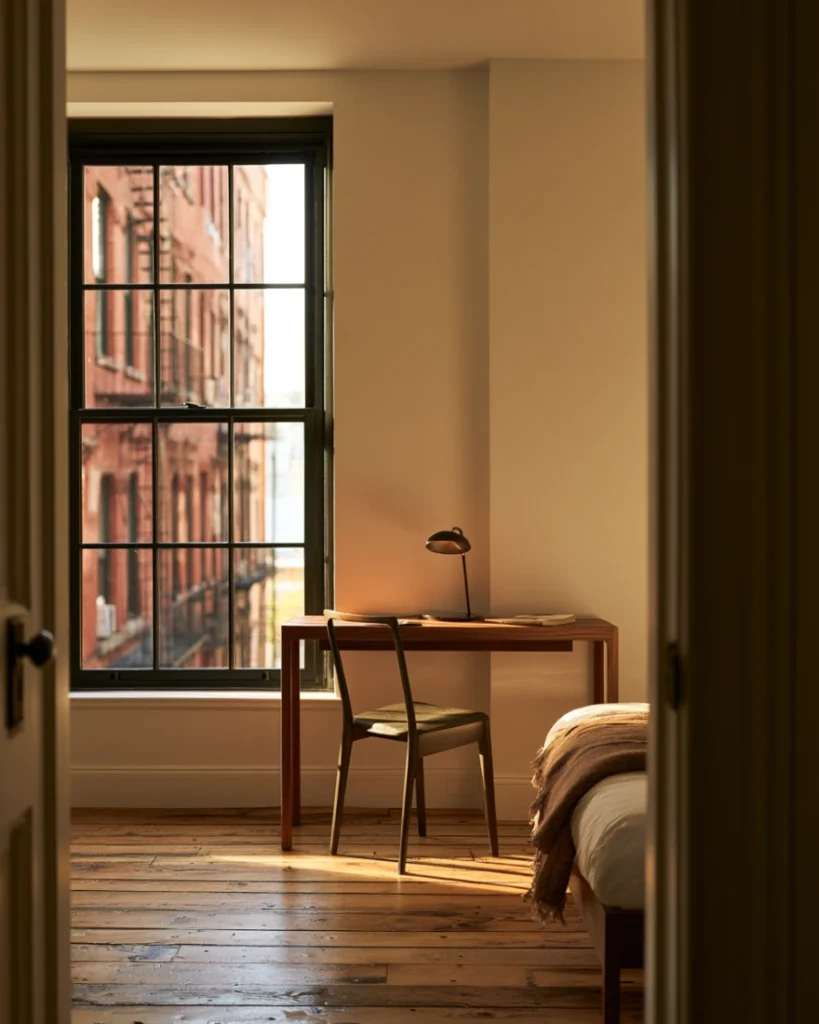
The desk gets the window, positioned so the glass is to one side rather than behind the screen or behind you.
The bed gets the darkest corner, furthest from the glass, and takes the blackout treatment.
That order is not negotiable in a shared room. A bed by the window in a room that also has a desk gets the worst of both.
That treatment matters more when a desk shares the room, because the CDC advises blocking or removing sources of white or blue light in a bedroom, including screens and lit dials.
A monitor on standby, a router light, and a charging laptop are all exactly that, sitting a few feet from your pillow.
Most people notice the curtain and never notice the four small blue points of light on the other side of the room.
Stand in the room with the lights off for a minute before bed. Whatever you can still see is what needs covering.
The cheapest fixes
- A switched extension lead, so everything at the desk goes off with one press
- Electrical tape over standby LEDs, which costs nothing
- A blackout blind behind a light curtain rather than one heavy panel doing both jobs
- The desk lamp on a warm bulb, not a cool white one
Conflict Three: The Desk Wants to Stay Set Up, the Room Wants to Look Like a Bedroom
A bedroom desk left mid-project is efficient on Monday and oppressive on Saturday.
The bedroom is the one room where the work has to become invisible, because you are in it when you are not working.
This is the conflict that decides whether you keep liking the room, and it has nothing to do with how the desk looks.
A tidy permanent desk still says work when you walk in on a Sunday morning. That is the cost, and it is worth naming before you accept it.
Pick one of three postures
There are only three honest answers, and choosing deliberately beats drifting into the worst one.
| Posture | What it means | Works when | Costs you |
|---|---|---|---|
| Always up | Desk stays set up permanently | You work daily, and the room is big enough | The room reads as an office |
| Closes down | Everything goes into one container each evening | You work most days | Two minutes at the end of each day |
| Folds away | A drop leaf or wall-mounted desk that disappears | You work a few hours a week | Setup time before every session |
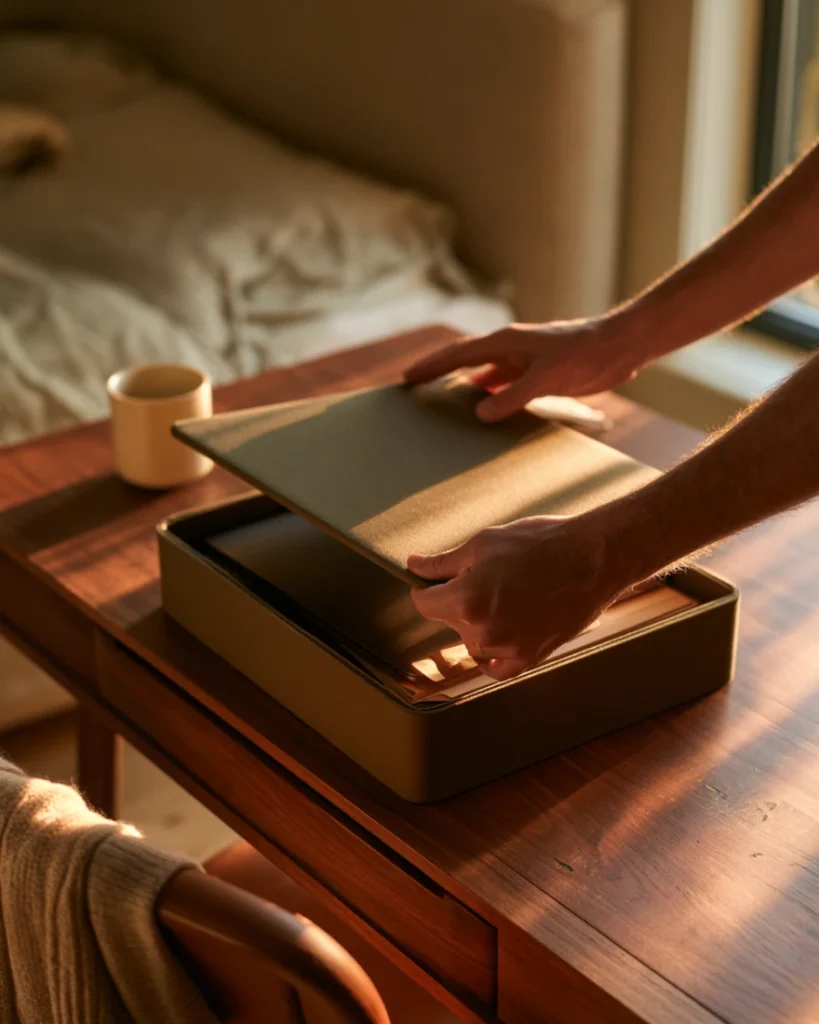
The middle option suits most people and almost nobody chooses it, because it needs a container decided in advance rather than a tidy-up.
What goes in the container:
- The laptop and its charger
- Any paper currently in play
- Pens and nothing else stationery
- Headphones and the cable that comes with them
One box, one lid, one home, and the same five-minute close that works in a dedicated office, since the routine matters more than the storage.
What not to do
Do not use the bed as the overflow surface for work, even temporarily.
The moment paperwork lives on the duvet during the day, the bed has become part of the desk and the room has lost the argument.
Also avoid a desk that faces directly into the bed. You will spend the working day looking at somewhere you would rather be.
Read more: storage that goes under the bed instead of beside the desk
Conflict Four: You Want a Big Desk, the Room Has a Walkway
Desk depth is the number people get wrong, and it is the one that costs floor.
What depth you actually need
A laptop and a notebook need about 20 inches of depth. A monitor at a comfortable viewing distance needs about 30.
Between those two, 24 inches is the usual compromise, and it works for most people with a monitor arm.
An arm buys back roughly 6 inches of depth by moving the screen off its stand and over the back edge.
It also lets you push the screen away when the desk is closed, which the fold-away posture needs.
Width is cheaper than depth. A 48 by 20 desk takes less floor than a 36 by 30 and gives you more usable surface.
The chair is the hidden cost
A desk takes its own depth plus about 30 inches for the chair pulled out, plus room to stand up.
So a 20-inch desk really occupies about 50 inches of floor depth, which in a 10-foot room is more than a third of the way across.
Measure that 50 inches on the floor with tape before you order. It is the number that surprises people.
A chair that tucks fully under the desk when not in use recovers about half of it, which is worth more than any storage feature.
That is why the desk and the bed cannot share a wall in most small rooms, and why the walkway around the bed has to be measured first.
Where the depth can come back
- A wall-mounted desk with no legs, which frees the floor underneath entirely
- A drop leaf that folds to about 6 inches against the wall
- A narrow console at 16 inches deep, for laptop-only work
- A desk that doubles as the nightstand at the head of the bed
Whatever you choose, the surface should hold almost nothing permanently, since a working surface and a storage surface are different jobs.
Conflict Five: Working Late, Sleeping Well
The last conflict is the one no furniture solves, and it is the reason a bedroom desk has a reputation.
The boundary that actually works
A time boundary beats a physical one in a room this size. Decide when the desk closes and keep it, rather than trying to hide it better.
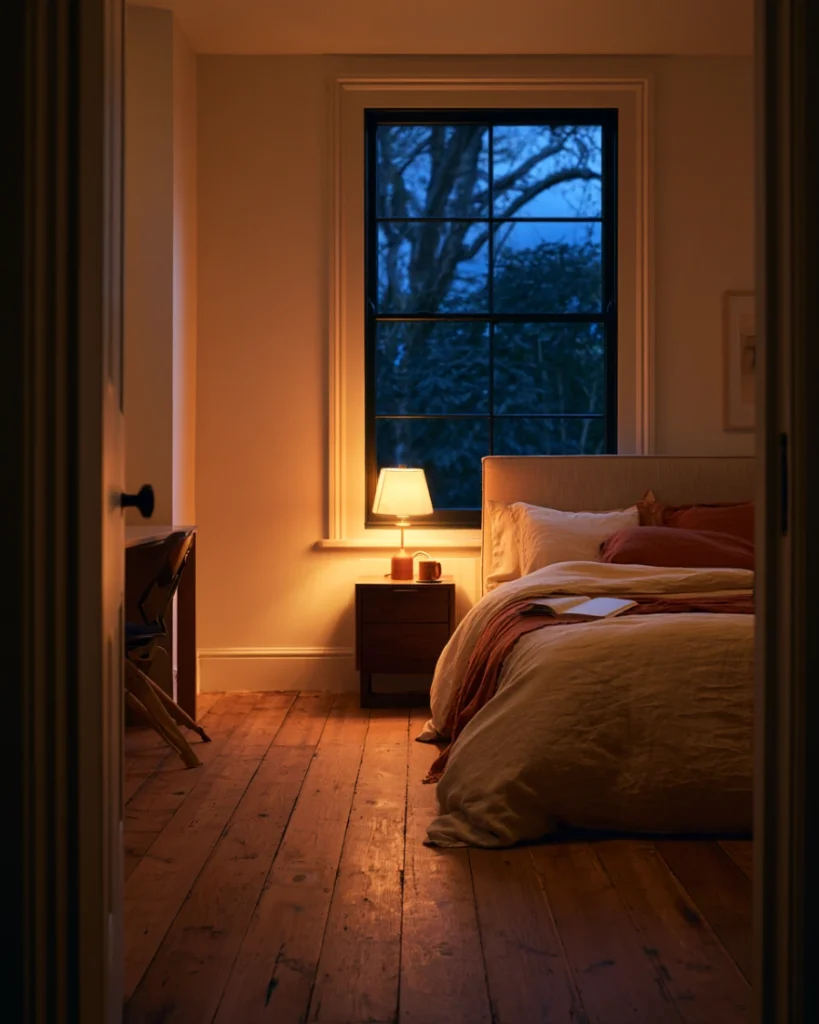
Turning the desk lamp off and the bedside lamp on is a smaller ritual than it sounds, and it does most of the work.
The change in light temperature is the signal, so use a warm bulb at the bedside and a cooler one at the desk.
Two lamps and a habit outperform any amount of furniture in settling this conflict.
If you can face the desk away from the bed, do. If you cannot, a folding screen or a curtain on a track costs very little.
Signs the boundary has failed:
- You check work email from bed
- The desk chair has clothes on it
- You have worked past the closing time three nights running
- You lie awake thinking about the thing on the desk
When the room is genuinely too small
Sometimes the honest answer is that the desk does not belong in the bedroom at all.
A dining table, a hallway console, or a corner of the living room may serve better than a desk you resent looking at from bed.
That is a real answer rather than a failure. A bedroom under about 90 square feet with a queen bed rarely holds a desk well.
In a studio, the decision is forced, and the layout carries it instead, so the room shape decides where the desk can go.
And in a spare room, the constraints change completely, because a guest bedroom has to convert rather than coexist.
Read more: clearing the room before you add anything to it
Settle Them in This Order
The conflicts have a sequence, and taking them out of order is why so many small bedroom desk setups end up in the wrong place.
The order that works
- Measure the clear wall runs, not the room
- Give the window to the desk and the dark corner to the bed
- Choose one of the three postures before buying anything
- Size the desk by depth, remembering the chair needs 30 inches behind it
- Set the time the desk closes, and keep it for a fortnight before judging
Only the fourth step involves buying anything, which is the opposite of how most people approach it.
Give the arrangement a fortnight before changing it. The first week in any new layout feels wrong regardless of whether it is.
If it still feels wrong after two weeks, go back to conflict one. The run you chose was probably the wrong one.
The ergonomics come after placement is settled, and five measurements decide whether the setup hurts.
If the room cannot hold both without feeling crowded, that is a volume problem rather than a layout one, and a diagnosis beats rearranging.