

Under bed storage ideas are really container decisions. Six container types cover everything that goes under a bed, and each one fails in a specific way. Match the container to what you are storing and to your clearance, and the rest looks after itself.
Measure floor to the underside of the frame first. Everything below assumes you have that number written down.
Most under bed storage advice lists products. This works backwards from what you are storing and how often you will reach for it.
The Six Containers, Compared
Every under-bed product on the market is a version of one of these six. The differences that matter are height, whether it seals, and whether it rolls.
Price varies more by brand than by type, so it is not a useful way to choose between them.
Read the table by your own clearance figure. If you have 6 inches, three of the six options are already ruled out.
That is the value of measuring first. It halves the shopping before you open a single tab.
| Container | Typical height | Seals against dust | Best for |
|---|---|---|---|
| Flat fabric zip bag | 5 to 7 in | Mostly | Seasonal clothes, spare bedding |
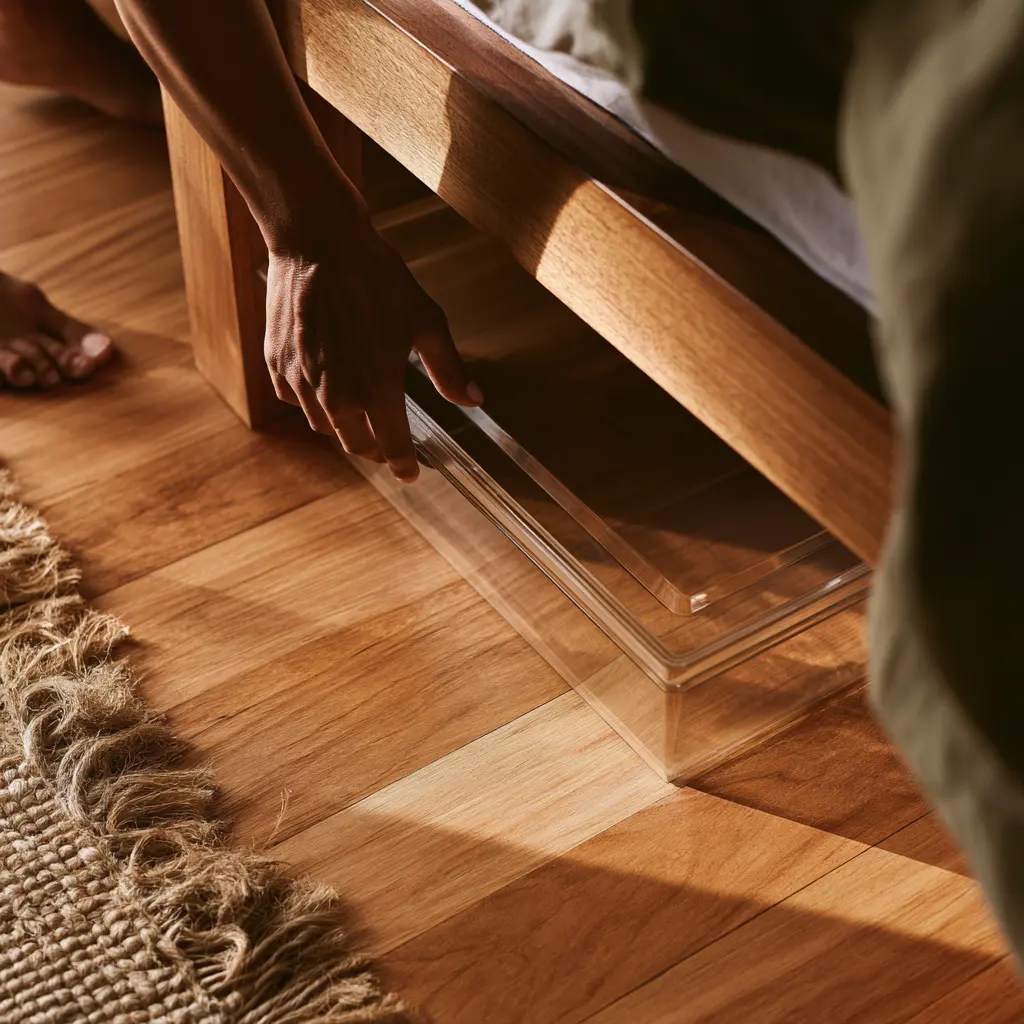
| Clear rigid bin with lid | 6 to 12 in | Yes | Anything you need to identify at a glance |
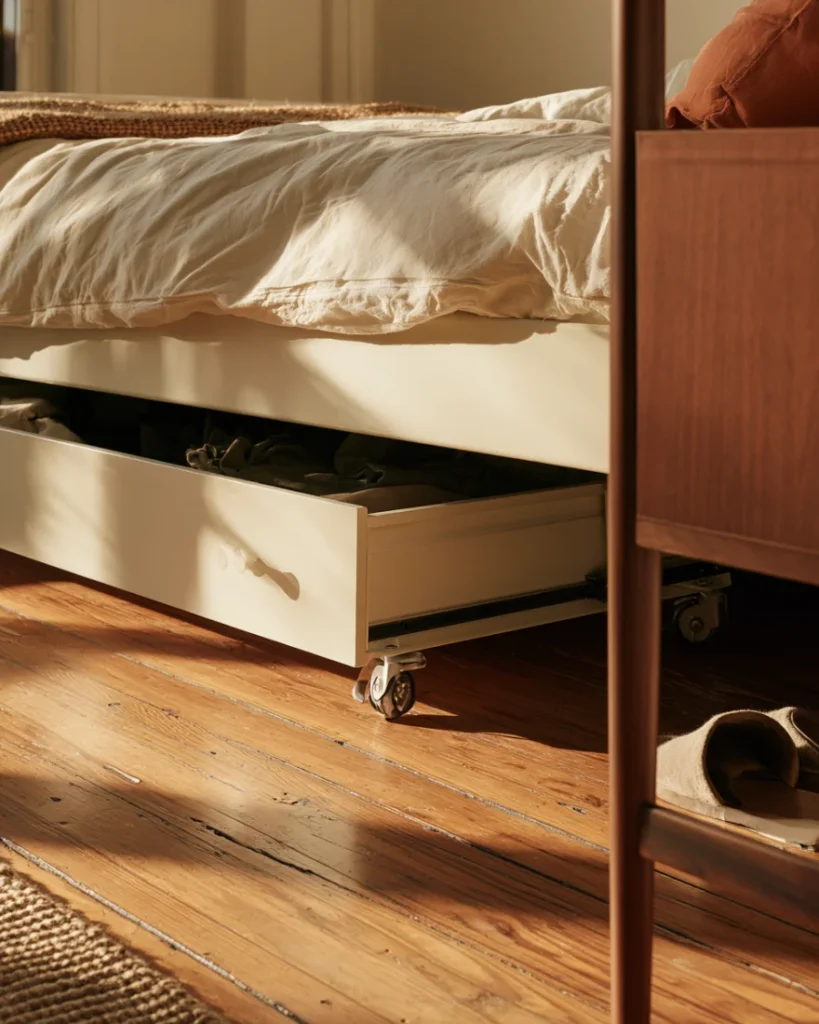
| Rolling drawer or cart | 5 to 9 in | No | Things used weekly |
| Vacuum bag | 2 to 4 in packed | Yes | Duvets, coats, bulk knitwear |
| Drop-front shoe box | 7 to 9 in | Yes | Shoes kept in pairs |
| Open tray or crate | 4 to 8 in | No | Books, shoes worn daily |
Buy one inch shorter than your clearance, never equal to it. Lids need room to clear the rail, and carpet lifts everything higher than the tape suggests.
How much each one actually holds
A standard under-bed footprint is roughly 28 by 16 inches. Volume then depends entirely on your clearance.
- At 4 inches clearance, a 3-inch bin holds about 0.8 cubic feet
- At 6 inches, a 5-inch bin holds about 1.3 cubic feet
- At 9 inches, an 8-inch bin holds about 2.1 cubic feet
- At 12 inches, an 11-inch bin holds about 2.9 cubic feet
The jump from 6 to 9 inches of clearance is worth roughly sixty percent more volume per bin, which is why risers pay for themselves before containers do.
Work out your own figure before shopping. It tells you whether you are buying four bins or seven.
Under bed storage is unusual in that the space is fixed and free. The only variable you control is how efficiently it is filled.
The clearance bands themselves, and which frames take risers, sit in the bed-level section of the small room guide.
Flat Fabric Zip Bags
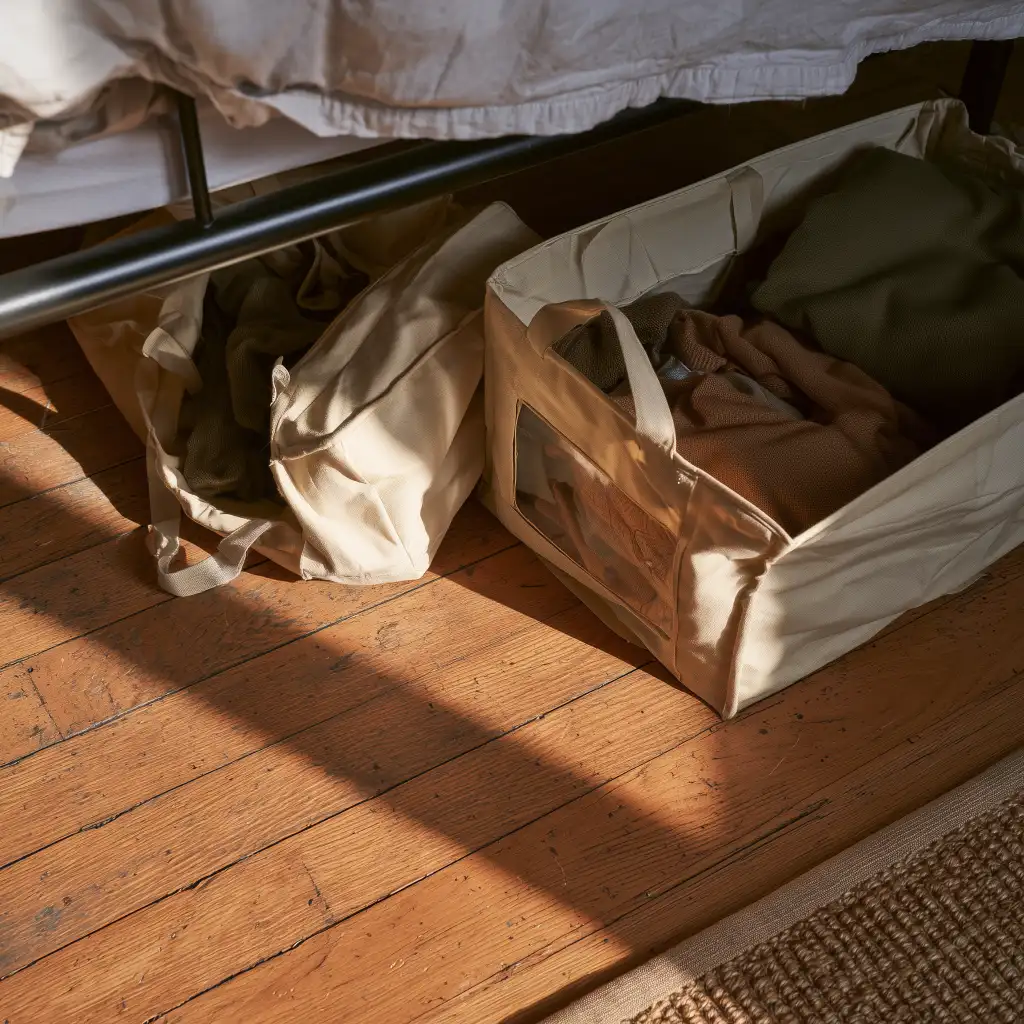
The default for anyone with low clearance. Soft sides mean they squeeze into gaps a rigid bin cannot.
They are also the cheapest of the six by some distance, which is why most people start here.
What they are good at
Seasonal clothing, spare sheets, and anything soft that does not mind being compressed slightly.
They are the most forgiving option for an awkward frame, because they deform around a centre rail that a rigid bin would hit.
The handles matter more than the fabric. A bag without a proper handle has to be dragged, and dragging is what tears the base.
How they fail
They slump. A half-full fabric bag loses its shape and becomes impossible to slide back in cleanly.
They also hide their contents completely, so a bag without a window becomes a mystery within two months.
Fill them to about eighty percent, and they hold shape. Fill them to 30%, and they collapse.
A bag with a clear window on the front solves the identification problem.
Seasonal clothing is the natural tenant, and sorting by last-worn date decides what qualifies.
Read more: what else can come off the bedroom floor at the same time
Clear Rigid Bins
The most useful container per pound spent, and the one people buy the wrong size of most often.
What they are good at
Anything you need to identify without opening. That covers most of what goes under a bed.
For most rooms, this is the default under bed storage container, and the other five are exceptions to it.
They also stack outside the bed when you are sorting, which fabric bags do not.
Clear beats opaque here for one reason. You will not label them, and you know you will not.
How they fail
Height, almost always. A bin bought to the advertised size rather than the measured clearance will not go in, or will not come out with the lid on.
Cheap ones also crack at the lip after a year of being dragged. Look for a moulded edge rather than a thin flange.
Weight is the other limit. A rigid bin full of books is heavier than you can comfortably slide on carpet.
Split heavy contents across two bins rather than filling one. The total volume is the same, and both actually move.
What belongs in a rigid bin, in rough order of how well it works:
- Linens and spare bedding
- Out-of-season clothing, folded
- Shoes kept in pairs
- Craft or hobby supplies in their own smaller boxes
- Anything with a shape that would crush in fabric
- Measure at the lowest point of the frame, usually the centre rail rather than a corner leg
- Subtract an inch for the lid and the carpet
- Check the lid clips, since unclipped lids lift when the bin is pulled
- Buy two matching rather than one large, because two slide out independently
Rolling Drawers and Carts
The right answer for anything you touch weekly, and the wrong answer for almost everything else.
What they are good at
Frequency. A rolling drawer is the only container here you will happily open twice a week for a year.
Everything else in this list is opened seasonally. This one is furniture you use.
Castors also solve the carpet problem. Everything else has to be dragged across the pile, and the pile is what makes under bed storage feel like effort.
If you have carpet and more than 7 inches of clearance, this is the container to buy first.
How they fail
They are open, so everything in them collects dust. That is fine for shoes and bad for textiles.
They also lose an inch or two of internal height to the castors, so a 9-inch clearance gives you about 6 inches of usable drawer.
For shoes specifically, this is usually still the best option under a bed, though most footwear is better stored somewhere other than the bedroom floor.
Read more: spare bedding usually belongs somewhere other than under a bed
Vacuum Bags
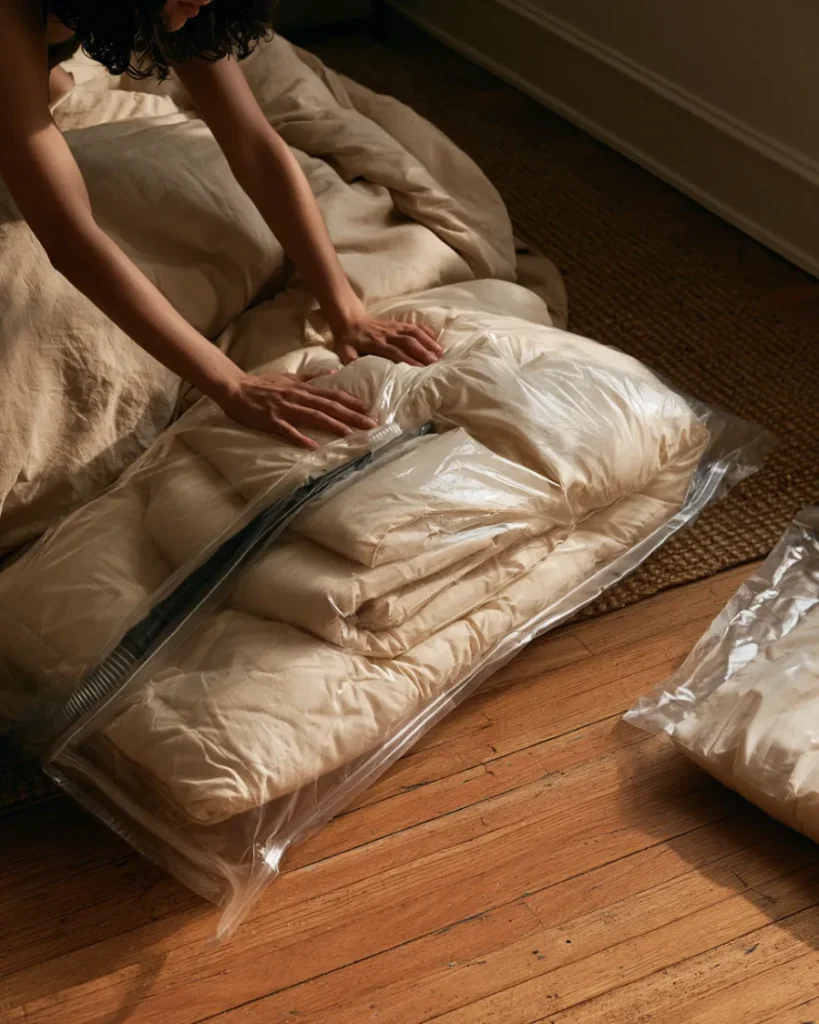
The only container that changes the volume of what you are storing rather than just containing it.
That makes them the one under bed storage product worth buying even if you already have containers.
What they are good at
Duvets, winter coats, and bulk knitwear. Anything with air in it that you will not want for at least a season.
A duvet at 4 inches packed instead of 14 is the single biggest volume saving available under a bed.
They also make low clearance workable. A 4-inch gap takes a packed vacuum bag and almost nothing else.
How they fail
Creasing and seal failure. Anything that needs to come out ready to wear will need ironing.
Check them after a month. A bag that has reinflated has a failed seal, and the contents have been under pressure the whole time for nothing.
Never use them for anything you want inside three months. Reopening and resealing costs more time than the space is worth.
They also need a vacuum cleaner with a hose to seal, which is worth checking before buying a pack of ten.
Down and feather items recover their loft after a day or two out of the bag. Synthetic fill sometimes does not.
Never vacuum pack:
- Anything leather or with leather trim
- Structured garments such as tailored jackets
- Anything you might want at short notice
- Items already slightly damp, which will stay damp
Drop-Front Shoe Boxes and Open Trays
Two containers with the same job and opposite trade-offs.
Drop-front boxes
Sealed, stackable, and you can reach the bottom pair without unstacking. That last point is what makes them worth the money.
They are also the only sealed option that lets you see the contents while keeping dust out entirely.
They are also tall for what they hold, so they need 7 inches of clearance minimum, and they waste space if you have 12.
Buy them in one size and one brand. Mixed boxes do not stack square, and the whole advantage disappears.
Open trays and crates
Cheapest option here, and correct for anything used daily and not harmed by dust.
Books, shoes in rotation, a yoga mat. Nothing textile, because an open tray under a bed is a dust collector by design.
They also work as a staging area during a clear-out, which is worth having, whatever else you buy.
A crate on castors is a common DIY version, and it works, provided the wheels are rated for the weight of what goes in it.
The Three Things That Go Wrong Under a Bed
Container choice is really risk management. These are the three risks, and they decide whether you need a seal.
Almost every complaint about under bed storage traces back to one of these three rather than to the container itself.
Dust
Under a bed is the dustiest horizontal surface in most bedrooms, because nothing disturbs it and skin cells and fabric fibres settle there constantly.
Air movement from the door and from getting in and out of bed pushes that dust toward the walls rather than clearing it.
Anything textile stored open will need washing before use. That is the whole argument for sealed containers.
Pull everything out and vacuum twice a year. It takes ten minutes, and it is the only maintenance under bed storage needs.
Do it when the seasons change, since you will be swapping the contents anyway.
A flat vacuum attachment reaches most of the way under a bed without moving the frame, which makes the job a five-minute one.
Damp
Air moves slowly under a bed, so if the room runs humid, that is where condensation and mildew show up first.
The EPA advises keeping indoor humidity below 60 percent, and ideally between 30 and 50 percent, which is worth knowing before you seal textiles into a bag for six months.
Store nothing under a bed on a solid floor against an exterior wall in a damp flat without checking that number first.
A cheap humidity meter costs very little and settles the question in a week.
Signs the space runs damp:
- A musty smell when you pull a container out
- Condensation on the window in the same room
- A cold exterior wall behind the bed
- Anything stored there previously coming out with spots
Crushing and access
Soft containers under a low frame get compressed every time someone sits on the bed. Rigid bins do not.
Slatted bases flex more than solid ones, so check the gap while someone is actually sitting on the mattress rather than when it is empty.
Access is the other half. Keep one side clear enough to pull from, and never fill the space right to the far wall.
Whatever goes at the back is effectively in long-term storage, so put the seasonal things there and the current things at the front.
Two shallow containers front to back beat one deep one, because the front one comes out without moving anything else.
If the bed is against a wall, everything has to come out from one side, which halves the usable depth in practice.
Read more: keeping the room clear once the storage is sorted
What Not to Store Under a Bed
Four categories that people put there and regret.
- Anything you need in a hurry, because retrieval always takes longer than you think
- Paperwork and photographs, which suffer from both dust and humidity
- Electronics, which collect dust in vents and dislike temperature swings
- Anything you have not decided about, since under the bed is where undecided things go to be forgotten
That last category is the important one. Under-bed space fills with deferred decisions faster than anything else in a bedroom, and a dated box stored outside the room handles them better.
Buying more containers before sorting is the same mistake in a different form, since storage bought ahead of the sort just preserves the volume.
Choosing in Ninety Seconds
Work down these four questions, and the container picks itself.
The four questions
- How many inches of clearance? Under 6 means fabric bags or vacuum bags only
- How often will you open it? Weekly means rolling, seasonally means sealed
- Is it textile? Textile means sealed, always
- Do you need to see inside without opening? That means clear rigid, not fabric
Most people end up with two types rather than one: sealed bins at the back for seasonal items, and one rolling drawer at the front for whatever is in use.
That combination covers dust, access, and frequency at once, which no single container manages.
Total cost for a full bed is usually under the price of one piece of storage furniture, and it uses space you are already paying rent on.
If two people share the bed, the access side becomes contested and the split changes, since shared rooms fail on findability rather than capacity.
That split is the practical answer for almost every bed, and it costs less than a matched set of anything.
Buy two containers, use them for a month, then buy more only if they filled properly. Buying a full set first is how the wrong height gets bought six times over.
Dorm beds are the exception, because the frame heights are institutional and the rules differ, so twin XL dimensions and bed height bands change the answer.
And if the under-bed space is already full and the room still overflows, the constraint is the wardrobe rather than the floor, since a packed rail hides more than a full bin does.