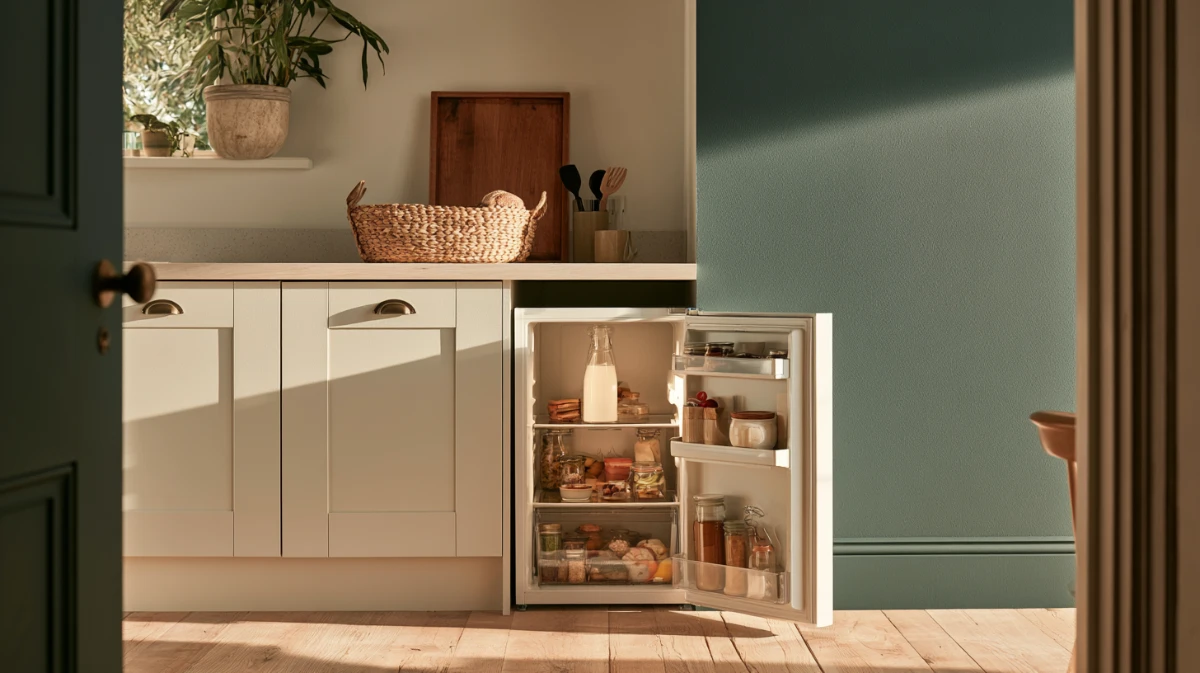


A small fridge is not one cold box. It is five climates stacked on top of each other, and food belongs in the climate it needs rather than beside the things it resembles.
Cold air sinks, so the bottom of the cabinet runs coldest. The door opens several times a day into a warm kitchen, so it runs warmest.
That matters because the safe ceiling is 40 degrees Fahrenheit. A door bin sitting above it is inside the range where bacteria multiply, whatever the dial on the front says.
Most fridges are loaded by category. Dairy together, drinks together, leftovers wherever they fit. Loading by temperature costs nothing and changes how long things last.
Five climates, not five shelves
The zones below are found in almost every upright fridge because they come from physics rather than from the model.
| Zone | Relative temperature | What belongs there |
|---|---|---|
| Door bins | Warmest and swinging | Condiments, jams, anything acidic or preserved |
| Top shelf | Warmer and steady | Leftovers, cooked food, ready-to-eat items |
| Middle shelf | Middle | Dairy, cheese, yoghurt |
| Bottom shelf | Coldest | Raw meat, poultry and fish, in a sealed container |
| Crisper drawers | Coldest and humidity-controlled | Fruit and vegetables, split by drawer |
Load the fridge by temperature rather than by category, starting with the bottom shelf.
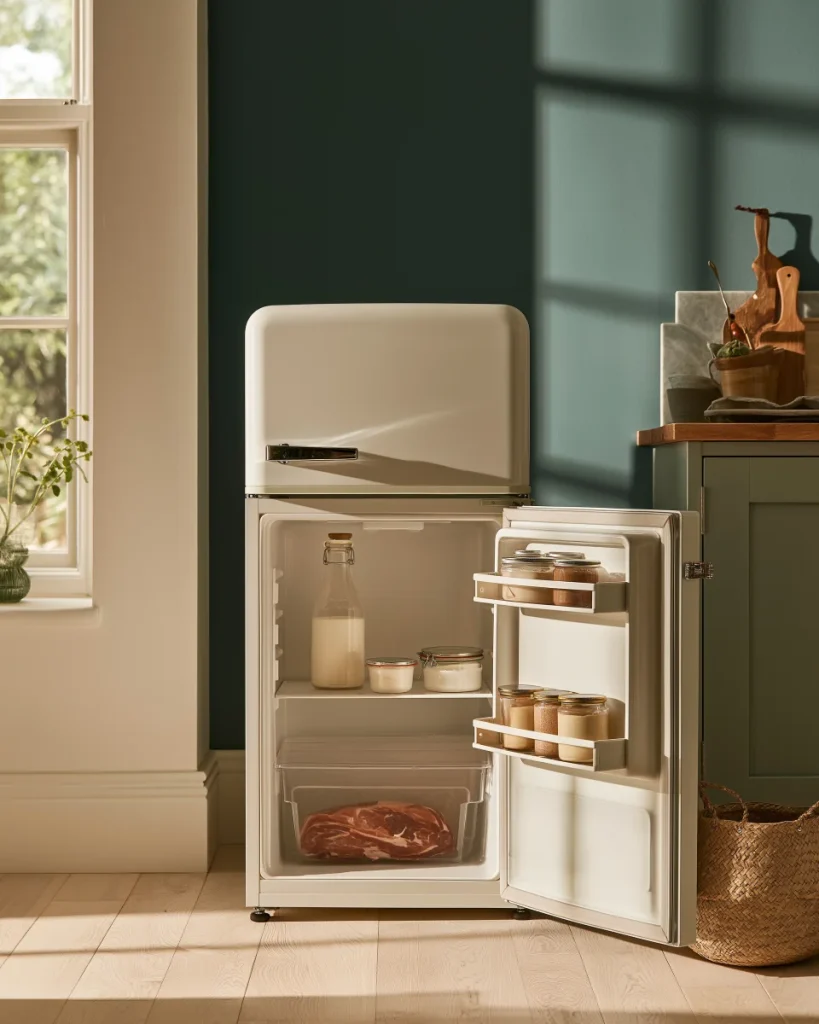
The bottom shelf earns raw meat twice over. It is the coldest zone, and anything that leaks there cannot drip onto food below it.
That second reason survives even in a fridge running perfectly. Contamination travels downward with gravity rather than with temperature, so the rule holds regardless of the reading.
Keep raw meat in a sealed container on the bottom shelf, never on a shelf above ready-to-eat food.
The door holds the wrong things
The door is the warmest part of the cabinet, and it swings through room air several times a day. It is also where households put milk and eggs.
Milk and eggs are two of the most temperature-sensitive items in the fridge, and the door is the least stable place in it. That pairing is the single most common error in a small fridge.
Move milk and eggs off the door and onto a middle shelf, and give the door to condiments. For the eggs, a shelf holder such as the YouCopia FridgeView Rolling Egg Holder takes the place of the carton on that middle shelf.
What the door is genuinely good for
- Ketchup, mustard, and anything with vinegar or salt doing preservative work
- Jams and preserves, which carry enough sugar to be stable
- Butter in a covered dish, since it is eaten fast and spreads better slightly warm
- Bottled drinks that get finished in a day or two
- Nothing raw, nothing dairy, nothing you would not eat past its date
A small fridge has fewer door bins than a full-size one, and they fill first because they are the easiest to reach. That is the same reach bias that fills the counter without anyone noticing.
Butter is the one item that belongs there on purpose. It is eaten quickly, it spreads better a few degrees warmer, and it has nothing in it that grows fast.
Read more: why the wall above the counter suits some things and destroys others
The crispers and the slider nobody moves
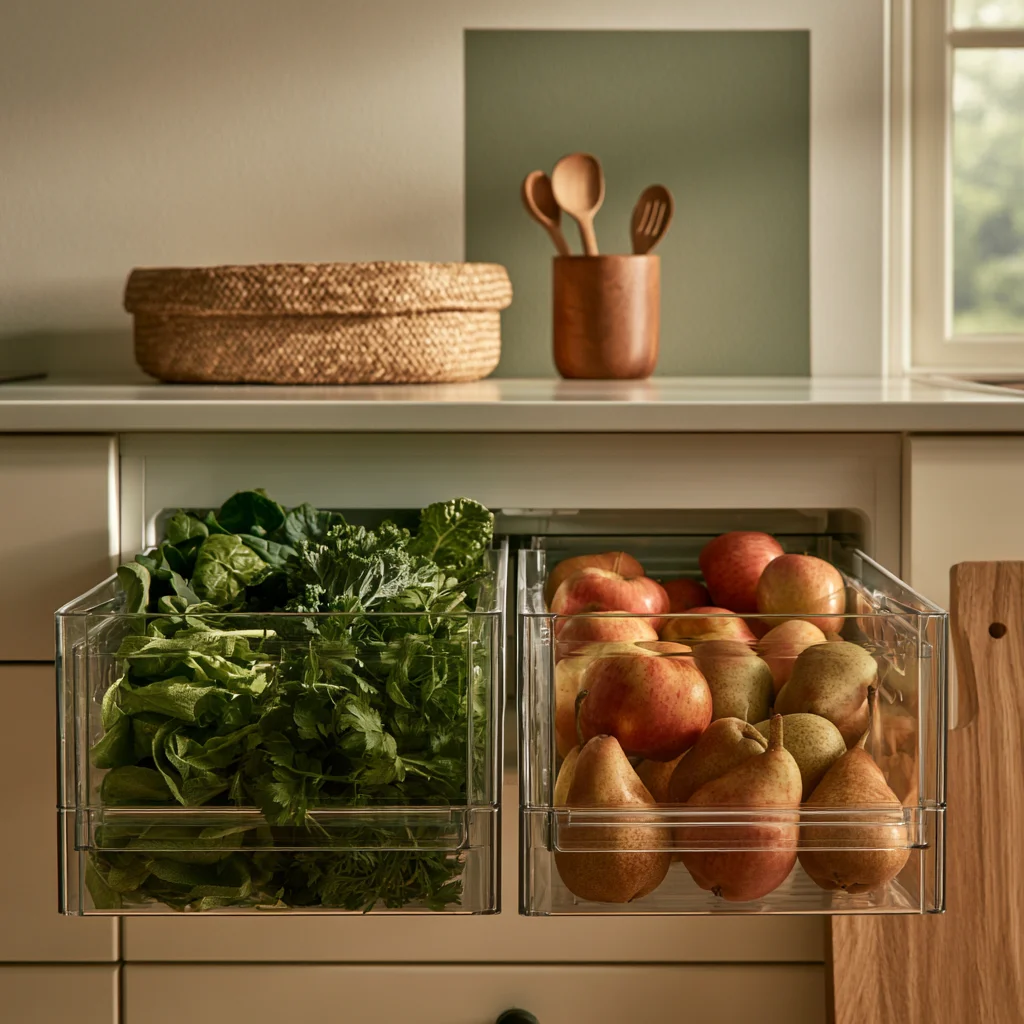
Crisper drawers have a humidity slider, and it is set at the factory. It stays where it was set, which wastes the one feature the drawer has.
High humidity suits things that wilt. Low humidity suits things that rot, because it lets the ethylene they give off escape.
| Slider setting | What it does | What goes in |
|---|---|---|
| High humidity, vent closed | Traps moisture in | Leafy greens, herbs, broccoli, carrots |
| Low humidity, vent open | Lets ethylene escape | Apples, pears, stone fruit, avocados |
| One drawer only | Set it to high | Greens spoil faster and visibly, so they win the drawer |
Set one drawer to high humidity and the other to low, and keep apples out of the greens drawer.
Apples and pears give off ethylene, which ripens whatever is next to them. In a shared drawer, that turns a week of lettuce into three days.
Tomatoes and bananas do the same thing, and neither belongs in a fridge at all, which frees drawer space before any sliding happens.
Keep tomatoes, bananas, and unripe stone fruit out of the fridge entirely, on the counter instead.
Counter space for those is worth planning rather than assuming, since it is the surface everything else competes for. The vertical inches a small kitchen usually leaves empty is where the overflow goes.
Map your own with one thermometer
The zone order is reliable, and the actual numbers are not, because they depend on the model, the load, and how often the door opens.
The safe ceiling is fixed. FoodSafety.gov publishes the cold storage guidance for home refrigerated food, and the short time limits it lists assume the fridge is holding at or below 40 degrees Fahrenheit throughout.
Verifying that takes one cheap appliance thermometer and five days. Move it to a different zone each morning and write down what it reads.
Five readings are enough to rank the zones, which is all the map needs to do. The absolute numbers matter less than knowing which shelf is coldest in your own cabinet.
Do it again in summer. A kitchen that runs ten degrees warmer in August pushes the door bin further out of range than any change in how you load it.
The five-day map:
- Day one, back of the bottom shelf
- Day two, front of the middle shelf
- Day three, top shelf at the front
- Day four, the middle door bin
- Day five, inside a crisper drawer
Run the five-day map before you buy a single bin, because it tells you which zones you can trust.
If the door bin comes back above 40, that zone holds condiments and nothing else. If the whole cabinet does, the dial needs turning down before any organizing happens.
The dial on most fridges is a number from one to five rather than a temperature, and the relationship between the two is not printed anywhere. Once the thermometer tells you which setting holds 37 degrees, write that number inside a cupboard door. It is the only calibration you will ever need, and it takes ten seconds.
What a small fridge changes
Everything above applies to any fridge. Three things get harder when the cabinet is small.
The three constraints a small fridge adds
- Less air volume, so the temperature swings further every time the door opens
- Fewer shelves, so zones blur and the middle does two jobs
- Shallower depth, which makes stacking the only way to use it
- No dedicated meat drawer, so the bottom shelf has to serve as one
- Overpacking, which blocks the circulation the cold depends on
Overpacking is the one that catches people out, because a full fridge looks organised. Cold air has to move around the food, and a packed cabinet has warm pockets in it.
The freezer works the opposite way, which is where the confusion starts. A full freezer holds its temperature better, and a full fridge holds its temperature worse.
Leave a finger's width of gap around anything you care about, since blocked air is why the back of a full fridge freezes, and the front does not.
Containers make this better or worse depending on how many shapes you own. Counting footprints rather than counting containers applies inside a fridge more sharply than in a cupboard, because the volume is fixed.
Read more: the fast, slow and dead stock system for a small pantry
The bins that help and the bins that do not
Fridge bins are sold on tidiness, and they cost volume. A bin with 5 millimetre walls loses that on both sides plus whatever the lid adds.
They earn their place where they group things that leave together, and they lose it where they simply put a wall around a shelf.
A bin holding lunch items that come out as a group saves time every morning. A bin holding four unrelated jars saves nothing and costs the wall thickness.
Bins worth having in a small fridge
- One low bin for raw meat on the bottom shelf, which contains leaks
- One shallow bin for the things that get eaten this week
- A turntable in a deep shelf, so the back is reachable
- A can holder only if you buy cans in quantity
- Nothing lidded, since a lid is a second thing to open
Choose clear bins over opaque ones, because a fridge you cannot see into gets bought twice.
Buying twice is the mechanism behind most fridge waste, and it is upstream of any storage decision. The point in the buying loop worth interrupting matters here as much as anywhere.
What leaves the fridge
A small fridge has no room for the things a large one absorbs without complaint.
Out on the first pass
- Condiments opened more than a year ago
- Anything in the back of a shelf you cannot identify
- Half bottles of drinks nobody finished
- Produce that has gone soft in a drawer set to the wrong humidity
- Items that do not need refrigerating at all, including most hard cheeses in use and unopened sauces
The last group is worth checking rather than assuming. Several things live in the fridge out of habit and are stable in a cupboard, which frees real volume.
Those items need somewhere to go, and a cupboard with a rotation habit is the right destination. Check the label before moving anything, since a few sauces do need chilling once opened.
The loading order
The order matters because the thermometer changes what the layout can be, and the clear-out changes how much layout you need.
In this sequence
- Empty the fridge and wipe the shelves
- Run the five-day thermometer map before deciding anything
- Put raw meat on the bottom shelf in a sealed container
- Move milk and eggs off the door to a middle shelf
- Set one crisper to high humidity and one to low
- Buy bins last, and only for things that leave together
Freeing the cupboard under the sink is often the quickest way to make room for what comes out of the fridge, and what belongs in that cupboard and what does not settles it.
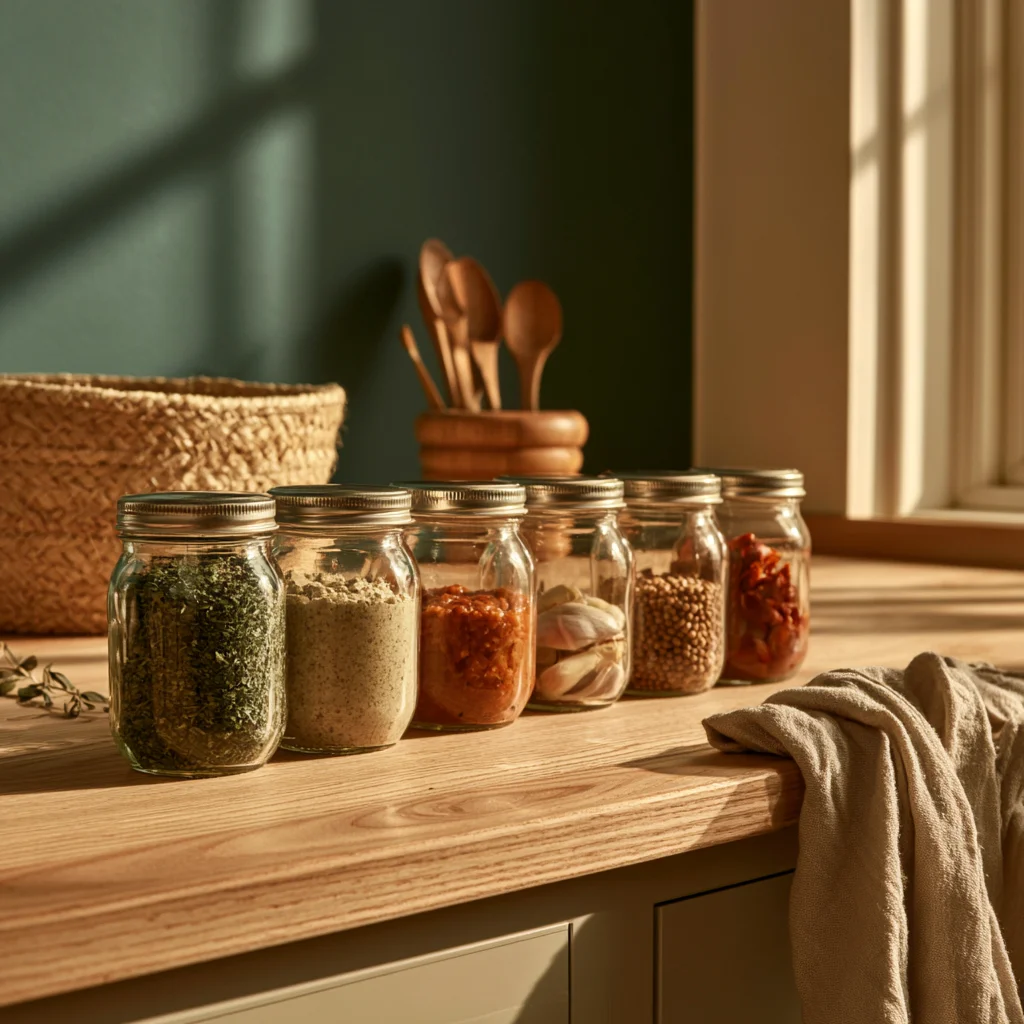
Small jars and sachets are the category that defeats every fridge shelf, and they belong flat in a drawer rather than upright in a bin. Why one visible layer beats any stacked system applies to them.
Anything that came out of the fridge because it does not need chilling still needs a home, and cabinet depth is the constraint. The dead depth in a standard base cabinet decides where it can go.
Pans are the other bulky category competing for the same cupboards, and they file rather than stack. Why the handle sets the footprint frees more cabinet than any fridge change will.
Read more: the buffer arithmetic behind how much of anything a household needs
If the whole kitchen feels immovable rather than merely full, the order is what to fix first. The room by room sequence that stops a clear out stalling applies to a kitchen as much as anywhere.
Wipe a spill the day it happens, since a dried drip is the cross-contamination route a sealed container was meant to prevent.
A small fridge works when the zones are respected, and the air can move. Neither of those costs anything, and both survive a week of normal shopping.
Nothing here needs a new appliance or a set of matching bins. It needs a cheap thermometer, five mornings, and a decision to stop loading by category.