

Pots and pans do not stack well because they are round. They stack badly because of the handle, and the handle is most of the footprint.
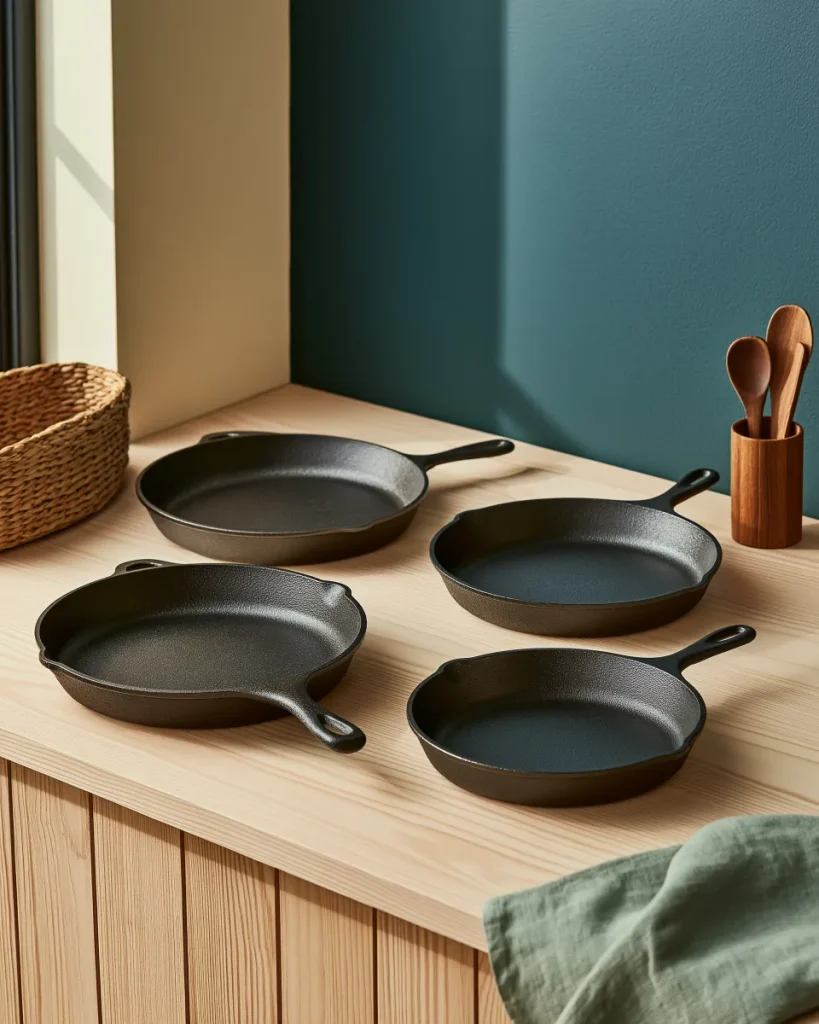
A 10-inch skillet with a 7-inch handle needs a bounding box of 17 by 10 inches, which is 170 square inches. The pan itself covers 79 of them.
So 54 percent of the space that skillet occupies is handle and dead corner. Nesting three of them does nothing about it, because the handles still project.
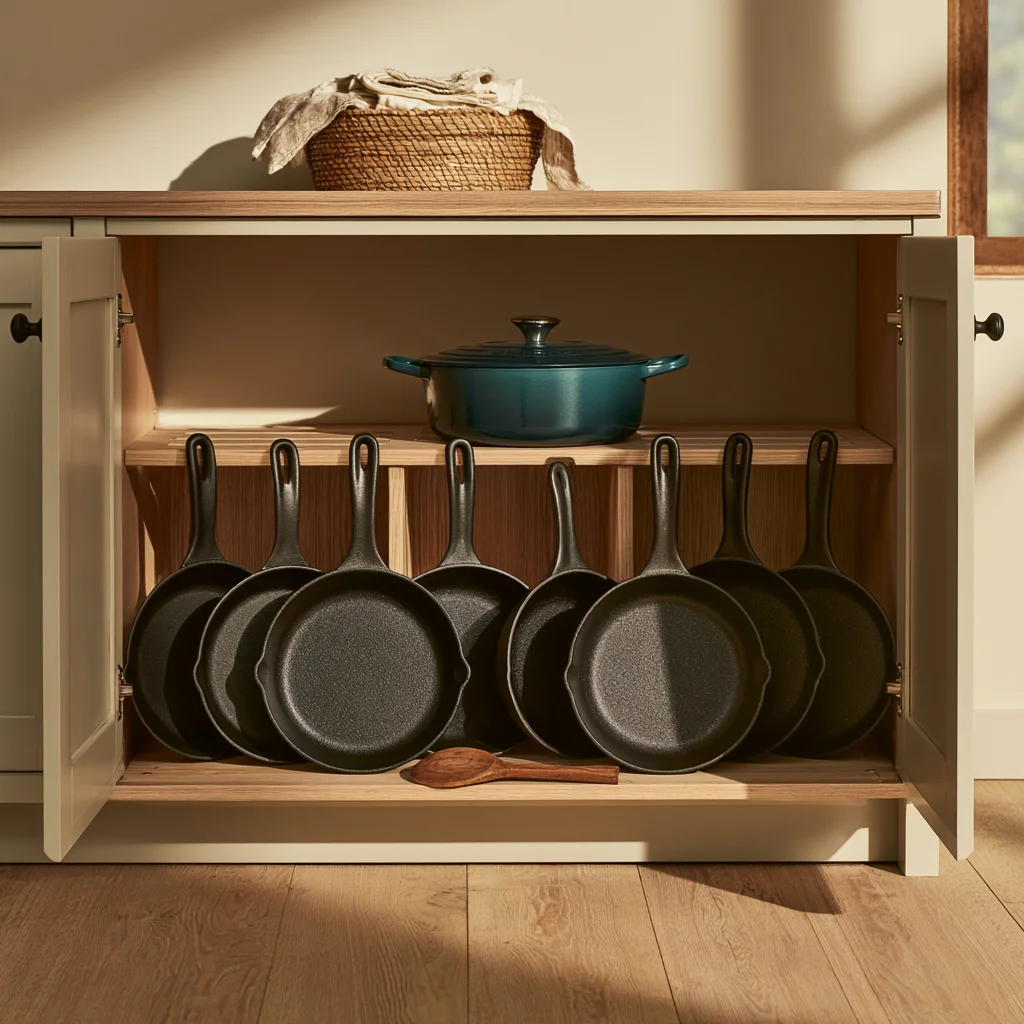
Turn the pans on edge, and the handle stops mattering. A 24-inch cabinet takes nine filed vertically against about three nested, which is three times the capacity on the same shelf.
The handle sets the footprint
Measure a pan the way a cabinet does, as a rectangle around the widest points. The number that comes out is not the diameter on the box.
| Pan | Bounding box | Pan area | Dead space |
|---|---|---|---|
| 8 in skillet, 6 in handle | 14 by 8 in, 112 sq in | 50 sq in | 55 percent |
| 10 in skillet, 7 in handle | 17 by 10 in, 170 sq in | 79 sq in | 54 percent |
| 12 in skillet, 8 in handle | 20 by 12 in, 240 sq in | 113 sq in | 53 percent |
The proportion barely changes with size, which is the useful part. Roughly half of any skillet footprint is space nothing else can use.
Two pans laid handle to handle recover some of it, and then neither one can be lifted without moving the other. The corner is the cost of reaching in.
Cabinet depth makes it worse rather than better. A 24-inch-deep base cabinet swallows a 17-inch bounding box and leaves 7 inches behind it that nothing reaches.
Measure the bounding box including the handle rather than the pan diameter, before buying any organizer.
Lidded pots behave slightly better because the handles are short and opposed. A stockpot is close to a true circle, and it is the only piece in the collection that nests honestly.
Most pots and pans storage advice starts with an organizer. The organizer is the last decision, after the count is down and the bounding box is known.
Why pots and pans defeat ordinary shelving
- The handle projects and cannot be stacked on
- The rim is wider than the base, so nesting leaves gaps
- Lids add height that stops anything sitting above
- Weight rules out the upper shelves people try to use
- Every piece is a different diameter, so nothing tessellates
On edge beats nested, three to one
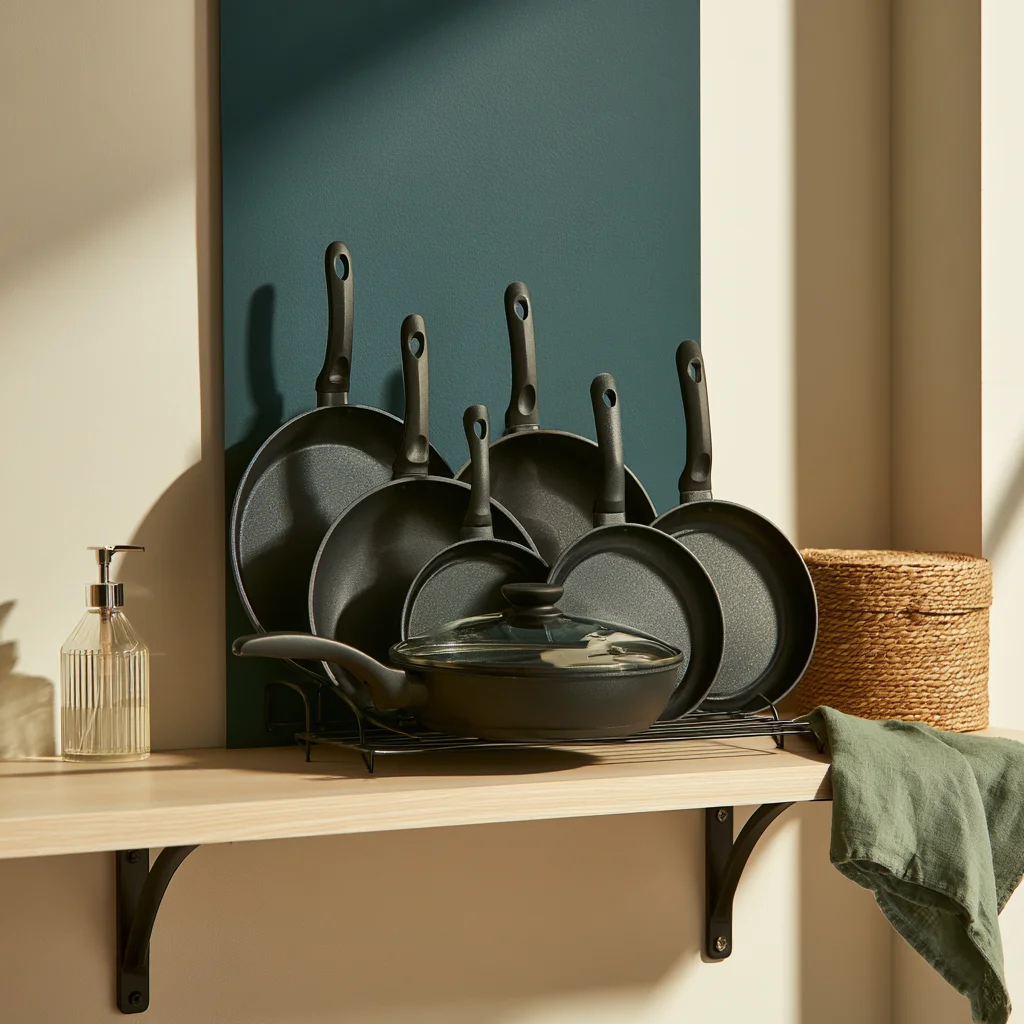
Filing a pan on edge turns the handle from a footprint problem into a spacer. The pan takes its thickness across the shelf and its diameter in height.
| Method | What fits in a 24 by 12 in cabinet | Access |
|---|---|---|
| Nested with handles alternating | About 3 pans in one stack | Lift two to reach the third |
| Filed on edge at 3 in each | 8 pans | Pull any one out directly |
| Filed on edge at 2.5 in each | 9 pans | Pull any one out directly |
| Filed on edge at 2 in each | 12 pans | Pull any one out directly |
Three against nine on identical shelf space, and the filed version has no lifting in it. That is unusual, because density and access normally trade against each other.
Filing pots and pans on edge is the one storage decision in this whole article that improves both at once. Everything else is a trade.
The reason it works is that a pan is thin in one axis and wide in the other two. Standing it up puts the thin axis across the shelf, where shelf width is the scarce thing.
File pans on edge in a divided cabinet rather than nesting them on a shelf.
A deep drawer does the same job with less fitting. Pans stand on edge in a drawer without dividers if they are packed closely enough to hold each other up. If the drawer is not full enough for that, a peg insert such as the Umbra Peggy Cookware Organizer holds each pan in place, and the pegs move to fit different sizes.
The drawer version costs more in weight than the cabinet version, which is the trade covered further down.
What makes filing work
- Adjustable dividers rather than fixed ones, since pan thickness varies
- A cabinet at least 12 inches deep, so a 10-inch pan clears the front
- Handles pointing outward, which turns them into pull tabs
- One slot per pan, with nothing doubled up
- A tension rod set of dividers if the cabinet cannot be drilled
The same single-layer principle runs through every small kitchen storage decision. One layer you can see beats two layers you have to lift.
Read more: why one visible layer beats any stacked system
Lids are a separate collection
A lid stored on its pan blocks nesting and adds an inch of height to every unit. Stored flat in a pile, it slides, and stored loose, it becomes the noise in the cupboard.
Lids file on edge for the same reason pans do. A rack takes ten in about eight inches of width, and every one is visible from the front.
Glass lids are the heaviest per inch and the most fragile, so they belong at the bottom of a rack rather than the top of a pile.
Sorting by diameter beats sorting by pan, because you look for a lid by size and never by which pan it came with.
Store lids separately and on edge, never on the pans they belong to.
Where lids can go
- A wire rack in the same cabinet, filed like plates
- Inside the cabinet door on a rail, for lids under an inch thick
- A shallow drawer with a divider per lid
- Sorted by diameter, since you match a lid by size rather than by pan
- Nowhere at all for the glass ones you never use, which should leave
The lid problem is the same one food containers have, and the arithmetic behind it is identical. Counting footprints rather than counting containers applies to cookware without adjustment.
Weight, and what a loaded drawer does to its slides
Pans are the heaviest thing in a kitchen after the appliances. A 10-inch cast iron skillet is about 5.5 pounds, a 12-inch about 8, and a 5 quart dutch oven around 11.
A deep drawer holding six of those carries 40 pounds before the drawer itself. That is a real load on a slide that was chosen for a cutlery tray.
Cabinet hardware is graded for exactly this. The BHMA cabinet hardware standard sets performance grades for drawer slides, with an additional heavy-duty grade above the three used for general hardware.
Check the drawer slide rating before loading a drawer with cast iron, and upgrade the slide rather than splitting the load.
The symptom of an overloaded slide is a drawer that drops at the front when it is fully out. Once that starts, it does not recover.
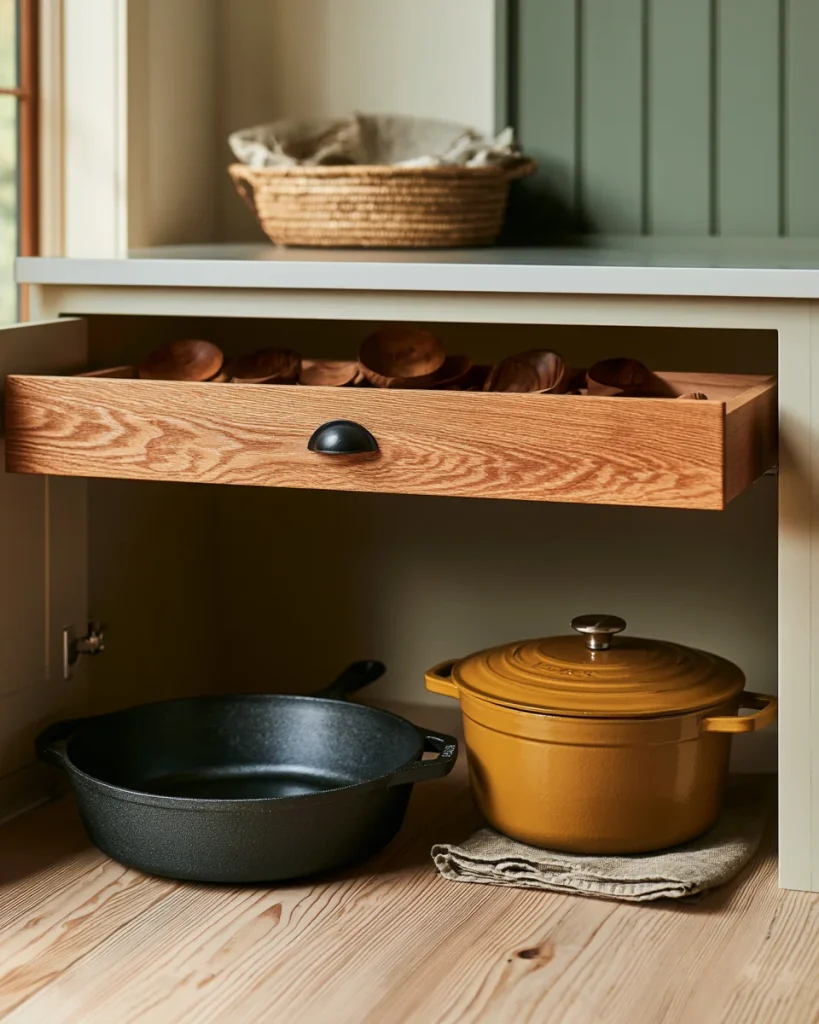
There is a cheaper answer than upgrading the slide. Put the cast iron in a base cabinet on the floor of the unit rather than in a drawer at all. Cast iron does not need to be reached quickly, it needs to be reached without lifting anything, and a cabinet floor gives you that for nothing.
Read more: the dead depth in a standard base cabinet
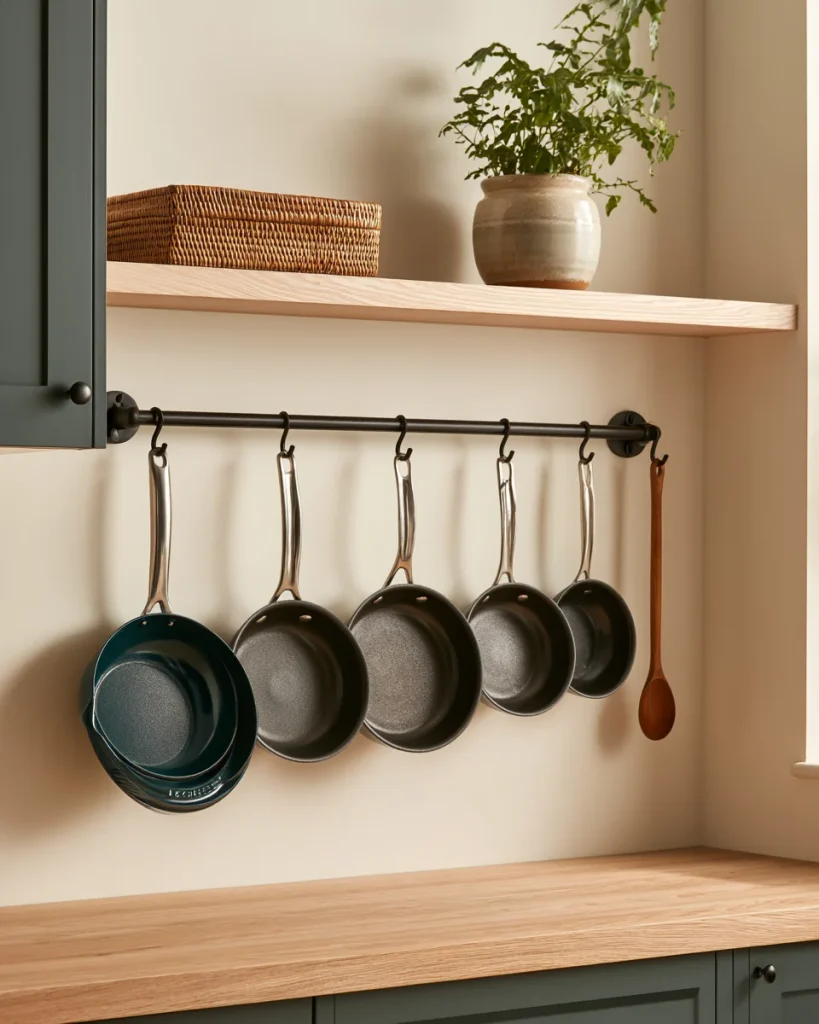
Hanging, where the handle earns its keep
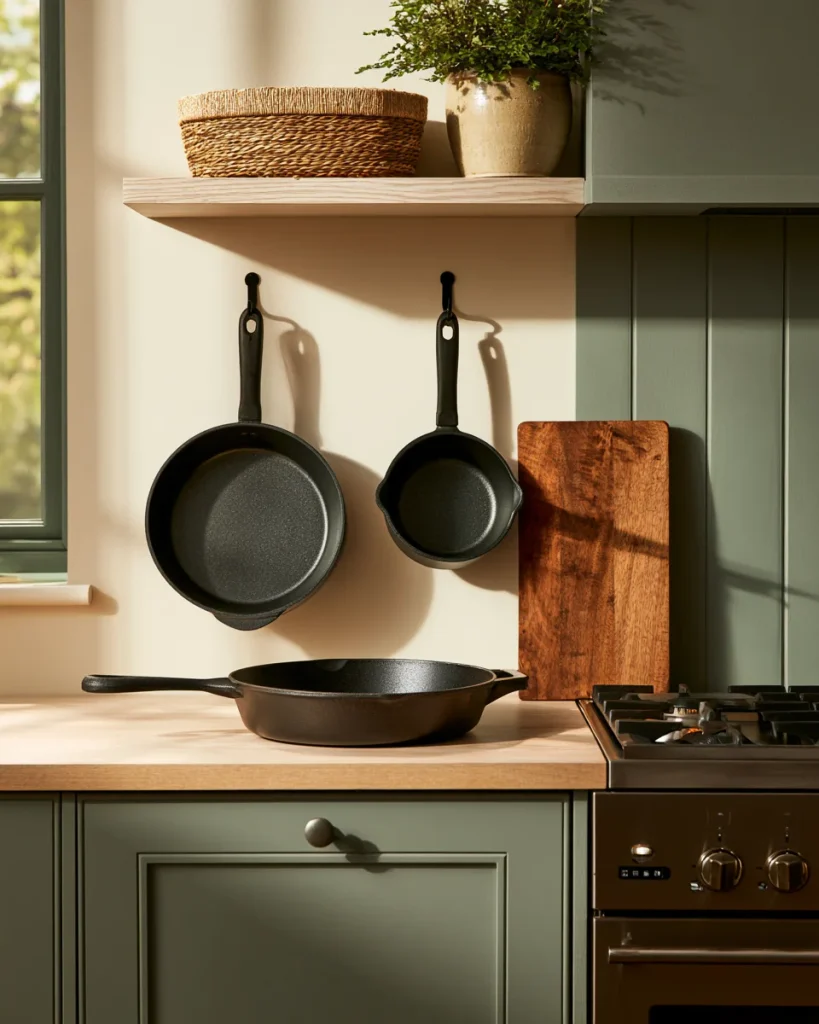
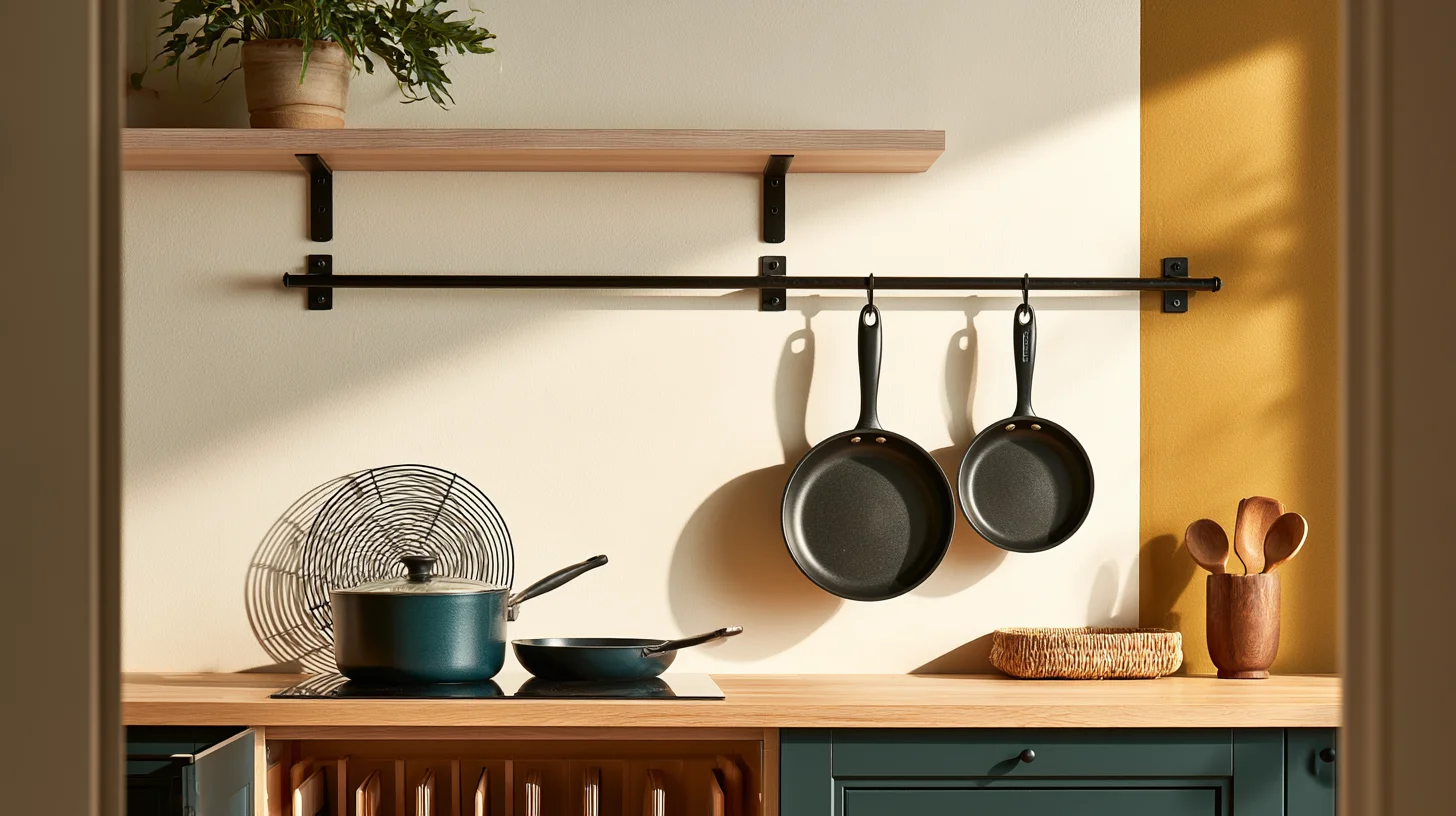
Hanging is the only method where the handle is an advantage rather than a cost. The pan hangs by the thing that was wasting your shelf.
The load is the constraint. Six pans averaging 4 pounds is 24 pounds on the rail, and six cast iron pieces averaging 5.5 pounds is 33.
That load is also dynamic. A pan lifted off a rail unloads one point and swings the rest, which is a different demand from a shelf that sits still.
Head height is the second constraint, and it gets checked last. A rail set for reach puts a 12-inch skillet at forehead level for anyone shorter than the person who fitted it.
Fix a hanging rail into studs or joists rather than into plasterboard alone, whatever the anchor packaging claims.
That is the same calculation any loaded shelf demands, and what a fixing genuinely holds on which wall type decides whether the rail is available to you at all.
Where a rail can go in a small kitchen
- Along the wall between the counter and the wall units
- Under a wall cabinet, on a rail screwed into the cabinet base
- Across a window reveal, if the window is not opened often
- On the side panel of an end cabinet, which is usually dead
- From the ceiling above an island, which needs joists rather than plasterboard
Anything hung near the hob collects the same film everything else does there, so the placement rules from sorting a kitchen wall by distance from the hob and sink apply to a pot rail too.
The sets and the guilt
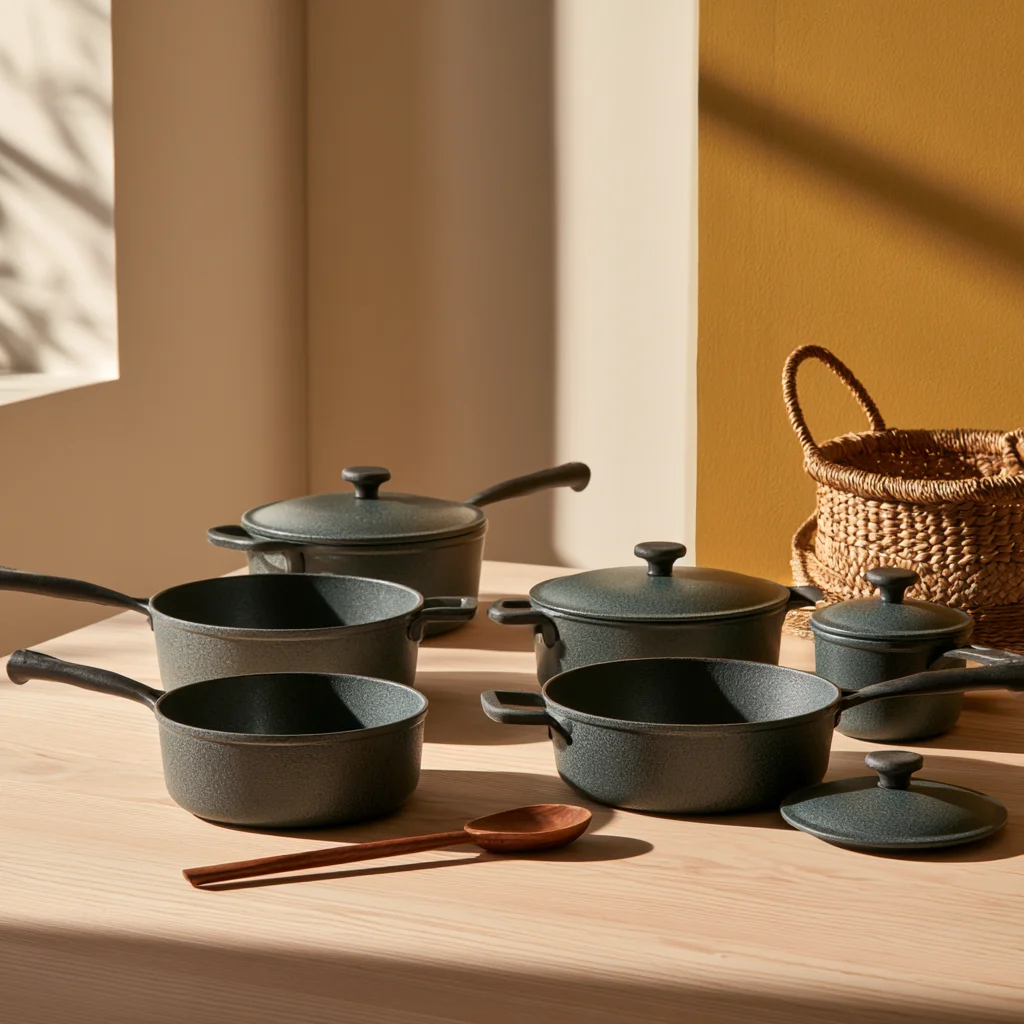
Cookware collections grow through sets and stay through guilt. Both are worth naming before any storage decision is made.
A set of twelve pieces sold as one purchase usually contains four you use and eight that have never left the cupboard.
The four are predictable. A large skillet, a medium saucepan, a stockpot, and one lid that fits two of them covers most home cooking.
Everything past that is either a genuine speciality you use, or it is the part of the set that came free with the part you wanted.
Out on the first pass
- Nonstick pans with a scratched or flaking coating, which no longer work
- The third saucepan of the same size
- Anything with a loose or wobbling handle
- Speciality pieces used once, including the fish kettle and the wok nobody heats properly
- Lids with no matching base
Keep the two pans you cook with daily out of the storage system entirely, on the hob or on a hook.
Sets are where the count grows fastest, since one purchase adds eight pieces you did not choose individually. The point in the buying loop worth interrupting matters more for cookware than for most categories.
If the cupboard feels immovable rather than merely full, the order is the thing to fix first. The room by room sequence that stops a clear out stalling applies to a kitchen as much as anywhere.
Where each piece should live
Once the count is down, placement is a frequency question, and it sorts into four bands rather than three.
Where pots and pans live matters more than what they live in, because the retrieval cost is paid every time you cook and the container cost is paid once.
| How often you use it | Where it goes | Why |
|---|---|---|
| Daily | On the hob or on a hook | No retrieval at all |
| Weekly | Filed on edge in the base cabinet nearest the hob | One movement to reach |
| Monthly or less | High shelf, back of a deep cabinet, or the oven drawer | Retrieval cost is acceptable |
| Twice a year | Out of the kitchen entirely | It is stock, not cookware |
Count the pans you cooked with this month before buying any organizer, using memory rather than intention.
The base cabinet nearest the hob is prime space, and it is usually holding something else. What belongs in the cupboard under the sink and what does not frees the wrong cupboard for the right contents.
Where there is no cabinet to spare at all, the answer moves to the walls, and the vertical inches a small kitchen usually leaves empty are where to look first.
Read more: the counter budget that gets spent without anyone noticing
Protecting the surfaces you keep
Filing and hanging both solve the space problem, and neither protects the finish. Metal against metal marks every time it moves.
Put a felt pad or a folded paper towel between any two pans that touch, including hanging ones.
Nonstick is the surface that loses most from stacking. A scratch through the coating ends the pan as a nonstick pan, whatever else it does afterwards.
That is a storage argument rather than a health one. A scratched pan sticks, so you use more oil and scrub harder, and then it goes in a cupboard and stays there.
Filing on the edge removes the contact entirely, which is the quiet reason it extends the life of a nonstick set as well as saving the shelf.
Cast iron is the opposite case. It is heavy enough to damage what it sits on rather than the reverse, so it belongs at the bottom of anything or on its own hook.
It also needs air. Cast iron stored lid down and airtight holds moisture against the seasoning, which is how a well-used pan develops rust in a cupboard.
Store cast iron with the lid off or ajar, never sealed, and never damp from washing.
Count, measure, then file
The count comes first because it changes what the storage has to hold, and the measurement second because it removes methods.
In this sequence
- Pull everything out and count what you cooked with in the last month
- Remove the scratched, the duplicated, and the orphan lids
- Measure the bounding box of the largest pan you keep
- Fit dividers in the cabinet nearest the hob and file on edge
- File the lids separately, sorted by diameter
- Hang the two dailies and leave them out of the system
Bulk and back stock follow a different rule again, since they move slowly and belong out of the working zone. The rotation that keeps a small pantry moving covers that half of the kitchen.
Pots and pans stop being a storage problem once the handles stop deciding the layout. Turn them on edge, file the lids separately, and hang the two you never put away.
None of that needs a new cabinet. Dividers, a lid rack, and a rail come to less than one replacement pan, and the count usually drops before any of it is bought.