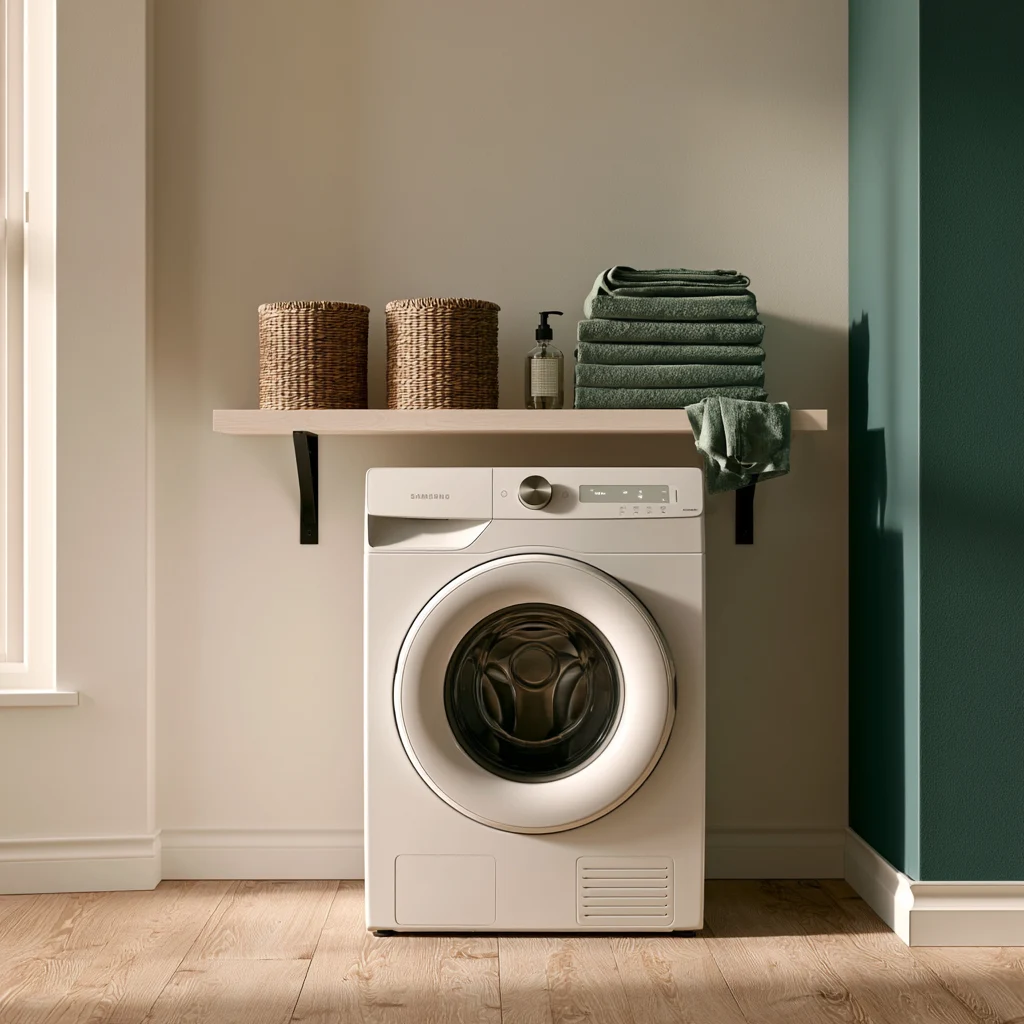


A small laundry room is planned around the machine, and it should be planned around the envelope the machine needs. Those are two very different numbers.
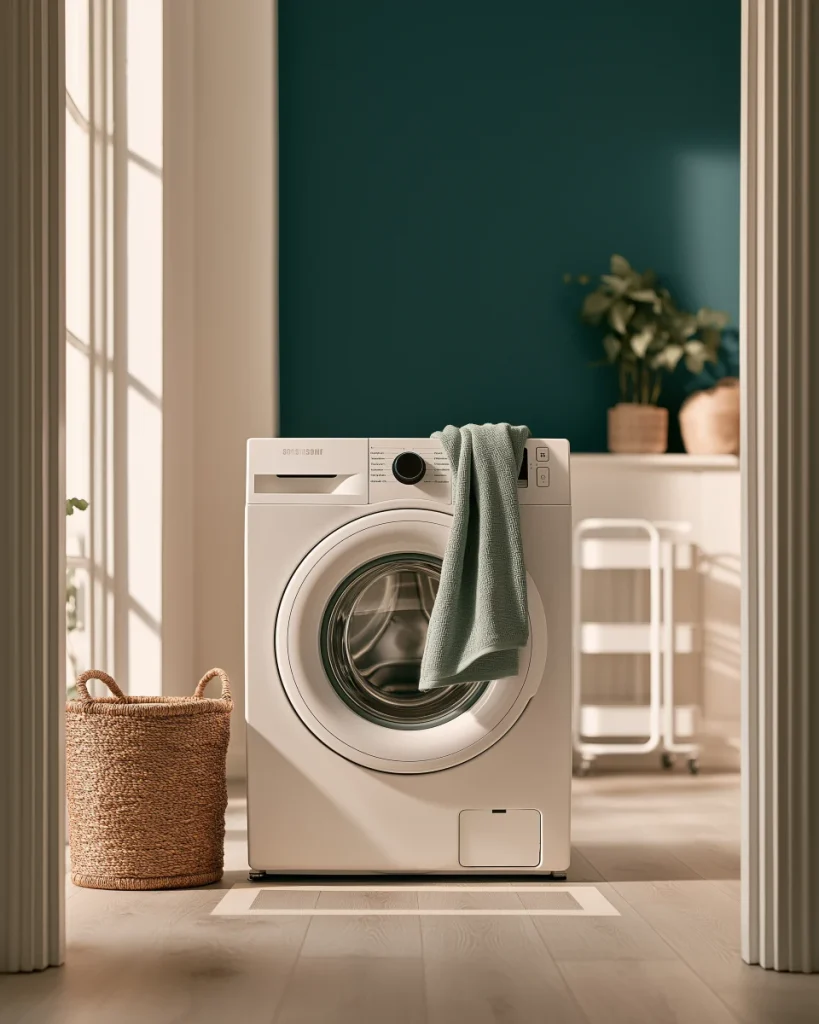
A washer is 27 by 31 inches, which is 5.8 square feet. Add an inch on either side, 6 inches behind for hoses and duct, and 21 inches in front for the door and your body.
The envelope comes to 29 by 58 inches, or 11.7 square feet. That is exactly twice the machine, and it is the number the room has to give up.
Laundry also has six stages, and a small room hosts two of them. Deciding where the other four go is most of the job.
The envelope is twice the machine
Every dimension below is service access rather than storage. None of it can hold anything, and none of it is optional in a small laundry room or a large one.
| Clearance | Inches | What it is for |
|---|---|---|
| Each side | 1 in | Vibration, and getting a hand down the gap |
| Behind | 6 in | Supply hoses, waste hose & duct without kinking |
| In front | 21 in | Door swing plus room to stand and load |
| Machine itself | 27 by 31 in | 5.8 sq ft |
| Total envelope | 29 by 58 in | 11.7 sq ft, twice the machine |
Measure the envelope rather than the machine before deciding anything fits.
The 6 inches behind is the one people compress, and it is the one that causes leaks. A hose bent tight against a wall fails at the bend rather than at the fitting.
What the envelope rules out in a small laundry room
- A door that opens inward across the 21-inch front clearance
- Shelving below waist height on the wall the machine faces
- A basket parked in the front clearance, which is where it always ends up
- Pushing the machine flat to the wall to gain 6 inches of shelf
- Any cabinet deeper than 12 inches on the opposite wall of a narrow room
The door is the one that catches people out. An inward-opening door and a front-loading machine want the same 21 inches, and only one of them can have it.
Rehanging the door to open outward is a 20-minute job, and it is usually the single cheapest fix in the room.
Stacking, and the floor it returns
In a 6-by-6-foot room, which is 36 square feet, a side-by-side pair carries an envelope of 22.6 square feet. That is 63 percent of the room gone to two appliances.
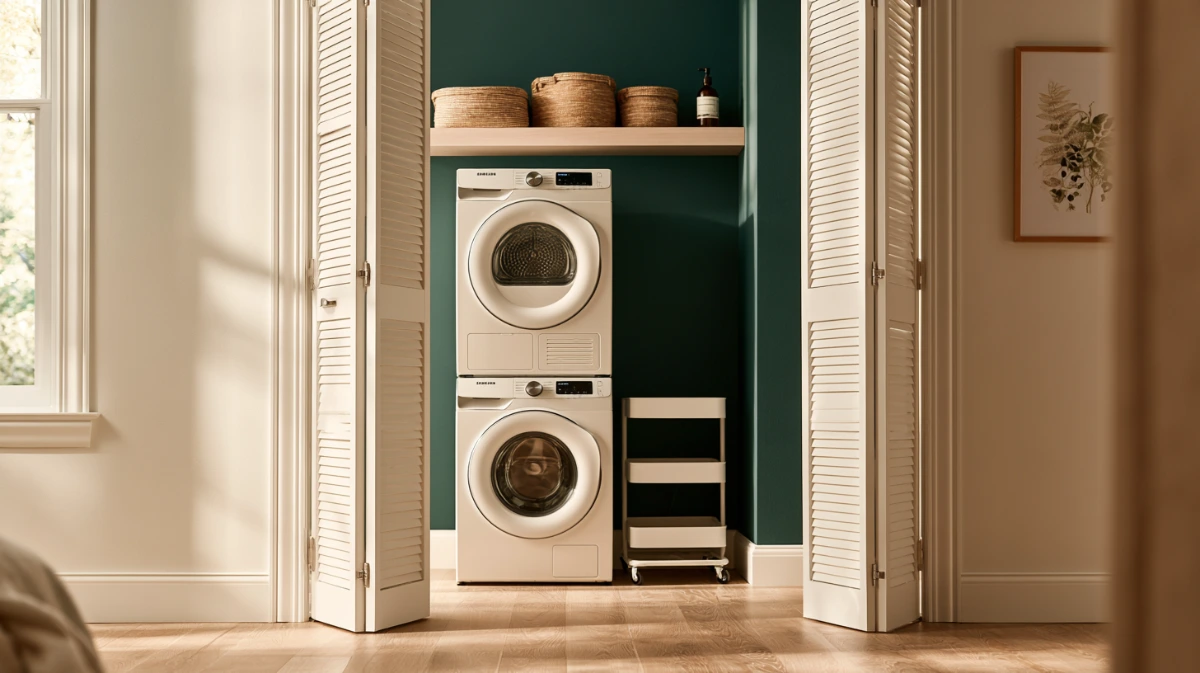
Stacked, the same pair needs 11.7 square feet, or 32 percent. Stacking returns 10.9 square feet, which is roughly 30 percent of the floor.
No shelving decision anywhere else in the room comes close to that. It is the single largest move available, and it costs the price of a stacking kit.
The catch is that it has to be the right kit for the pair. A universal strap is not a stacking kit, and a dryer resting on a washer without one will walk off.
Stack the pair if the machines allow it, since it returns about 30 & of a small room floor.
What stacking costs you in return
- A stacking kit, which is model-specific and not optional
- Reaching the dryer controls, which sit above head height for some people
- The folding surface a side-by-side pair gave you for free
- Top loaders, which cannot stack at all
- Servicing, since the lower machine now has a dryer bolted on top
The lost folding surface is the real trade, and it is solvable. A wall-mounted fold-down shelf gives it back without taking any floor.
What a wall fixing genuinely holds decides whether that shelf is available to you.
The vent belongs inside the envelope
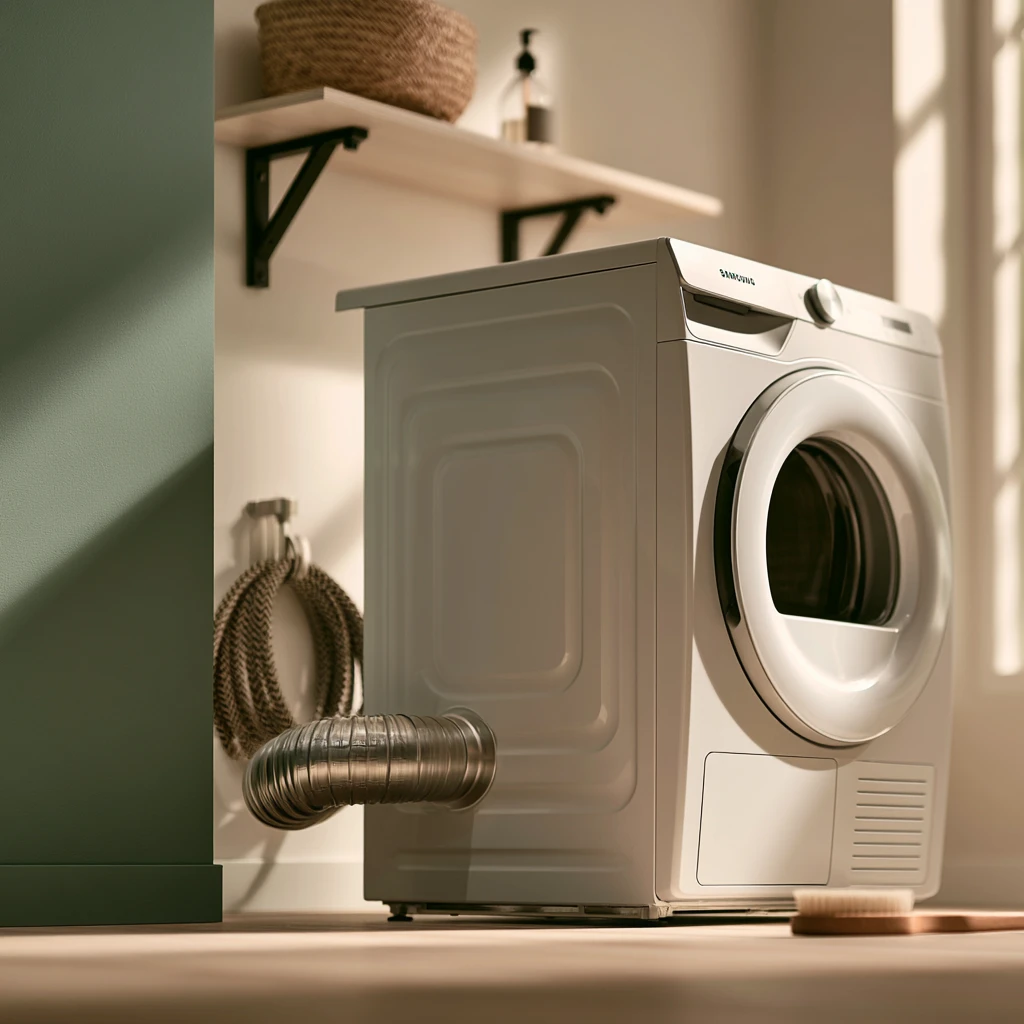
A vented dryer needs a duct run, and the duct is part of the machine, not an accessory. Crushing it behind the appliance is the most common installation error in a tight space.
ENERGY STAR guidance on clothes dryers is blunt about the consequence. Cleaning the lint filter after every load improves air circulation and dryer efficiency, and it is a safety measure as well as an energy one.
The same logic applies to the duct behind the machine. A crushed or over-long run restricts the airflow the dryer depends on, so loads take longer, and lint collects in the restriction.
Use rigid metal duct rather than flexible plastic, and keep the run as short as it will go.
A condenser or heat pump dryer removes the duct question entirely, which is why they suit interior closets with no outside wall. They cost more, and they run slower.
They also put the water somewhere. A condenser dryer collects it in a tank you empty, or pumps it into the waste, rather than pushing it outside as vapour.
Read more: how each piece of furniture earns the floor it stands on
Six stages, and a room that fits two
Laundry is a process rather than a place. The room hosts washing and drying, and the other four stages have to be assigned somewhere.
| Stage | Needs | Where it usually goes |
|---|---|---|
| Dirty waiting | A container, no surface | Bedrooms and bathroom |
| Washing | The machine envelope | The laundry room |
| Drying | The machine or line space | The laundry room, or a rack elsewhere |
| Folding | A flat surface at hip height | A fold-down shelf or a bed |
| Ironing | A board and a socket | Stored flat, used elsewhere |
| Clean waiting | A basket per destination | Back in the bedrooms |
Give the dirty stage a container and the folding stage a surface, and let the other stages leave the room.
The stage that traps people is clean waiting. A basket of clean laundry that has nowhere to go sits in the room for days, and it is the reason it never looks finished.
That stage is not a laundry failure. It is a wardrobe or a linen cupboard with no free capacity, showing up two rooms away from where the problem sits.
That stage is a storage question rather than a laundry one. Clean linens need a destination with a fixed capacity, or they have nowhere to land.
The buffer arithmetic that sets how many sets a bed needs decides where the basket empties into.
The same applies to clothes. A wardrobe with no free space sends the basket straight back to the laundry room.
Sorting by the reason each item is still hanging there is upstream of this whole problem.
Read more: the height bands that decide what any narrow closet holds
Drying without a dryer
Air drying is the normal case in a small flat, and it is almost always undersized. A full load needs 12 to 15 linear metres of line, and most racks give you far less.
Measure a rack by its rails rather than its footprint. A tall three-tier rack and a wide two-tier rack can carry the same total line in very different amounts of floor.
| Drying option | Line available | Covers a full load |
|---|---|---|
| Over-bath rack | 6 metres | No |
| Folding floor rack | 10 metres | Almost |
| Ceiling airer, 4 bars at 4 ft | 16 metres | Yes |
| Retractable wall line, 5 lines at 6 ft | 30 metres | Yes, twice over |
Count the linear metres before buying a rack, since the common floor rack is one load short.
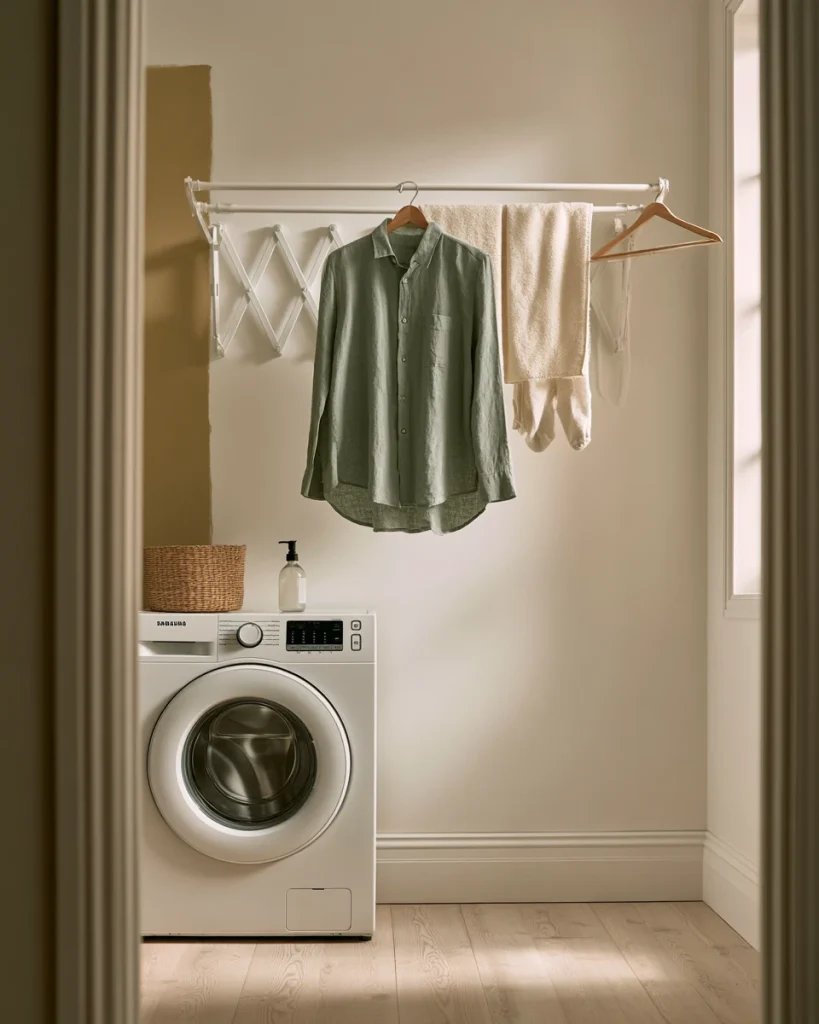
The ceiling airer is the one that suits a small laundry room, because it uses the volume above head height that nothing else can occupy.
What decides which drying option works
- Ceiling height, since an airer needs headroom under it when lowered
- Whether the room has a window that opens
- How many loads a week, because one rack cannot serve two loads a day
- Whether anything hanging blocks the machine door
- How long a load takes to dry, which sets how often you can run the machine
Ceiling and high wall space is the recurring answer in small rooms generally, for the same reason it works here. The three sightlines a small room loses to furniture explains why the high wall costs nothing.
The water you just released into the flat
Air drying moves the water out of the clothes and into the room. A 7 kilogram load spun at 1400 rpm holds around 50 percent of its dry weight in water.
That is roughly 3.5 litres, and all of it evaporates into the air of the flat over the next day.
In a closed room with no extraction, it condenses on the coldest surface, which is usually an outside wall or a window reveal. That is where the mould appears.
Never air dry a full load in a closed room, and open a window or run extraction while it dries.
A dehumidifier is the honest answer where a window is not an option. It collects the same 3.5 litres into a tank instead of into the plaster. It also dries the load faster than still air does. Run it in the same room with the door shut, which is the one time a closed door helps rather than hurts.
Damp behaves differently from a leak and needs a different fix, which is worth knowing before you buy anything. What still air does inside a closed cupboard is the same mechanism at a smaller scale.
What comes out of a small laundry room
A small laundry room collects things that have nothing to do with laundry, because it is the last room in the flat with a spare shelf.
Out on the first pass
- Half-used detergents from products you no longer buy
- Cleaning supplies that belong under a sink
- Tools and paint tins stored here because there is no shed
- Single socks kept in a bag for a partner that will not return
- Empty baskets, which are storage waiting for a use
Keep one detergent, one softener, and one stain treatment, and finish the rest before buying more.
Cleaning supplies in particular have a proper home, and it is not this room. Move them to the cupboard they belong in on the same day you pull them out.

Renting, and the machine that is not yours
A rented flat usually comes with the machine and its position fixed, which removes the stacking decision from a small laundry room and leaves everything else intact.
Available without drilling or plumbing
- A rolling cart in the gap beside the machine, if the gap clears 6 inches
- An over-machine shelving unit that stands on its own legs
- A tension rod across an alcove for hanging shirts straight from the drum
- A freestanding ceiling airer that braces between floor and ceiling
- A drip tray under the machine, which is the cheapest insurance available
Replace the supply hoses on a date rather than when they fail, and note the date somewhere you will find it.
Hoses are the one maintenance item worth doing in a rental you do not own. A burst hose in a flat with no floor drain damages your possessions before anyone else notices.
Turning the supply valves off when you go away for more than a night costs nothing and removes the risk entirely for that period.
Where the machine sits in a kitchen rather than a room of its own, the constraints change again, and the vertical inches a small kitchen leaves empty are usually the only spare space available.
In a studio, the machine competes with everything else for floor, and the walkway it needs cuts across the room. What a divider costs you in daylight and floor is the wider version of that problem.
Read more: the storage a small bedroom is not currently using
Envelope first, stages second
The envelope comes first because it removes options, and the stages come second because they tell you what the room does not have to hold.
In this sequence
- Measure the envelope and mark it on the floor with tape
- Decide stacked or side by side, since it changes everything after it
- Check the duct run and shorten or replace it
- Assign the four stages the room cannot host
- Count the linear metres of drying line you need
- Fit the fold-down surface last, in whatever wall is left
If the answer comes out that the room genuinely cannot host the machines, the conversion question changes shape entirely, and what a room conversion costs against a wall of storage is the comparison to run.
None of the six steps needs a purchase. Tape, a tape measure, and a decision about where four stages go cover the whole list.
Leave the machine door ajar between washes, which is free and stops the drum from smelling.
A small laundry room works when the envelope is respected, and the stages are assigned. Everything else in it is shelving, and shelving was never the constraint.