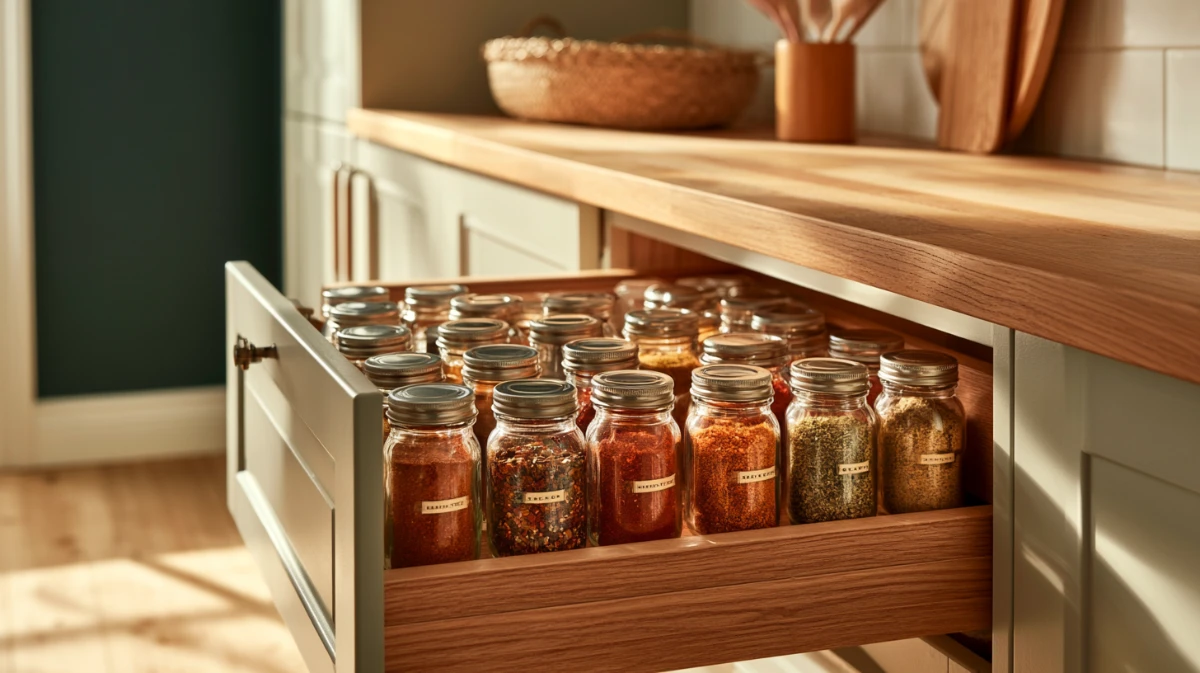


A spice drawer fails for a reason nobody names. A jar has three faces you could read, and every storage method shows you exactly one of them.
Standing in a drawer, you see the lid. On a wall rack you see the side. In a tiered insert, you see the front of the label.
Jars arrive labelled on the side only. Put them in a drawer, and you are looking at twenty identical lids, which is why the drawer gets sorted twice a year and never stays sorted.
Fix the face before you buy an insert. The insert decides which face you look at, and the label has to be on that face.
Three faces, one visible
Work out which face your method shows before deciding anything else, because it dictates where the writing goes.
Most spice drawer organization advice starts with the insert. The insert is the last purchase, after the face is settled and the count is down.
| Method | Face you see | What the label needs |
|---|---|---|
| Standing in a deep drawer | The lid | A round label on top of every cap |
| Lying flat in a shallow drawer | The side, front row only | Side labels, and only one row deep |
| On a wall rack or shelf | The side | The maker label works as it comes |
| In a tiered cabinet insert | The front of the label | The maker label works as it comes |
| On a turntable | Whichever side faces you | Labels on two opposite sides |
Decide the method first, then label the face that method shows.
The turntable is the one worth reading twice. It shows whichever side happens to be turned toward you, so it needs the name on two opposite faces or you spin it looking for one jar.
That single rule removes most of the frustration. A drawer of lid-labelled jars is faster than any rack, and a drawer of side-labelled jars is slower than no system at all.
It also explains why bought organizers disappoint. They are sold on how they hold the jars, and the thing that decides whether they work is what you can read once the jars are in.
The drawer depth that settles it
A standard 4-ounce spice jar is roughly 2 inches across and 4 inches tall. A standard cutlery drawer is 2.5 inches deep.
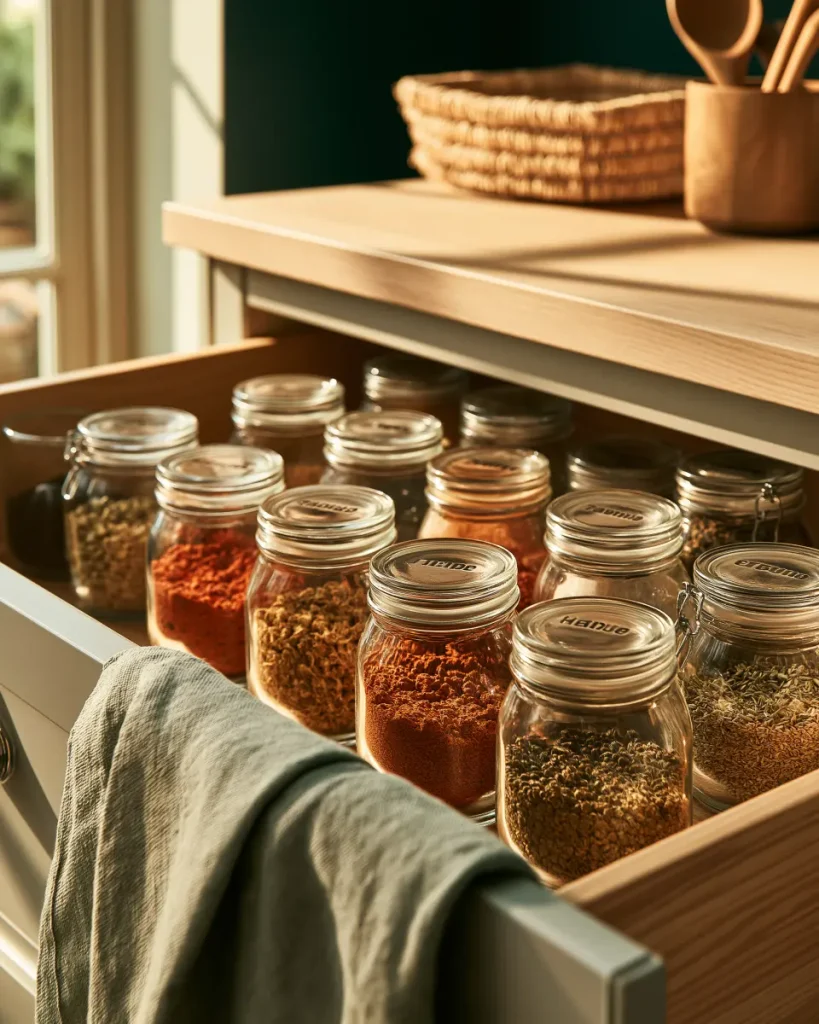
So the jar does not stand up in the cutlery drawer that is offered to it. It has to lie down, and lying down, it shows the side to whoever is behind it rather than to the person looking in from above.
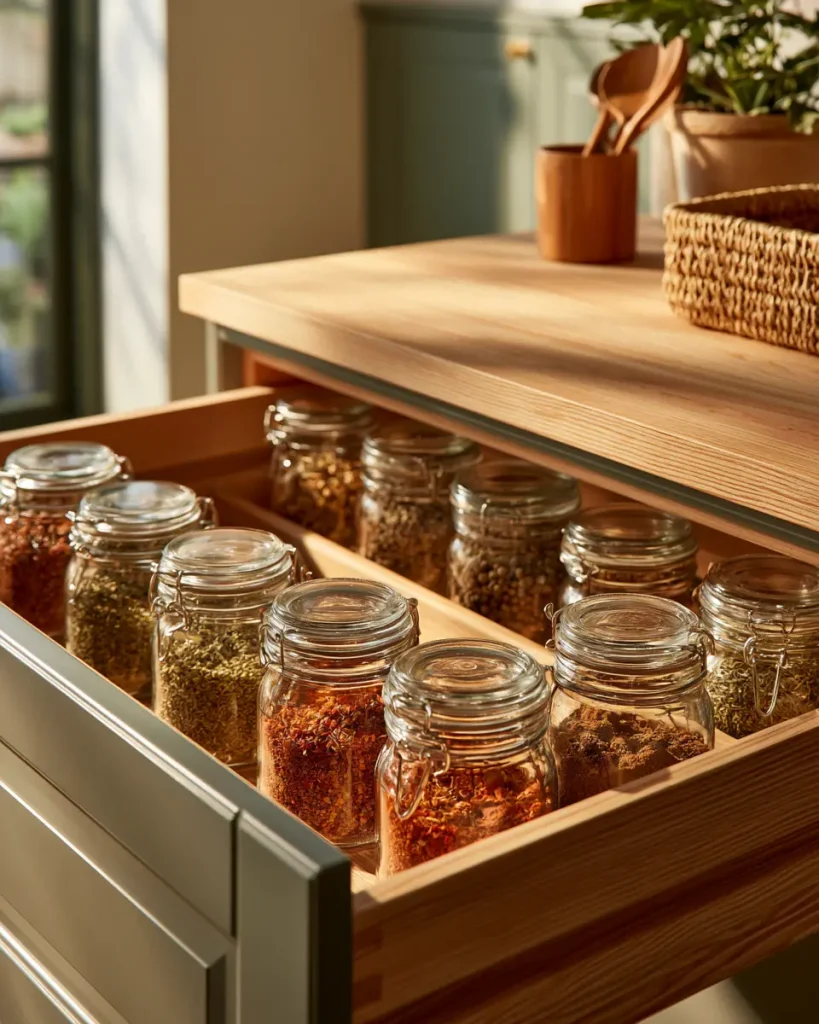
A deep drawer at 6 inches lets the jar stand. That is the version where lid labels work and where the capacity is highest.
| Drawer or shelf | Jars it holds | Face visible |
|---|---|---|
| Shallow drawer 21 by 15 by 2.5 in, lying flat | 30 | Side, front row only |
| Deep drawer 21 by 15 by 6 in, standing | 70 | Lid |
| Wall shelf 21 in, single row | 10 | Side |
| Tiered cabinet insert, three tiers | 30 | Front of the label |
Measure the drawer depth before buying jars or an insert, since 4 inches is the number that decides the whole approach.
The deep drawer holds more than twice the shallow one and shows one face for every jar. It is the strongest option available, and it is the drawer that usually gets given to pans.
Width matters less than depth here, which is unusual. Twenty-one inches across takes ten jars whether the drawer is deep or shallow, and the depth decides whether they stand.
That is a trade worth running properly, since pans file rather than stack and do not need a deep drawer at all. Why the handle sets the footprint for cookware frees the drawer this needs.
Lying flat, and the row you cannot see
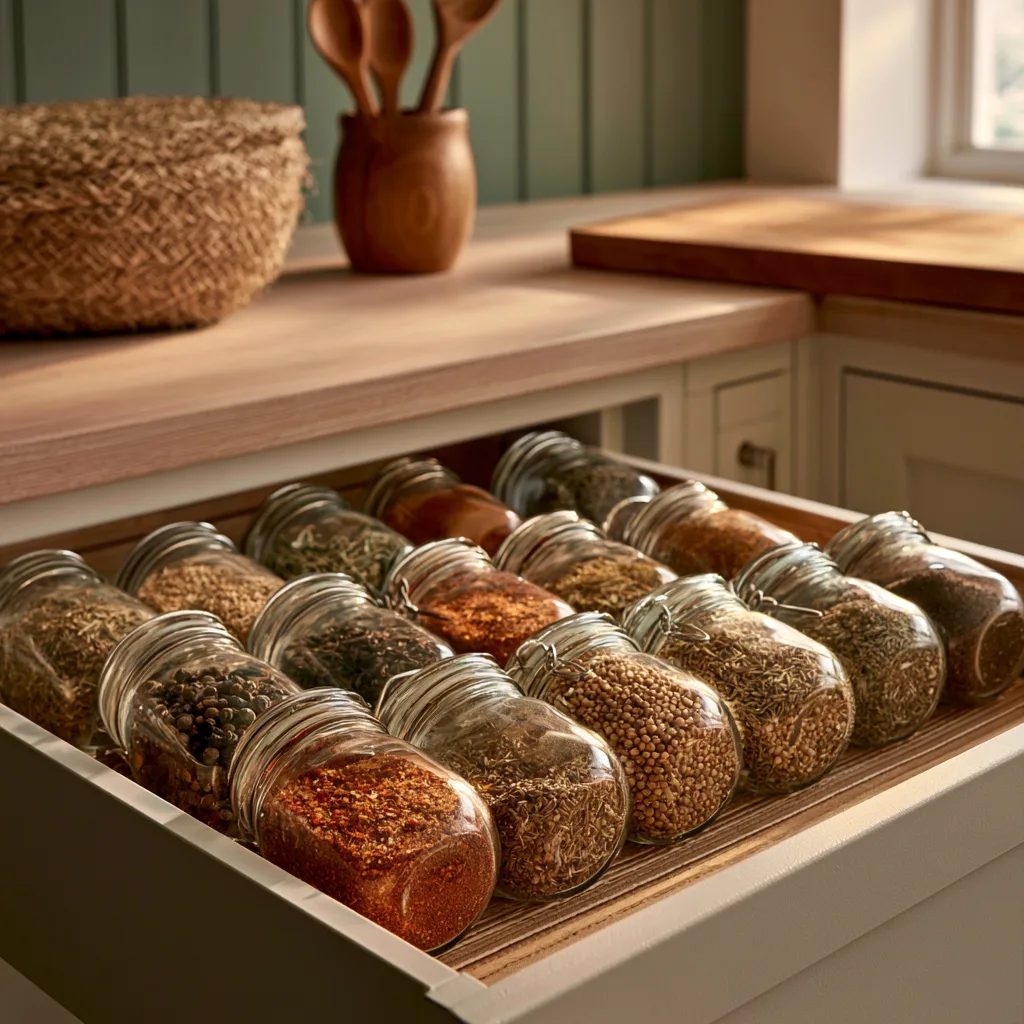
A shallow drawer holds 30 jars in three rows and shows you the front ten. The two rows behind them are storage rather than access.
A spice drawer that needs unloading before you can find anything has stopped being a drawer. It is a box with a handle on it.
A tiered insert fixes this by lifting each row above the one in front. It costs depth you do not have in a 2.5 inch drawer, which is why the inserts sold for it are angled rather than stepped.
What makes a shallow drawer work
- An angled insert rather than a flat tray, so the back rows tilt toward you
- One row of everyday jars at the front, unangled and grab-able
- Side labels facing the front edge, all in the same orientation
- Nothing behind the third row, since a fourth row is invisible
- A liner that grips, so opening the drawer does not shuffle the order
Keep a shallow drawer to three rows and put the daily ten at the front.
The third row is the one to watch. It works while the drawer is full and stops working the moment a jar in front of it goes missing and the order shifts.
A gripping liner solves that for a few pounds. Without one, every pull rearranges the drawer slightly, and after a month the order you set has gone.
Labelling for the face you will read
Lid labels are the cheapest upgrade in this whole article, and they are what makes a deep drawer work. Print or write them once, and they last for years.
Write the name and the month it was opened. The second one matters more than it looks, and it is the thing bought labels never carry.
What goes on the label
- The name, in a size readable at arm's length
- The month and year it was opened
- Whole or ground, since the two age at very different rates
- Nothing else, because a crowded label reads slower than a sparse one
- The same font and orientation on every jar, so the eye scans rather than reads
Write the opening month on every jar, since that is the only thing that tells you when to replace it.
A printed date on the jar is a manufacture or best-before date, and it tells you nothing about when the seal was broken. The clock that matters starts the first time you open it.
The same visibility problem shows up wherever small items get stacked, and the answer is the same. One visible layer beats any stacked system whether the items are lids or jars.
Most of the drawer is not in use
A household cooking normally reaches for eight to twelve spices in a month. A drawer holding forty means roughly three-quarters of it is sitting still.
| Jars owned | Used in a month | Sitting still |
|---|---|---|
| 30 | 8 | 22 jars, 73 percent |
| 40 | 10 | 30 jars, 75 percent |
| 50 | 12 | 38 jars, 76 percent |
That is not a fault on its own. Some of those jars are for dishes you cook twice a year and you want them there when you want them.
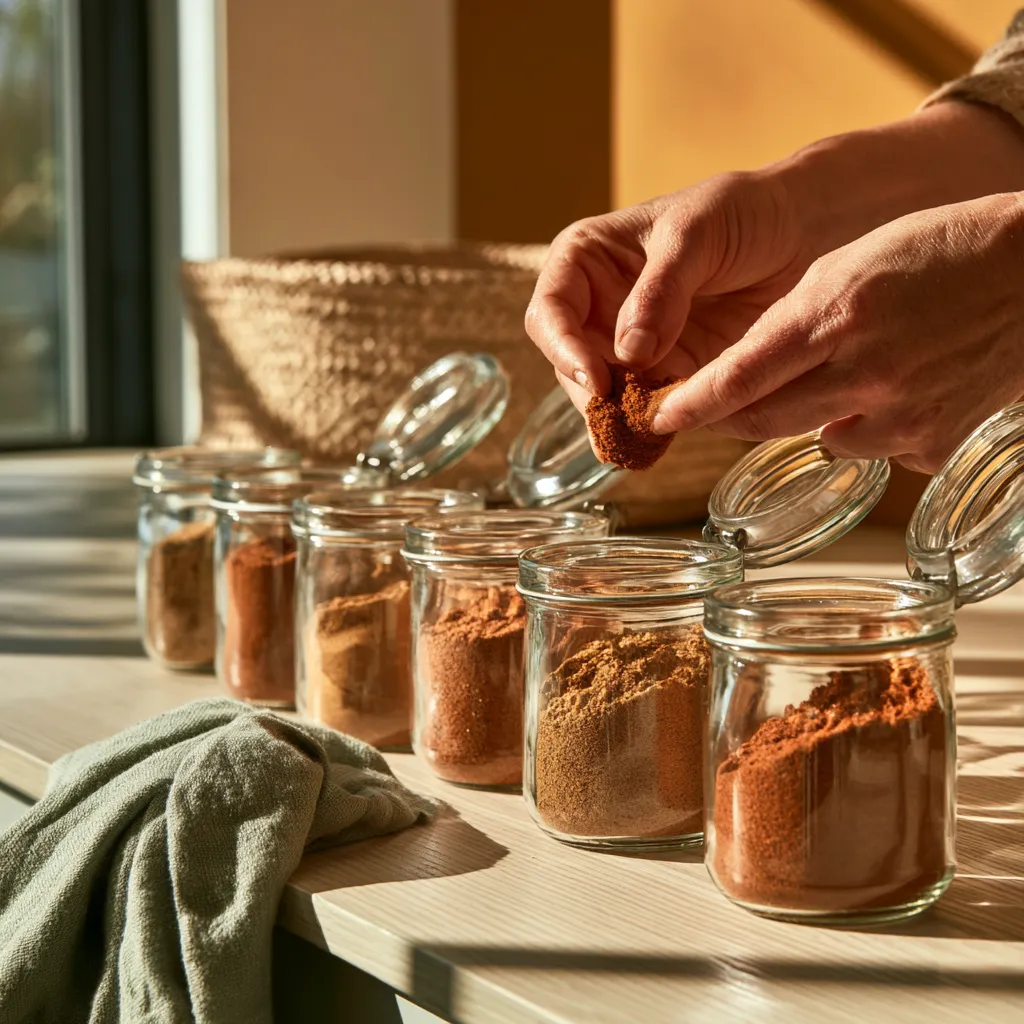
What makes it wrong is age. Iowa State University Extension notes that herbs and spices do not spoil, they lose flavour and potency, and suggests checking them with a rub and a smell rather than trusting the date on the jar.
A jar that has been sitting for three years is taking a slot and contributing nothing to the food. That is the honest test, rather than whether it is still safe.
Whole spices outlast ground ones by years because less surface is exposed. Buying peppercorns rather than ground pepper buys time as well as flavour.
Rub a pinch between your fingers and smell it, and replace anything with no aroma left.
Do the rub test on every jar in one sitting rather than one at a time. Your nose adjusts within a few jars, so work in batches of eight with a break between, and open a window. Testing forty jars in a closed kitchen produces forty jars that all smell the same by the end.
Out on the first pass
- Anything with no smell when you rub it
- Duplicates bought because the first jar was invisible in the drawer
- Blends for one recipe you made once
- Jars with no label at all, which cannot be identified safely
- Anything that has clumped solid, which means moisture got in
Duplicates are the mechanism worth stopping rather than the symptom worth clearing. The point in the buying loop worth interrupting applies to spices as much as to anything larger.
Read more: the fast, slow and dead stock system for a small pantry
Decanting, and when it earns the work
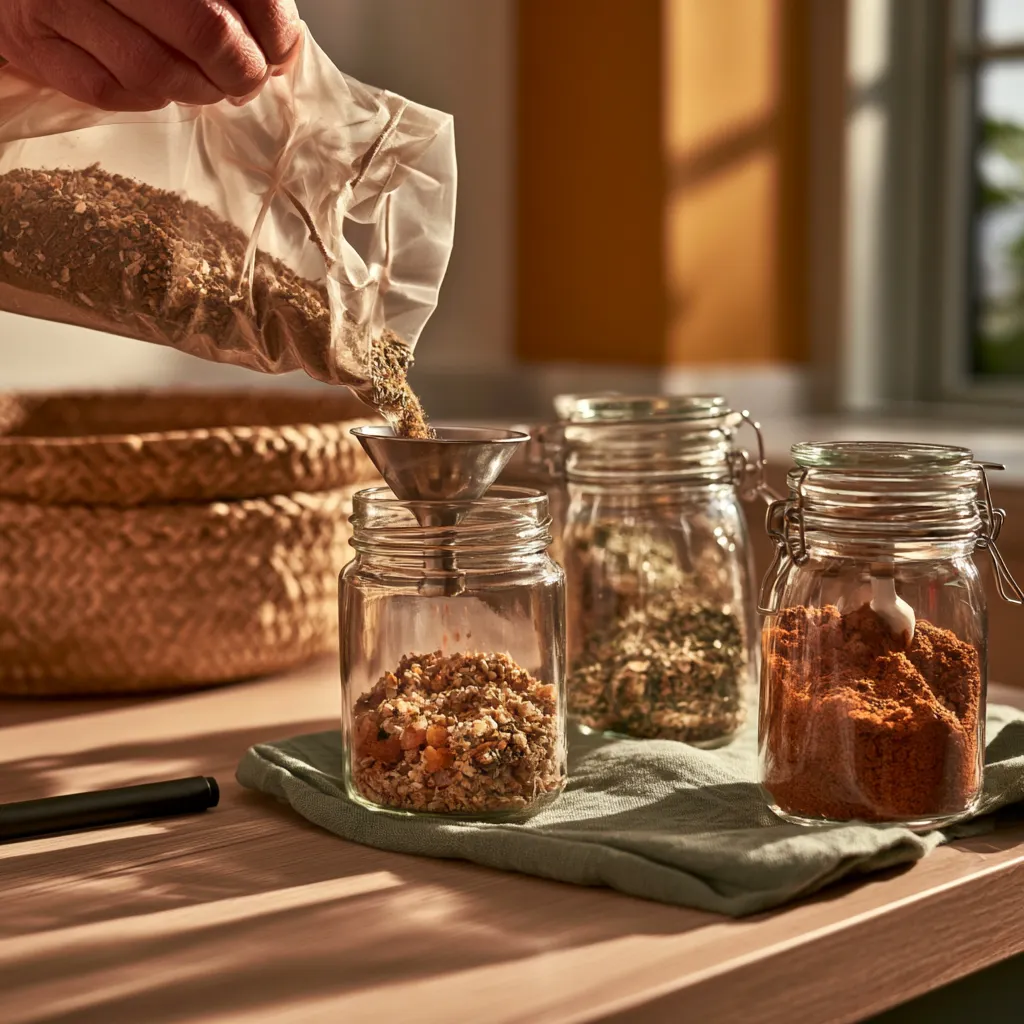
Decanting into matching jars is the photograph everyone has seen and it is genuinely useful for one reason. Uniform jars tessellate and mixed jars do not.
A drawer of shop jars in five sizes wastes the gaps between them. A drawer of one size wastes none of it, which is where the extra capacity comes from.
When decanting is worth the afternoon
- You have thirty or more jars, where the gaps add up
- The drawer is deep enough to stand them, so lids can be labelled
- You buy refills in bags rather than replacement jars
- You will write the opening date on each one, which shop labels never carry
- Not worth it for under fifteen jars, where a rack costs less and does the same
Decant only if you will label the lids, since undecanted jars at least carry a name on the side.
Glass beats plastic for this, and clear beats opaque in a drawer where light never reaches the contents. On a counter the reverse holds, since light degrades what is inside.
Buy one jar first and check it fits standing before ordering twenty four. A quarter inch of extra height is the difference between a drawer that closes and one that does not.
Refill bags cost less than replacement jars and they store flat, which is the other half of the case for decanting once rather than rebuying jars forever.
If there is no drawer to spare
A spare drawer is the exception rather than the starting point in a small kitchen, and the fallbacks each show a different face.
The alternatives, and what each shows you
- A tiered insert in a base cabinet, showing the label front
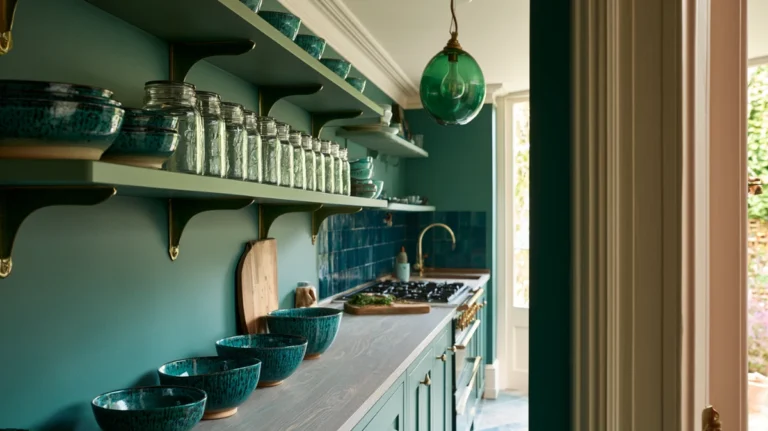
- A wall rack beside the hob, showing the side, at the cost of heat exposure
- The inside of a cupboard door, showing the side, for one row only
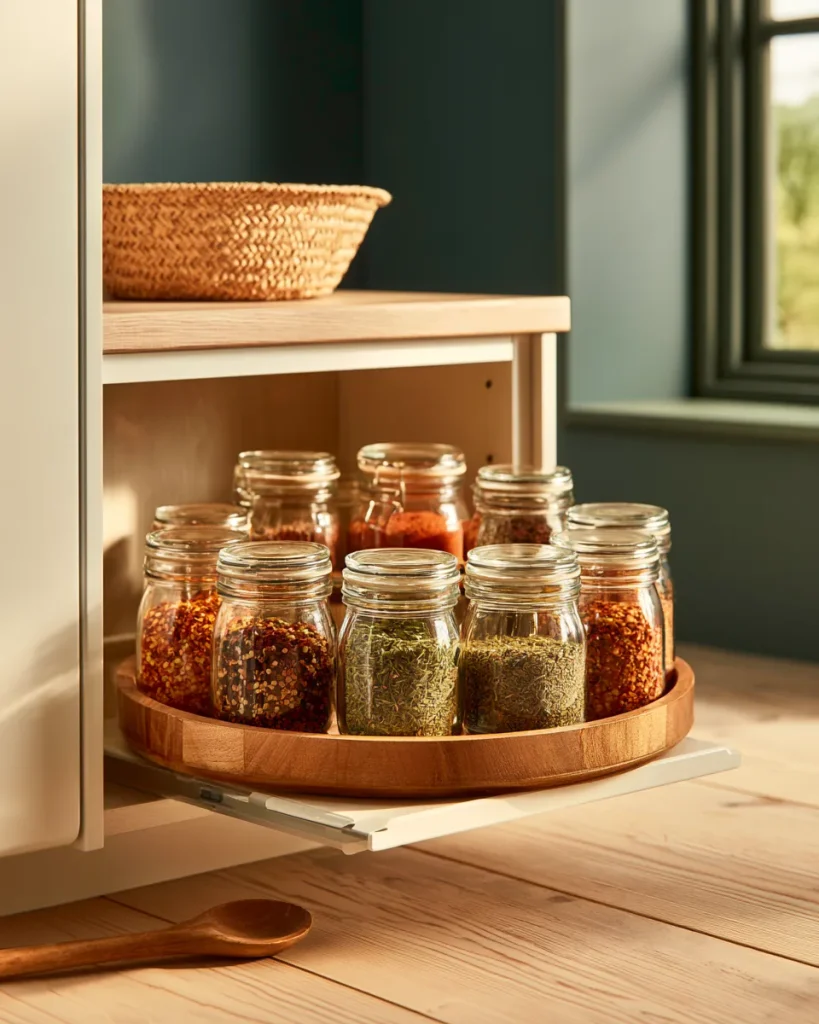
- A turntable in a corner cabinet, showing whichever side is turned to you
- A shallow bin pulled out like a drawer, showing the lid
The wall beside the hob is the tempting one and it is the worst climate in the room for anything you want to keep. Why distance from the hob decides what a wall can hold rules it out for spices specifically.
Keep spices away from the hob and the window, since heat and light both cost potency.
The rack beside the cooker is the single most photographed spice storage idea and the worst performing one. It sits in the hottest, greasiest air in the room.
A corner cabinet is usually the least used volume in a small kitchen and a turntable makes it reachable. The dead depth in a standard base cabinet is where the space has been hiding.
Sorting order inside the drawer
Alphabetical is the default and it is the wrong default. You reach for spices by how often you use them, not by their first letter.
Frequency order puts the daily eight at the front and everything else behind. It is faster to use and slower to explain, which is why alphabetical wins by accident.
Sort by frequency at the front and alphabetically only within the back rows.
Baking spices are the exception worth grouping, since they get used together and in a batch. Keep cinnamon, nutmeg and cloves adjacent whatever the frequency says.
A spice drawer sorted by frequency needs resorting about once a year, when what you cook shifts. Alphabetical never needs resorting and never gets faster either.
Read more: the counter budget that gets spent without anyone noticing
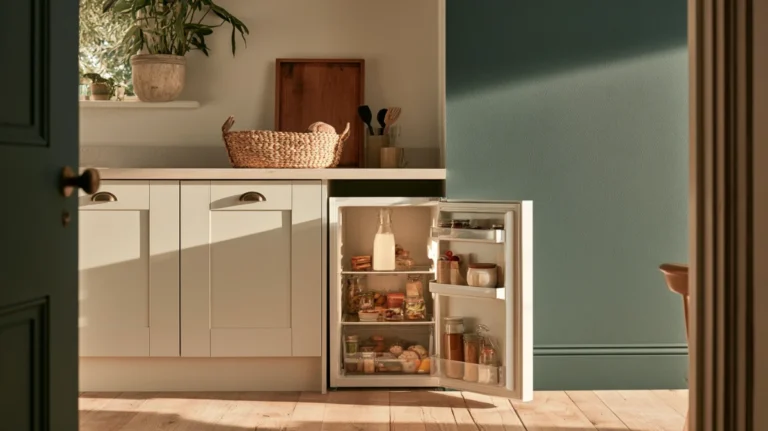
The fridge takes a handful of things people assume belong in a spice drawer, and the climate rules there are different again. Which of five fridge zones each item belongs in settles paprika, chilli flakes and anything ground from fresh.
Read more: the room by room sequence that stops a clear out stalling
Working through it
Each step below removes options from the next one, which is why the insert is bought last rather than first.
The sequence
- Empty the drawer and rub and smell every jar
- Discard anything with no aroma, no label or a solid clump
- Measure the drawer depth and decide standing or lying
- Choose the method, which fixes which face you will read
- Label that face on every jar, with the name and the opening month
- Buy the insert last, sized to what is left
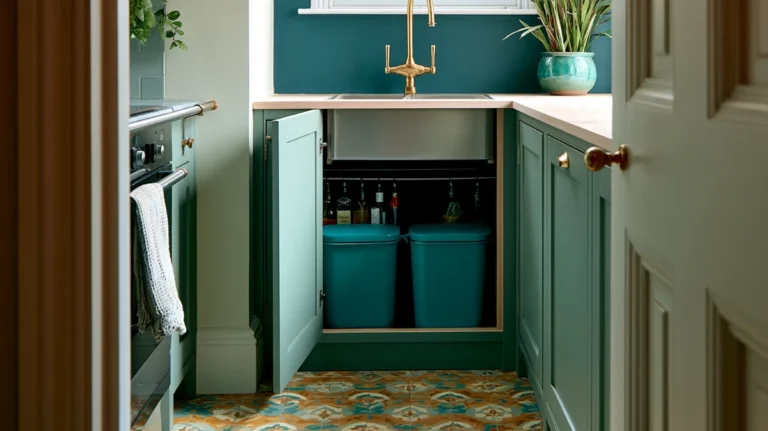
The cupboard under the sink is often where the overflow ends up, and it is the wrong home for anything that minds damp. What belongs in that cupboard and what does not rules spices out of it entirely.
Anything that came out of the drawer and still deserves keeping needs a home with a rotation habit attached. The vertical inches a small kitchen usually leaves empty is where to look for it.
A spice drawer stays sorted when the label faces the way you look at it. Everything else in this article is capacity, and capacity was never the reason the drawer stopped working.
The whole job is an afternoon and a marker pen. The insert is optional, the jars are optional, and the labels are not.