

Under kitchen sink storage fails for a reason no other cabinet in the house has to deal with. There is live plumbing inside it.
Water arrives two ways. It comes in under pressure through the supply lines and leaves by gravity through the trap, and every one of those connections is a joint that eventually weeps.
That is the whole difference between this cupboard and every other one. Under sink storage is storage inside a plumbing enclosure that happens to have a door on it.
So the sorting question is not which bin fits. It is what a slow leak would do to each thing you are about to put in there.
The geometry comes second, and it is stranger than it looks. Most of the full height in the cabinet sits in two narrow channels at the sides, not in the middle where you are reaching.
Under kitchen sink organization advice almost always starts with containers. They are the last decision rather than the first.
Buying them early is how a cupboard ends up with a bin that stops the door from closing.
The cabinet is not the box you think it is
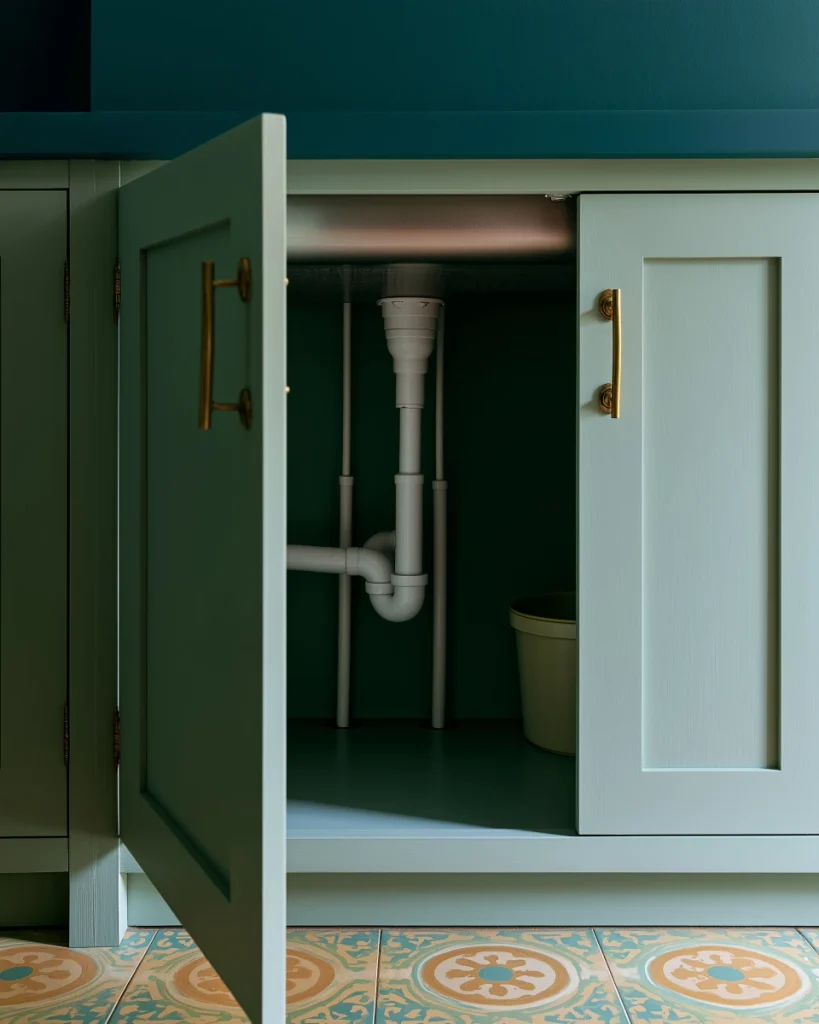
A 36-inch sink base gives you roughly 34 inches of interior width, 22 inches of depth, and 30 inches of height once the toe kick is taken off, on paper, that is 13 cubic feet.
The bowl removes the middle of it. A bowl 22 inches wide and 8 inches deep, plus its mounting hardware, hangs down about 9 inches below the underside of the counter.
That leaves 21 inches of clear height through the centre of the cabinet. The full 30 inches survives only at the two sides, outside the width of the bowl.
Where the height really sits
Each side channel works out around 6 inches wide. Narrow, and the only place in the whole cabinet where something tall can stand upright.
A spray bottle base is around 4 inches square, so a channel takes a single file of bottles with 30 inches of clear air above them.
That is the opposite of how people load the cabinet. The sides get ignored because they are awkward to reach, and the middle gets stacked until it fouls the bowl.
The door opening lies to you
The gap between the open doors is narrower than the interior behind it. Hinges and the cabinet stiles eat an inch or two at each edge.
That gap is what limits what you can get in and out, though, so it caps the width of any rigid bin regardless of how much room sits behind it.
Measure the door opening and the interior separately, and buy to whichever is smaller.
What the trap costs you
The P-trap takes a block out of the centre roughly 10 inches in every direction, and it sits back from the door rather than against it.
Subtract the bowl and the trap, and the usable volume comes to about 9.9 cubic feet. That is 76 percent of the figure you get by multiplying the door opening.
The missing quarter is why so many organizers bought on width alone go back to the shop. The width was never the constraint.
| Zone | Clear height | Width | Usable volume |
|---|---|---|---|
| Left side channel | 30 in | 6 in | 2.3 cu ft |
| Right side channel | 30 in | 6 in | 2.3 cu ft |
| Centre, under the bowl | 21 in | 22 in | 5.3 cu ft |
| Total after bowl and trap | 9.9 cu ft | ||
| Naive door-opening figure | 13.0 cu ft |
Measure the clear height under the bowl and the width of each side channel before buying any organizer.
The numbers above assume a 36-inch cabinet with an 8-inch bowl. Run yours with a tape measure, because a double bowl or a deeper sink shifts every figure.
A two-tier riser in the centre gets 10.5 inches per tier. A full-size spray bottle runs 10 to 12 inches, so the sprays go on the bottom and only short items fit above.
A waste disposal unit removes most of this discussion. It takes one side of the cabinet entirely and leaves a single channel plus whatever clears the motor housing.
If yours has one, the wider storage moves for a kitchen with no spare room matter more than anything you can do inside this cupboard.
What water cannot touch
Start with the things a leak would not care about, because those are the only items that belong on the floor of the cabinet.
Organizing under the kitchen sink gets much simpler once this pass is done, because the list of survivors is short enough to place by hand.
Everything on the list below dries out and continues working. None of it becomes more dangerous when it is wet, and none of it hides the damage.
Safe on the cabinet floor
- Plastic and glass bottles with intact caps
- Rubber and silicone gloves
- Stainless or plastic buckets and washing-up bowls
- Scrubbing brushes with plastic handles
- Sealed plastic tubs of dishwasher tablets
Notice how short that list is. Almost nothing else in a normal cleaning cupboard passes the test, which is the point of running it first.
A bucket is the single best object to keep down there. It survives water, it holds other things, and it doubles as the container you carry out to clean with.
Pans get stored here in kitchens with no other option. The weight is fine on a cabinet base, and the damp is the reason to look elsewhere first.
Try the hanging and lid options that keep pans out of a wet cupboard before giving them the floor of this one.
What a slow drip ruins without showing it
The second group survives a splash and dies from a slow drip. The damage stays invisible for weeks because the packet still looks fine from the front.
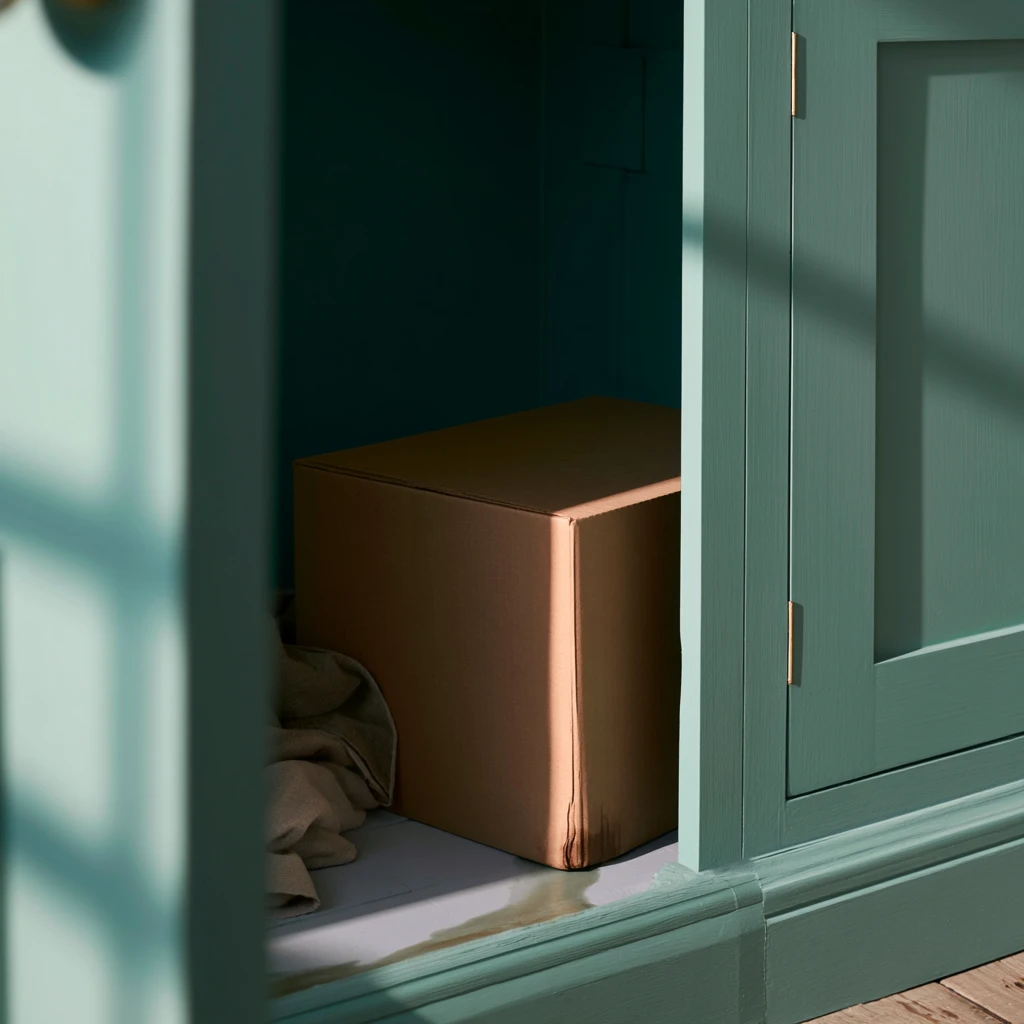
Cardboard is the worst of them. It does not fail where the water is, it draws moisture up the corrugations and softens near the top, which is exactly where you grip it.
Move these off the floor and into the side channels
- Cardboard boxes of anything, which wick water upward
- Paper towel and bin liner rolls
- Sponges and cloths, which stay damp and start to smell
- Spare bulbs in their cardboard sleeves
- Pet food, which spoils and draws insects
- Anything with a paper label you still need to read
Food of any kind is the clearest case. It belongs in a dry cupboard with a rotation habit, and the fast and slow mover system that keeps stock moving works nowhere near a water supply.
Decant anything that arrives in cardboard into a sealed plastic tub before it goes under the sink.
What gets worse when it gets wet
The third group changes character rather than just spoiling. Wet does not only ruin these items, but it also makes them behave differently.
These should not be in the cabinet at all
- Powdered products, which cake into a solid block
- Steel wool and bare metal, which rust into whatever it is sitting on
- Batteries, whose contacts corrode where you cannot see them
- Extension leads, chargers, anything with a plug on it
- Small appliances kept down there to save counter space
Nothing with a plug on it goes under a sink, at any height in the cabinet.
Bleach and ammonia-based cleaners are the other pair worth separating. Keep them apart, keep both capped, and follow the standing advice never to mix cleaning products.
A leak that reaches two open containers can bring their contents together inside a closed cupboard with no ventilation. That is the argument for capped bottles in their original packaging, and it costs nothing to follow.
Cleaning supplies collect in more than one place, and the duplicates come from forgetting what is already down there.
The point in the buying loop where that stops is worth knowing if you own three of the same spray.
Read more: where cleaning kit ends up when the laundry area is doing double duty
Damp, which is not the same thing as a leak
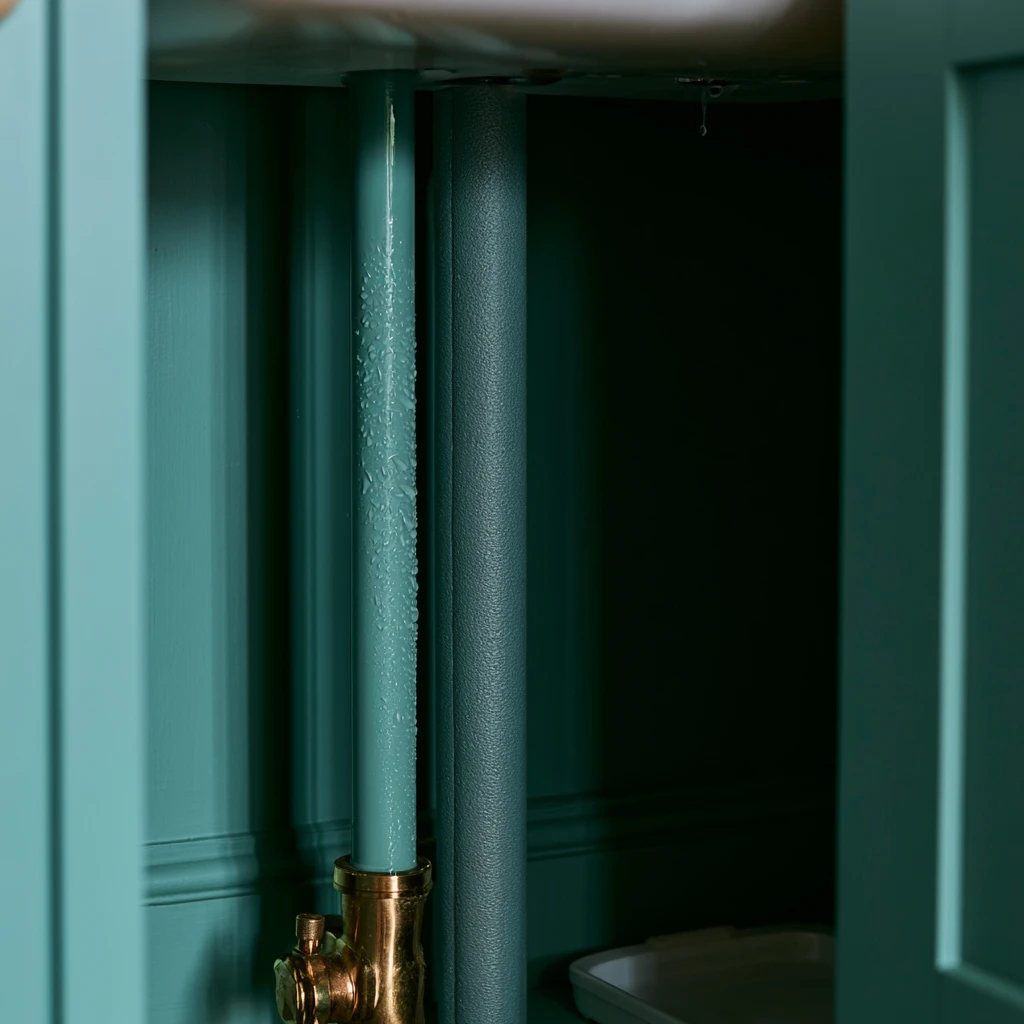
A cabinet can be dry and still be humid. The doors stay shut, the space is unventilated, and the cold water pipe runs through it at mains temperature.
In a warm kitchen, that pipe sits below the dew point for part of the day, so it sweats. The water is not coming from a joint, it is condensing out of the air onto the pipe.
That is why a cabinet with no leak at all still smells musty and still swells at the back corner. The volume is small, and the moisture has nowhere to go.
An under kitchen sink cabinet that stays dry underneath and still smells is almost always doing this. The fix is airflow and pipe lagging, not a stronger cleaner.
Lag the cold supply pipe with foam sleeving before you buy anything else for a damp cabinet.
What to do about a cabinet that is damp rather than leaking
- Leave the doors open for an hour after any big clean
- Lag the cold supply pipe with foam sleeving, which stops the sweating
- Keep a gap between stored items and the back wall so air can move
- Leave nothing porous sitting directly on the cabinet floor
- Put a moisture absorber in the cabinet and replace it when it fills
Renting, and what you are allowed to touch
Under kitchen sink storage in a rental has one extra constraint. You cannot alter the plumbing, and in most tenancies you should not be trying to.
That rules out re-routing a trap, moving a shut-off valve, or fitting anything that needs a pipe cut. It leaves everything else on this page intact.
It also changes what you do when something drips. A weeping joint is a landlord repair, and delaying it makes the cabinet base your problem instead of theirs.
Photograph the joint and the date before you report a leak, so the repair record starts when you noticed it.
Foam pipe lagging, tension rods, trays and free-standing bins all come out cleanly at the end of a tenancy, which is the same test that decides what furniture is worth buying for a rented studio.
The chemicals, and who else can reach them
The under kitchen sink cabinet is where a household keeps its cleaning products, and it sits at precisely the height a small child reaches without climbing anything.
The scale of that is documented. US poison centre data for 2024 shows 99.2 percent of reported exposures in children under six were unintentional.
Cleaning substances sit among the substances most often involved in that age group, and this cabinet is where they live in almost every home.
Unintentional means exploratory. It means the door was unlatched and the bottle was at hand height, not that anybody in the house was careless.
What changes if a child under six lives in the home or visits it
- Move cleaning products to a high cabinet rather than latching a low one
- Keep everything in its original container with the label intact
- Re-close child-resistant caps fully every single time
- Keep the poison centre number somewhere you can reach it fast: 1-800-222-1222
- Treat visiting children as living there for storage purposes
Move the chemicals up rather than latching them in, because a latch is one failure away and height is not.
That empties most of the cabinet, which is a good outcome. What is left is buckets, gloves, brushes, and bin liners, and none of those need to be anywhere else.
It also frees the side channels, which were the hardest space to use. Long-handled brushes and a folded step stool stand up in a 6-inch channel, and nothing else will.
The same reach argument applies to every low cupboard in a home with small children, and the low storage that is designed to be reachable should be the only low storage they can open.
Containers that clear the trap
Now the shapes. Anything that assumes a rectangular cabinet will foul the trap, which is why the returns shelf at every homeware shop carries under sink organizers.
What fits around the plumbing
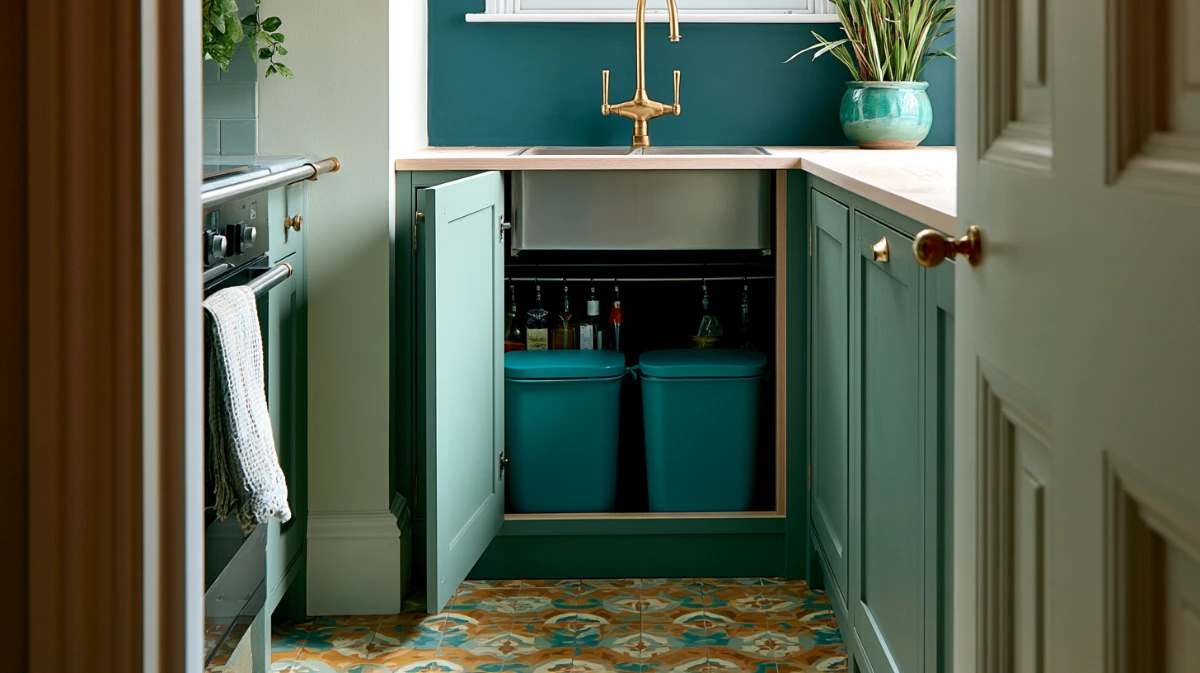
- Two narrow bins, one per side channel, rather than one wide one
- A split or U-shaped riser that straddles the trap instead of meeting it
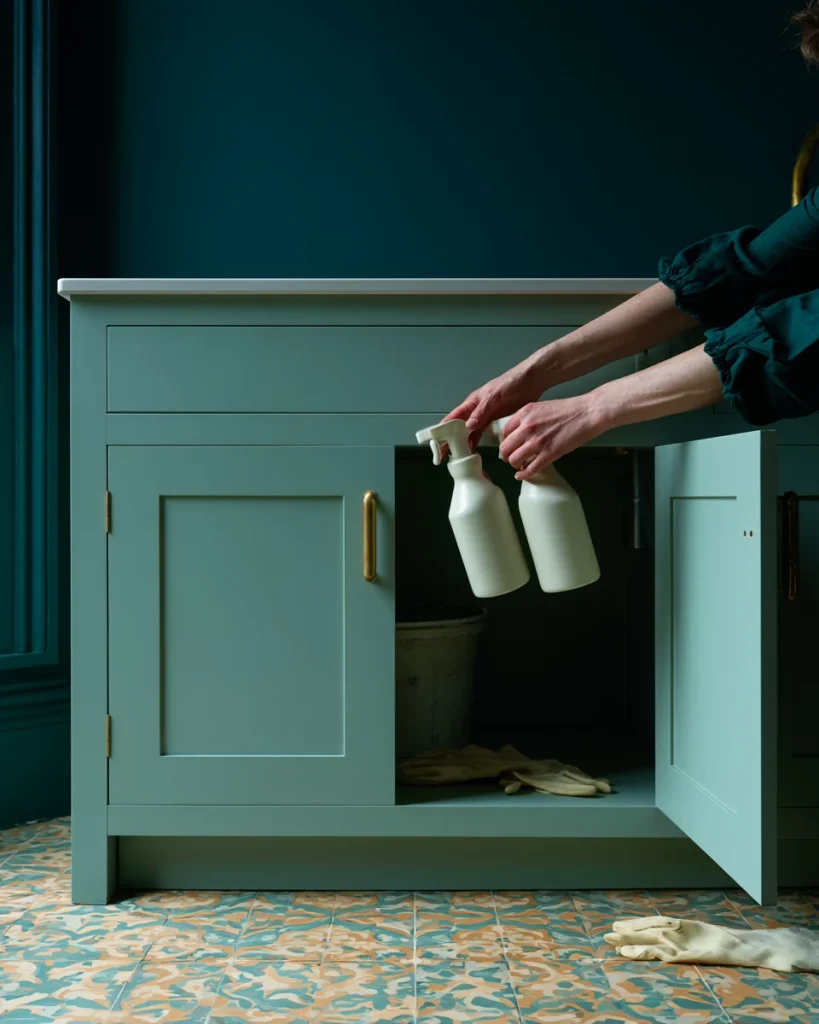
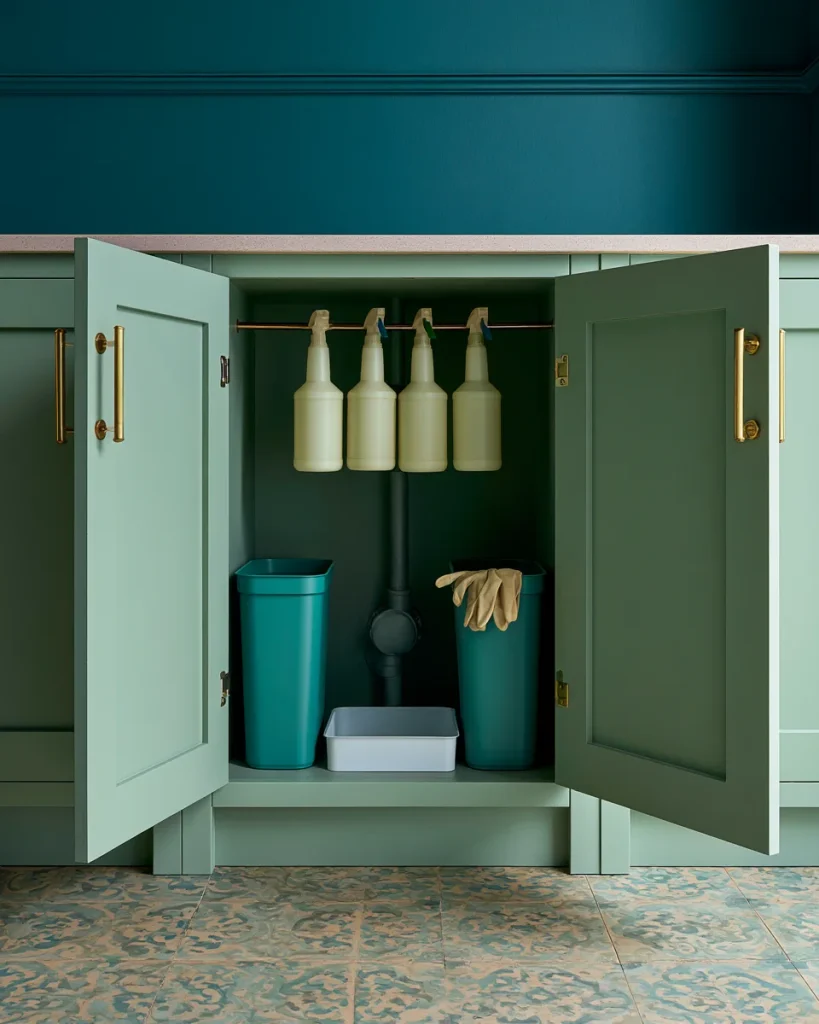
- A tension rod across the cabinet with sprays hung by the trigger
- A shallow pull-out sized on the depth from the door to the trap
- An over-door rack for flat, light items only
The tension rod is the highest value item on that list and the cheapest. Hung by the trigger, a row of sprays uses the vertical air the bowl leaves empty above them.
Most under kitchen sink organizers are sold on width, which is the one dimension that was never in short supply. Depth and clear height are what decide whether a thing fits.
Buy two narrow bins instead of one wide one, because a wide one can only ever sit in front of the trap.
Measure the pull-out on depth rather than on width. The number that matters is how far back the trap sits from the closed door, and it is usually smaller than it looks.
The wall above the sink has the opposite problem, and it gets solved with different materials. Why anything mounted in the steam zone has to be slatted or wire is the other half of this cabinet.
Awkward volumes are a running theme in small kitchens, and the same measure-first habit applies to the cabinets and drawers that are not carrying their share.
Shallow and wide beats deep and stacked almost everywhere in a kitchen, which is why a single-layer drawer works better than any tiered rack for anything small enough to lose.
Over-door racks are the one item people consistently overload. They hang on the door, so every gram of it swings on two hinges that were sized for a panel.
Keep them to bin liners, cloths, and gloves. A door rack full of full bottles will drop the door out of alignment within a year.
The same caution applies to any under sink organization system that hangs rather than stands. Weight on a hinge is borrowed, and the door pays it back.
Read more: what should be sitting out on the counter once this cupboard is sorted
The check that takes thirty seconds a month
Everything above assumes you will notice a leak. Under a sink, behind a bin, in the dark, you will not, unless you look on purpose.
A slow weep does its worst damage before it produces a puddle. By the time water appears on the kitchen floor, the cabinet base has usually been wet for weeks.
The monthly look
- Run a dry hand around both supply line connections
- Feel the trap joints and the underside of any disposal unit
- Lift whatever is sitting on the cabinet floor and touch the board
- Look for a dark line or a swollen edge at the back corners
- Check the seal where the sink meets the counter, from above
A shallow tray under the trap turns an invisible leak into an obvious one. Water pools where you can see it instead of soaking straight into chipboard.
A white tray works better than a dark one, because a small amount of water is visible against white and invisible against black plastic.
Tie the check to something you already do monthly rather than setting a reminder for it. Thirty seconds attached to an existing habit survives. A standalone reminder does not.
Put a shallow tray under the trap and check it on the same day you do anything else monthly.
A cabinet base that has already swollen does not recover. Replacing one is a bigger job than it looks, and it is the reason the tray is worth the two minutes.
Read more: the drawer that keeps every small container visible instead of stacked
Sort by what a leak would damage, then fit the shapes around the plumbing. The cabinet gets much easier once you stop treating it as a cupboard that happens to have a pipe in it.
It is a wet space you are borrowing for storage, and the things that live there should be the things that do not mind.
Get that right, and under kitchen sink storage stops being the cupboard nobody opens. It becomes the four or five objects you reach for and nothing else.