

Home office organization ideas mostly fail because they treat everything as the same problem. Only one thing on your desk keeps arriving, and that is paper. Cables, supplies, and the surface are one-time jobs you have not finished.
So which of the things on your desk will be back tomorrow, no matter what you do today?
Paper will. Everything else stays put once it has a place, which is why the fix for each is completely different.
Paper Is the Only Thing That Keeps Arriving
A cable does not multiply overnight. Paper does, and it arrives whether or not you have a system waiting for it.
That makes paper the only part of a home office that needs a recurring process rather than a container.
Cables, pens, and the surface all sit still. Sort them once, properly, and they stay sorted until something changes.
Home office organization ideas that treat a cable drawer and an inbox as the same job will fix neither.
That difference is what the rest of this is built on, so it is worth being sure it is true in your room before reading on.
Why filing systems fail
Most filing systems sort by category. Finance, house, work, medical.
Category sorting requires a decision at the moment paper arrives, and that decision is what nobody makes on a Tuesday evening.
Sort by what has to happen to it instead. There are only three answers.
Action, retention, or bin. Every sheet that has ever crossed a desk fits one of them.
- Act on it, which means it needs a date
- Keep it, which means it needs a retention period
- Bin it, which is most of the pile
What actually has to be kept, and for how long
Retention is where people hoard, because nobody wants to be the person who binned the wrong thing.
That fear is doing a lot of work in a filing cabinet, and almost none of it is justified.
Scan anything you are genuinely unsure about, then bin the paper. A scan takes twenty seconds and settles the argument.
Keeping a sheet because it might matter is how a two-drawer cabinet becomes four.
The periods are published rather than a matter of judgement. The IRS sets how long to keep records supporting a return, and most of a filing cabinet falls outside them.
| Document | Keep for | Then |
|---|---|---|
| General tax return and supporting records | 3 years from filing | Shred |
| Claim for a loss from worthless securities or bad debt | 7 years | Shred |
| Records where income was understated by more than 25 percent | 6 years | Shred |
| Employment tax records | 4 years after the tax is due or paid | Shred |
| Any year no return was filed | Indefinitely | Keep |
Everything not on that list is a preference, not a requirement. Utility bills, delivery notes, old manuals and expired warranties are all preference.
Manuals in particular are worth binning on sight. Every one of them is a search away online, in a version that has been corrected since.
The preference pile usually breaks down like this:
- Manuals and setup guides, bin, all of them are online
- Utility and phone bills, bin once paid unless you claim them
- Delivery notes and receipts under warranty value, bin
- Bank statements, bin, the bank keeps them longer than you will
- Warranties and proof of purchase, keep for the life of the item
Warranties are the one exception. Keep those for the life of the item and no longer.
The one rule that empties a filing cabinet
- Pull every folder older than three years.
- Keep only what matches a row in the table above.
- Shred the rest in one sitting rather than reviewing it twice.
- Expect to keep under a fifth of what comes out.
The weekly paper pass
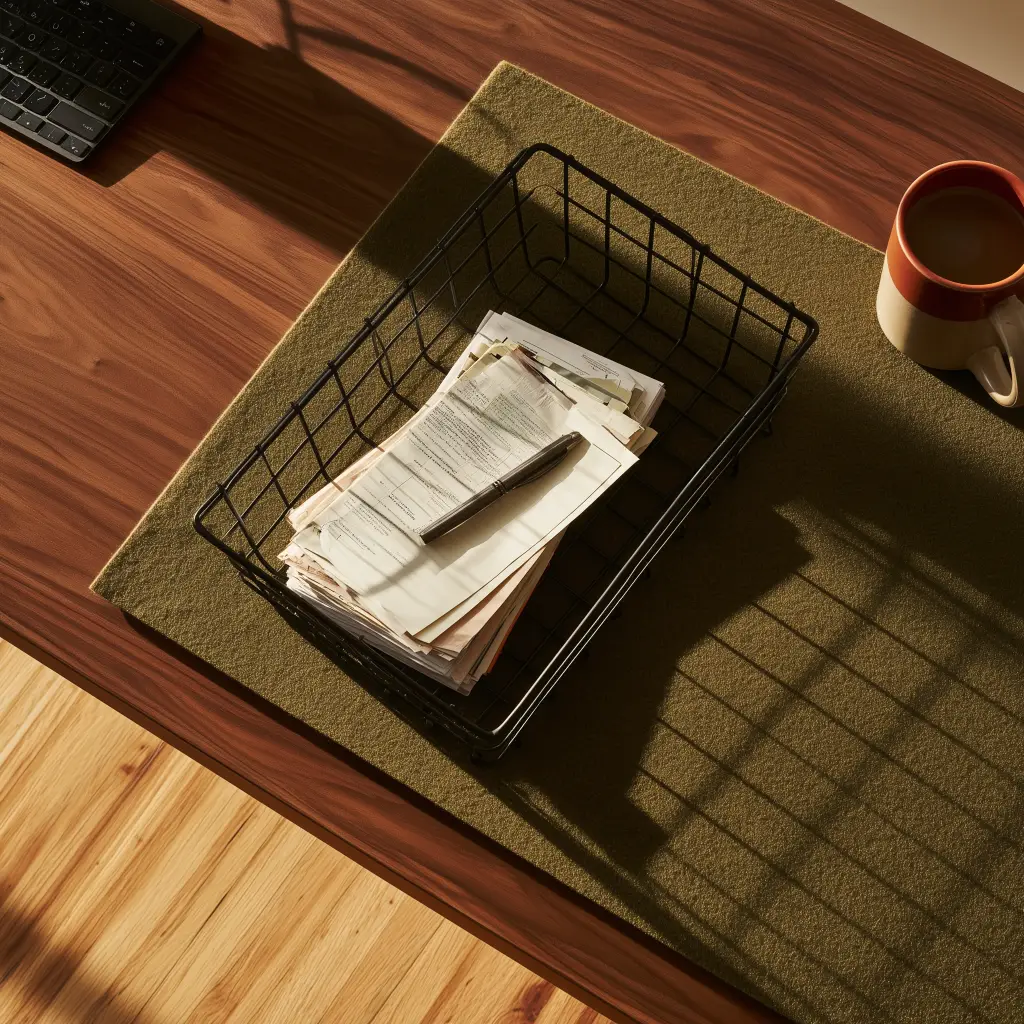
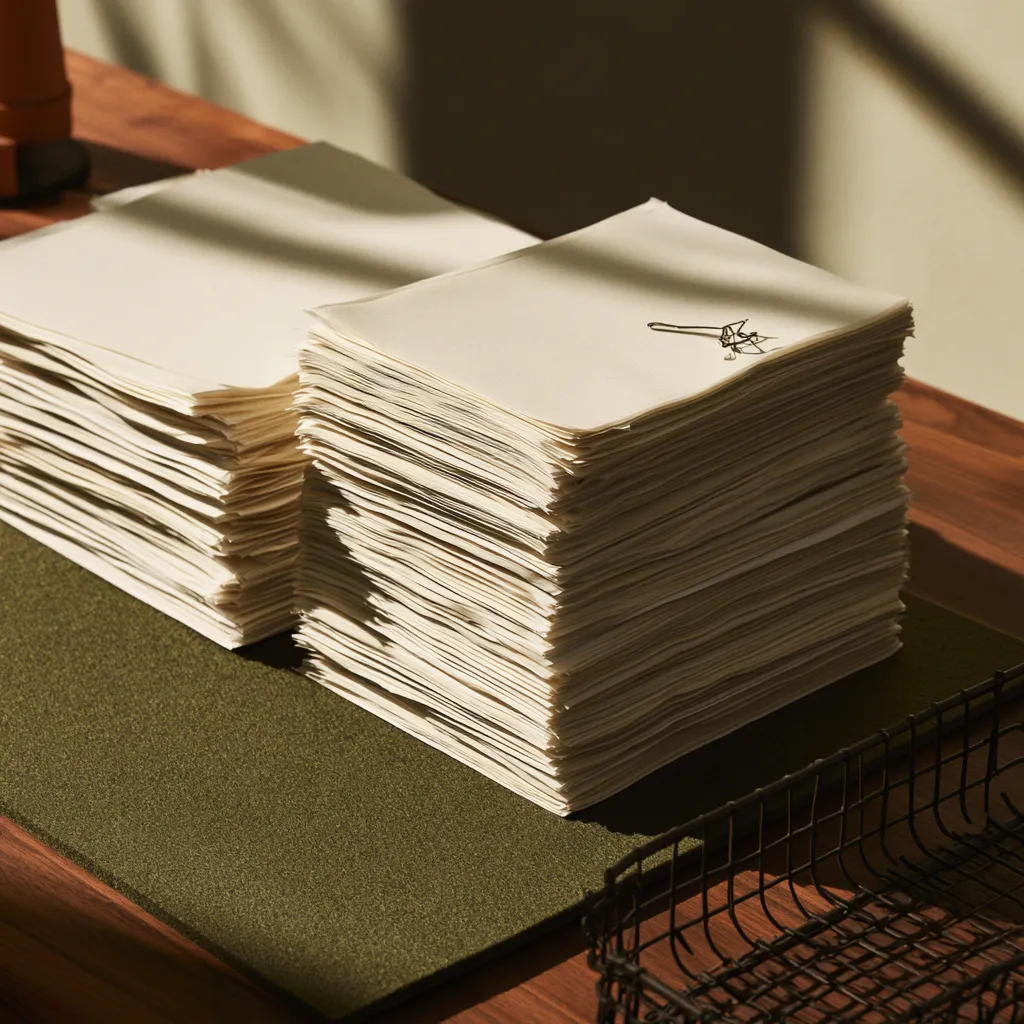
One tray, one time a week, ten minutes. Everything that arrives goes in the tray unopened until then.
Opening post as it arrives is what creates the pile, because opened paper needs a decision and closed paper does not.
The tray is allowed to look full. That is its job.
Pick a fixed slot, not a spare moment. Friday afternoon works because anything needing action lands before the week closes.
One tray only. Two trays becomes a sorting decision, which is the thing the tray existed to remove.
The tray should be shallow enough that a full one is obviously full. A deep tray hides three months of post.
Cables Are a One-Time Job, Usually Done Badly
Cables look like an ongoing problem and are not. They are a single afternoon that nobody has spent.
Do it once properly, and it stays done for years, until you buy a new monitor.
Budget ninety minutes and unplug everything first. Working around live cables is why the job gets abandoned halfway.
Bundle at the source, not in the middle
Most people gather cables halfway along their run, which is where the tangle already is.
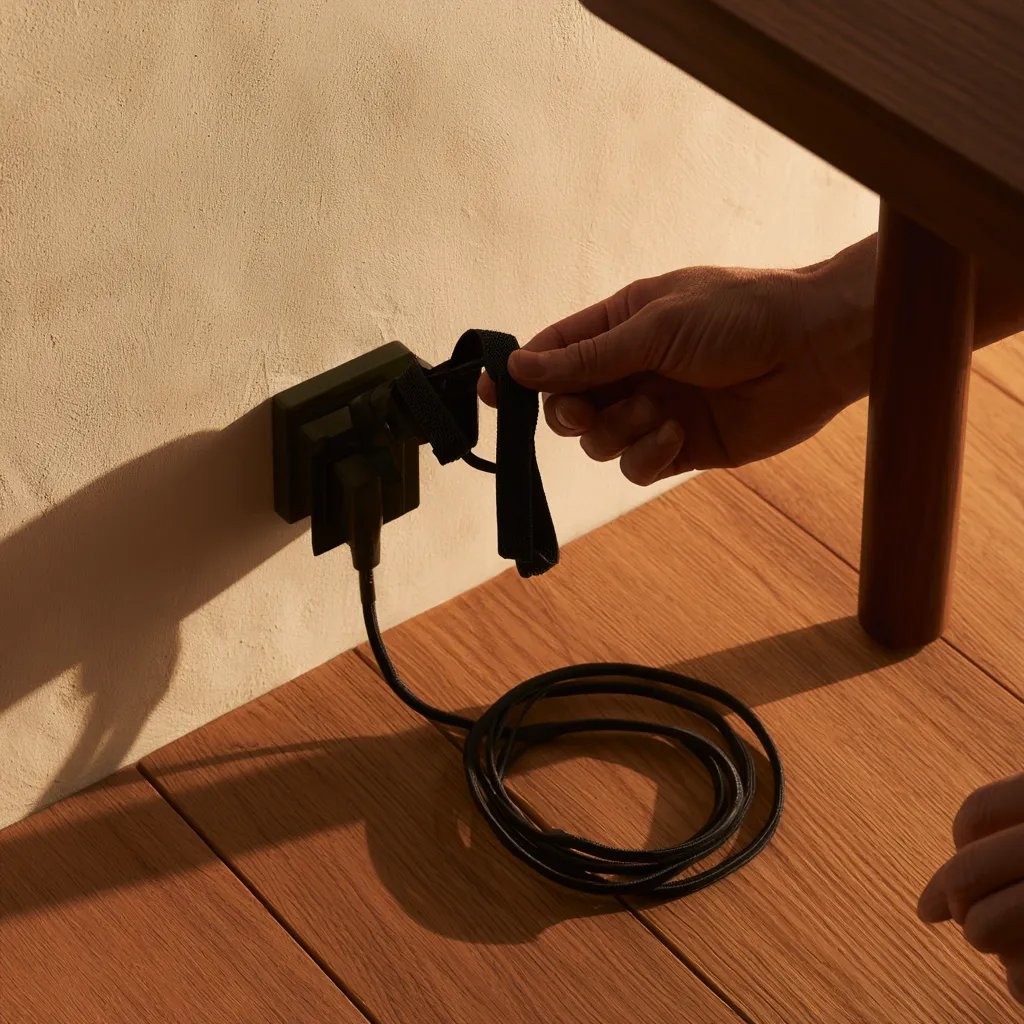
Tie within a few inches of the plug instead. The slack then falls behind the desk rather than across it.
Leave one loop of slack per cable. A cable pulled tight unplugs when the desk moves.
Reusable ties beat zip ties for anything you will touch again. Zip ties are for the run behind the desk that never changes.
A tray or channel under the desk holds the bundle off the floor, which matters more for cleaning than for looks.
What to label and what not to bother with
Label only the cables you will ever unplug: the laptop, the monitor, and anything charging.
Labelling all fourteen takes an hour, and you will read three of them, ever.
Label at the plug end, not the device end. The plug end is the one you are looking at when you need to know.
The ninety-minute version, in order:
- Unplug everything and pull the desk out
- Bin any cable that belongs to a device you no longer own
- Bundle each remaining cable at its plug
- Label the three or four you will unplug again
- Run the bundle into a tray and push the desk back
Half of most cable drawers belongs to devices that left the house years ago. That pass alone is worth the afternoon.
Power and outlet placement is a different job and belongs earlier in the process, since where the desk goes is decided by the outlets.
Supplies Need a Ceiling, Not a Container
Buying an organiser for stationery is the most common of all home office organization ideas, and it solves nothing on its own.
A drawer insert holds the pens you already have. It does not stop the next twelve arriving.
Stationery is unusual in that most of it arrives free. Conferences, packaging, other people, old jobs.
Free things bypass every buying rule you have, which is why the ceiling has to be about quantity rather than spending.
Refusing a free pen feels absurd in the moment and saves you a drawer over five years. Most home office organization advice never mentions it.
Set the number before you buy the container
Decide how many of each you keep, then buy a container that fits exactly that number and no more.
An organiser sized to your current volume is a permission slip to keep the current volume.
Test every pen before it goes back in the cup. Roughly a third will be dead, which is a third of the storage problem gone in five minutes.
Read more: the same ceiling logic applied to a desk surface
A working ceiling for one person
- Four pens and two pencils, in a cup on the desk
- One notebook in use, one spare in a drawer
- One pack of sticky notes, not five colours
- One roll of tape, one stapler, one pair of scissors
- Everything above those numbers goes in a single overflow box, out of the room
The overflow box
Anything above the ceiling goes in one box, and the box lives somewhere other than the office.
When a pen dies, you go to the box. When the box is empty, you buy.
Keeping the box outside the office is the part that matters. In the room, it becomes a second drawer within a month.
This is the same mechanism that works on any other supply cupboard in the flat, and it holds better when the whole household runs on it.
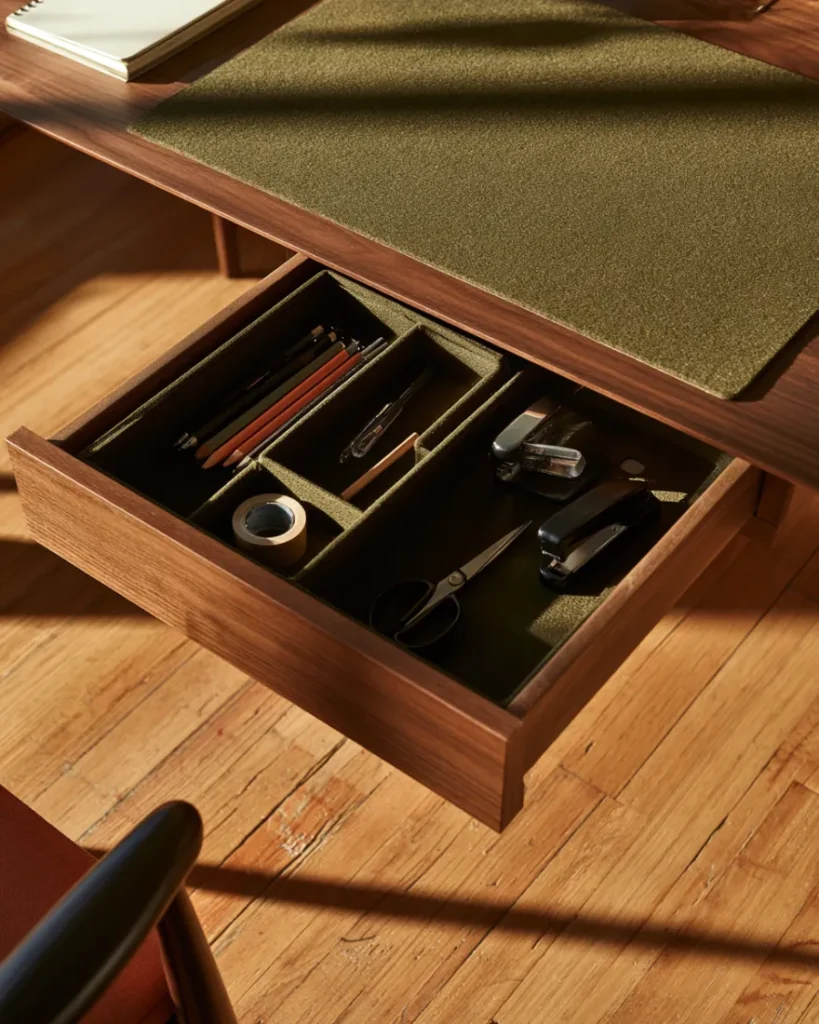
The Desk Surface Has Three Jobs and Room for One
A desk is asked to be a work surface, a storage surface, and a display surface. In a small room it can only be one.
Pick work, and move the other two onto the wall or into a drawer.
What earns a place on the surface
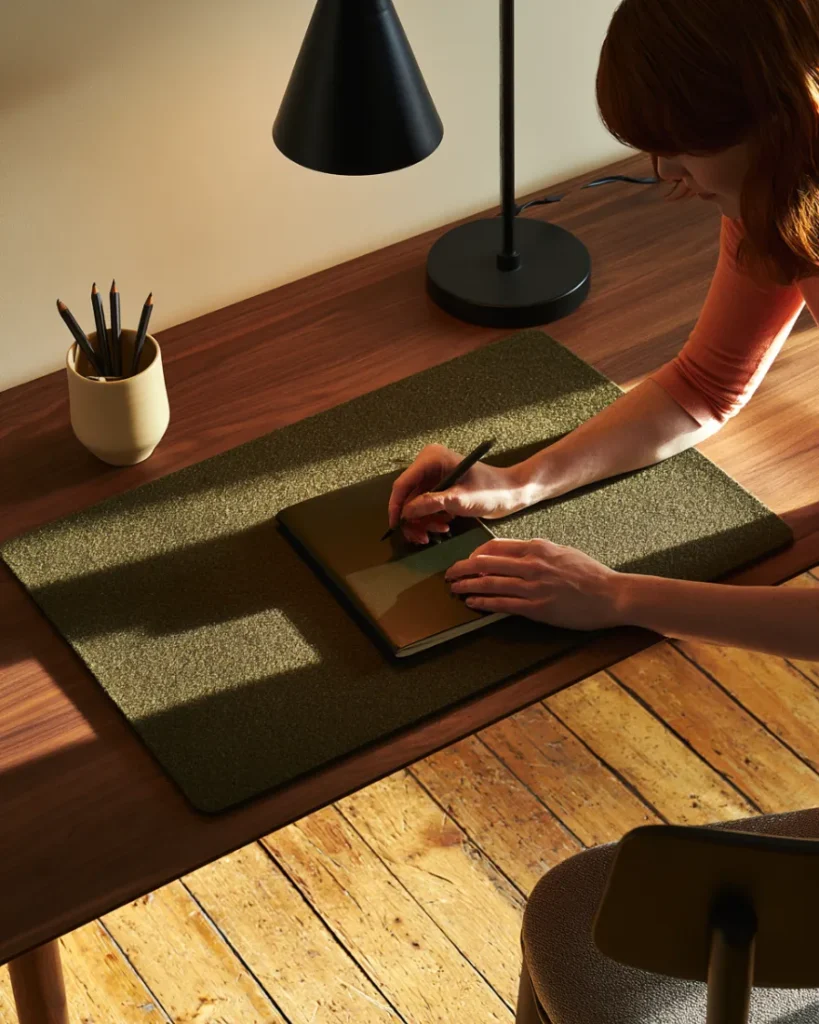
Only what you touch during actual work: the screen, the keyboard, one notebook, one pen cup, one drink.
Everything else is storage or display, and both have better homes a foot away.
Photos and plants are the usual argument. Both are fine, on a shelf, not on the working half of the desk.
The working half is whatever your forearms sweep when you type. Measure it once, and you will stop putting things there.
For most people, that is a band roughly 24 inches wide and 15 inches deep in front of the keyboard.
Anything inside that band is either in use or in the way. There is no third category.
A shelf above the desk absorbs most of it, though what it can hold depends entirely on how it is fixed.
The vertical move
Wall space above a desk is the cheapest storage in the room and the least used.
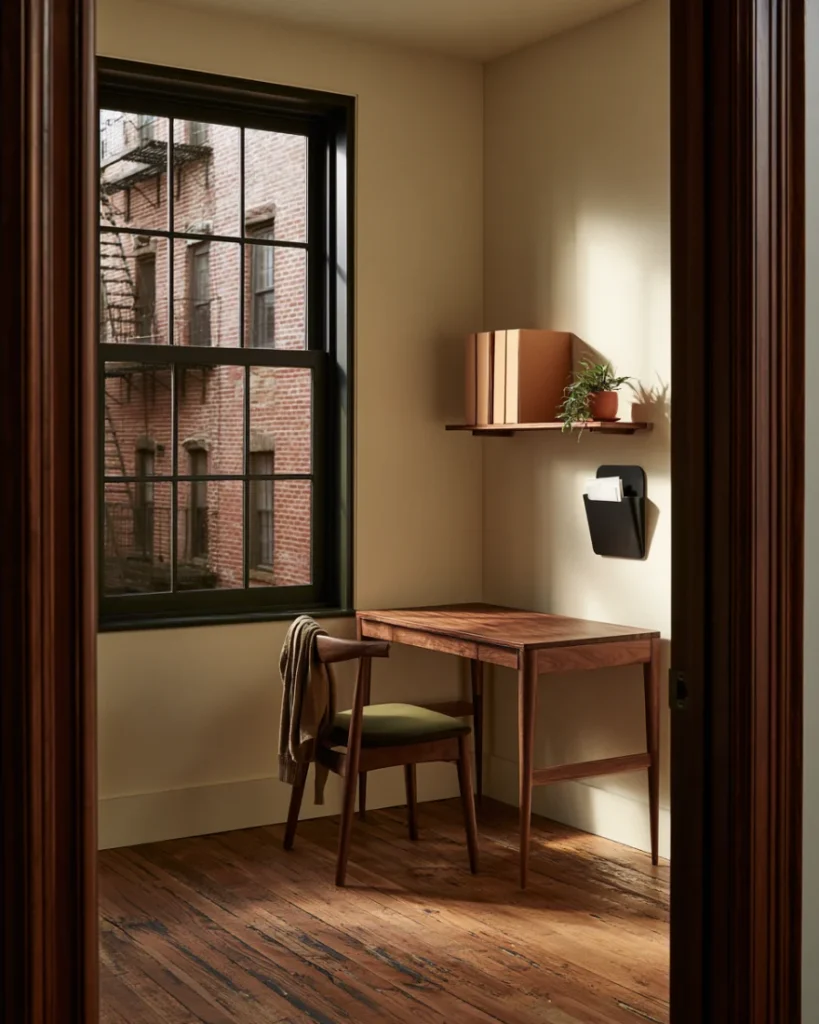
A shallow rail, a wall pocket for active paper, and one shelf clears a surface faster than any drawer insert.
Keep anything above the desk shallow. A deep shelf at head height makes a small room feel like it is closing in.
Renting rules out fixings for a lot of people, in which case a freestanding unit beside the desk does the same job.
A narrow shelf unit at desk height also gives you a second surface for anything mid-project, without widening the desk itself.
In a converted closet, the wall is often all you have, which changes the order you fit things in.
When the desk is not really yours
A dining table or a bedroom desk has to reset to a non-work state every evening.
That means everything needs a container it goes back into, not a place it sits.
One box, one bag, one basket. If the reset takes more than one trip, it will stop happening within a fortnight.
Read more: choosing furniture that has to do two jobs
A shared room changes the whole calculation, and a guest room doing double duty has its own constraints.
The same is true of a desk squeezed into a bedroom, where the desk competes with the bed for the only good wall.
What People Get Wrong About Home Office Organization
Three mistakes account for most of the failed attempts, and all three feel productive at the time.
Buying before measuring the volume
Organisers get bought to a picture rather than to a count. The drawer insert arrives, and the drawer still does not close.
Count first. Twelve pens need a cup, not a fourteen-compartment tray.
Measure the drawer interior too. Inserts are sold to nominal drawer sizes, and real drawers are smaller inside.
Buying is also the most enjoyable part of any home office organization project, which is exactly why it happens first.
Do the counting on a day you cannot order anything. It changes what you end up buying.
Treating digital and paper as one problem
They share nothing. Paper needs a physical route and a retention rule. Files need search, not folders.
Scanning everything just moves the pile, unless the digital side gets its own clear-out first.
Organising a room you have not finished setting up
If the desk is at the wrong height or the light is behind the screen, no amount of tidying fixes the room.
Setup comes first. Organisation is what you do to a room that already works.
It is worth being blunt about this, because most home office organization ideas are sold as a fix for problems that are actually ergonomic.
A tidy desk at the wrong height still hurts after an hour.
Read more: getting the desk, chair and light right before you tidy anything
If the office also has to hold craft or hobby materials, that is a different volume problem entirely, and it needs sorting by project rather than by supply type.
The Five Minute Close
Back to the question at the top. Paper is the thing that will be there tomorrow, so the close is built around paper and nothing else.
The order
- Every loose sheet into the tray, no reading
- Pen cup back to four pens
- Notebook closed and squared
- Cables tucked, mug out of the room
Five minutes, same order, at the end of the working day rather than the start of the next one.
Doing it at the end works because the cost lands on the day that created the mess.
Doing it in the morning turns tidying into the first task of the day, which is how it gets skipped.
Set a recurring alarm for the first month. After that, the alarm becomes unnecessary and slightly annoying, which is the signal it worked.
A desk that closes cleanly is worth more than a desk that was organised well once in March.
When it stops working
If the tray overflows two weeks running, the weekly pass is not happening, and nothing downstream will hold.
If the surface fills but the tray is empty, the problem is the supply ceiling rather than the paper route.
Both diagnoses take one glance, which is the advantage of splitting the room into things that arrive and things that sit.
That split is the whole of these home office organization ideas. Everything else is detail.
Run the paper route for a month before changing anything else. It is the only part that needs your attention every week.
The rest of the room you fix once, on a Saturday, and then leave alone.
That is the honest promise here. One Saturday, then ten minutes a week, and the room stops being something you have to think about.
And if neither is the issue and the room still fills, the volume is arriving from outside the office, which a whole-flat reset is better at catching.
Starting is the hard part for most people, and a single drawer is a legitimate first target.
In a studio, the office has to disappear at the end of the day rather than merely tidy, so the layout carries more of the work than the storage does.