

Kitchen shelf placement is decided by two fixtures, not by whichever wall happens to be free. The hob throws grease, and the sink throws steam.
Anything inside the reach of either one gets coated. A shelf that needs degreasing every week stops getting used within a month, and then it just holds dust.
Most kitchen shelf ideas start with the bracket and the board. Sort your walls by distance from those two fixtures first, because the zone decides the depth, the finish, and what can sit there.
That order settles most of the argument about open shelving too. Open shelves are not impractical everywhere, only in specific places, and those places are predictable.
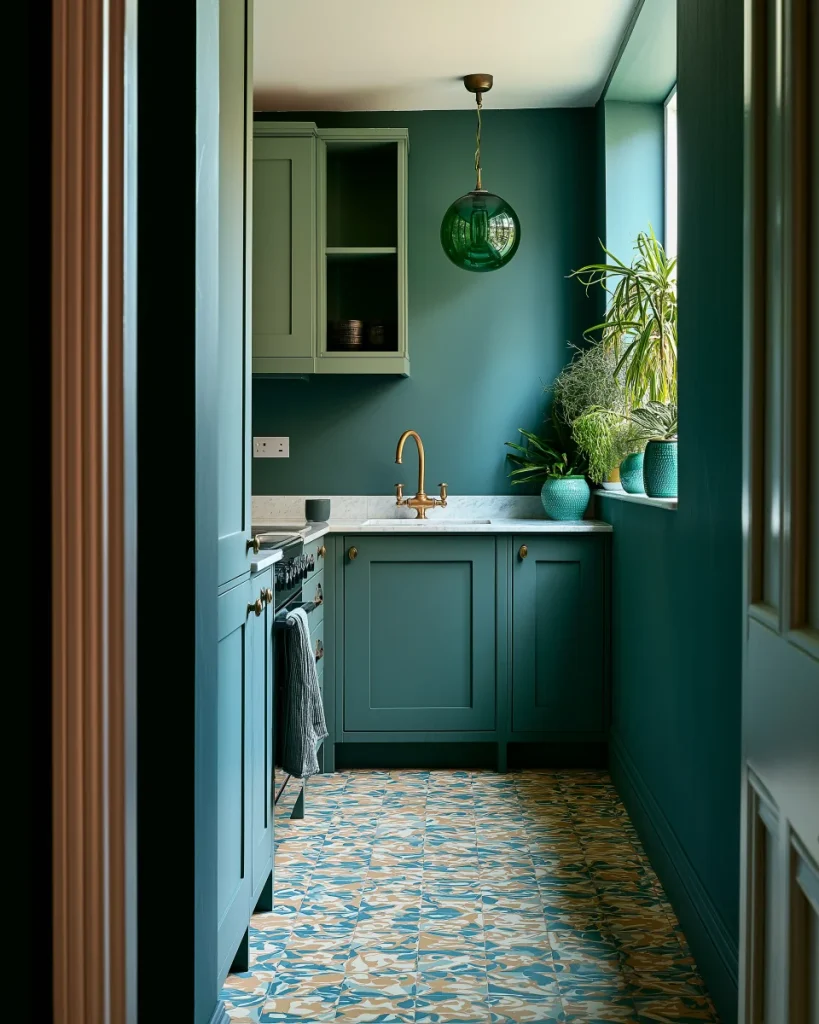
Two fixtures decide where a kitchen shelf goes
Grease travels as an aerosol. It rises off the pan, spreads with the air the extractor is pulling, and settles on the first horizontal surface it reaches.
Steam behaves differently. It condenses on whatever is cooler than it is, which means the underside of a shelf above a dishwasher gets wet every cycle.
Distance from those two points sorts a small kitchen into four zones, and the zones do not follow the layout you would draw on paper.
The four zones, measured from the hob and the sink
- Inside the splatter arc, roughly within three feet of the hob
- Under or beside the steam, meaning above the sink and the dishwasher door
- The drywall, more than about four feet from both
- The leftover walls, which are dry but awkward to reach
If you have not mapped the kitchen into working areas yet, the zone method that sets those areas in the first place is the step that comes before this one.
Zone one, inside the splatter arc
The wall beside and above a hob is the most tempting shelf site in a small kitchen, because it is the closest to where you are standing.
It is also the one place where a kitchen shelf pays for itself only if everything on it gets used every time you cook.
An extractor hood does not clear the whole area. It pulls the column of air directly beneath it, and anything sitting outside that column gets the overflow instead.
That is why the shelf beside the hob picks up more residue than the wall behind it. A vertical wall sheds what lands on it, while a horizontal board holds everything until you wipe it.
What survives here
Anything you would wash anyway. Cooking oil, salt in a lidded pot, a stack of tasting spoons, the two pans that go on the heat daily.
Sealed glass with a lid beats open ceramic in this zone, because a film you can wipe off a smooth jar is a film that soaks into unglazed clay.
What does not
Cookbooks, paper, anything with a fabric or raw wood surface. Cutting boards left out here take on the smell before they take on the stain.
Small appliances belong nowhere near it either. Vents and control panels collect grease in places you cannot reach with a cloth.
Keep the splatter zone to items you already wash weekly, and nothing else.
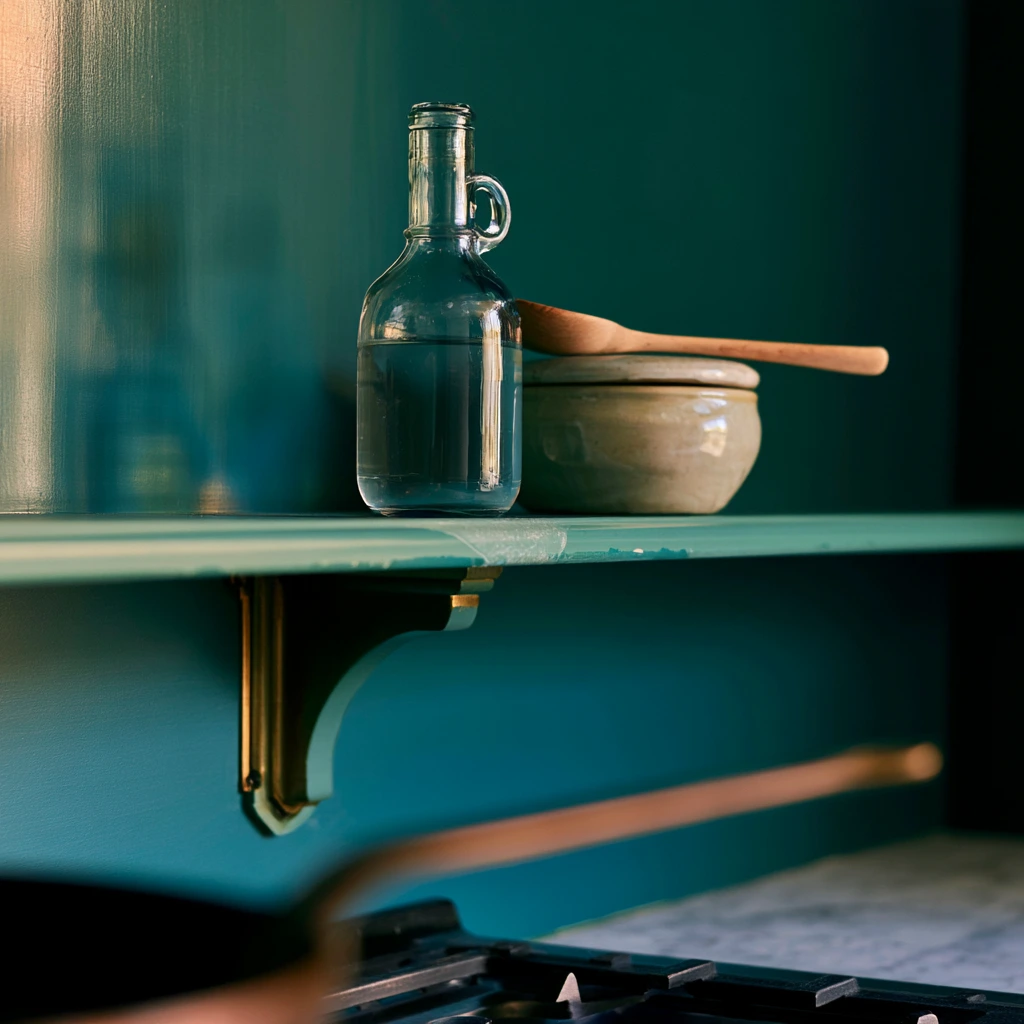
Pans are the usual reason people want a shelf here, and a shelf is rarely the best answer for them. Hanging and lid storage options handle the weight better than a bracketed board does.
Zone two, under the steam
The sink and the dishwasher produce a different problem. Steam does not settle evenly. It condenses on the coldest surface it meets and runs.
A shelf directly above a sink collects water on its underside, which then drips onto whatever is below at the moment you are using the tap.
A dishwasher makes it worse for a few minutes at the end of every cycle. Opening the door releases a sheet of hot vapour that goes straight up the face of the units above it.
This is the zone where a draining shelf works and a solid one does not. Slatted, wire or perforated surfaces let the load dry instead of sitting in a ring of water.
A kitchen wall shelf above the sink also has to clear the taps at their full swing. Measure with the mixer turned up to its highest point rather than at rest.
What belongs in the steam zone
- A slatted or wire shelf, never a solid board
- Everyday glasses and mugs, stored upside down
- The washing-up brush and the sponge, off the sink edge
- A small draining rack if it can sit above the taps
- Nothing made of untreated wood or particle board
Choose a slatted or wire surface for anything mounted above a sink or a dishwasher door.
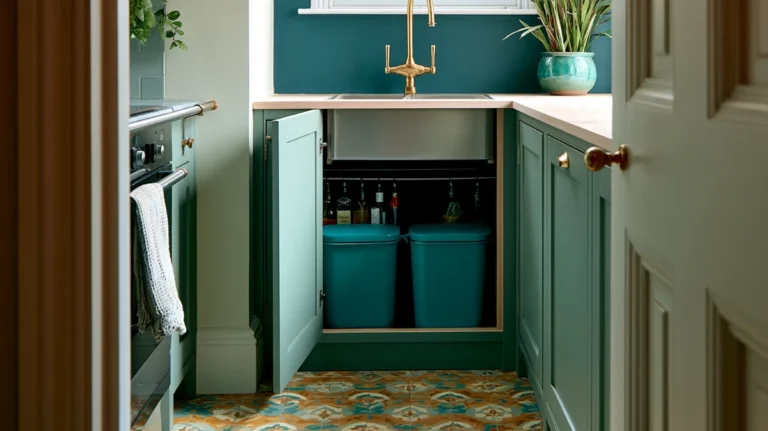
The cupboard below has the same moisture problem in reverse, and the plumbing and damp constraints down there rule out most of what people try to store in it.
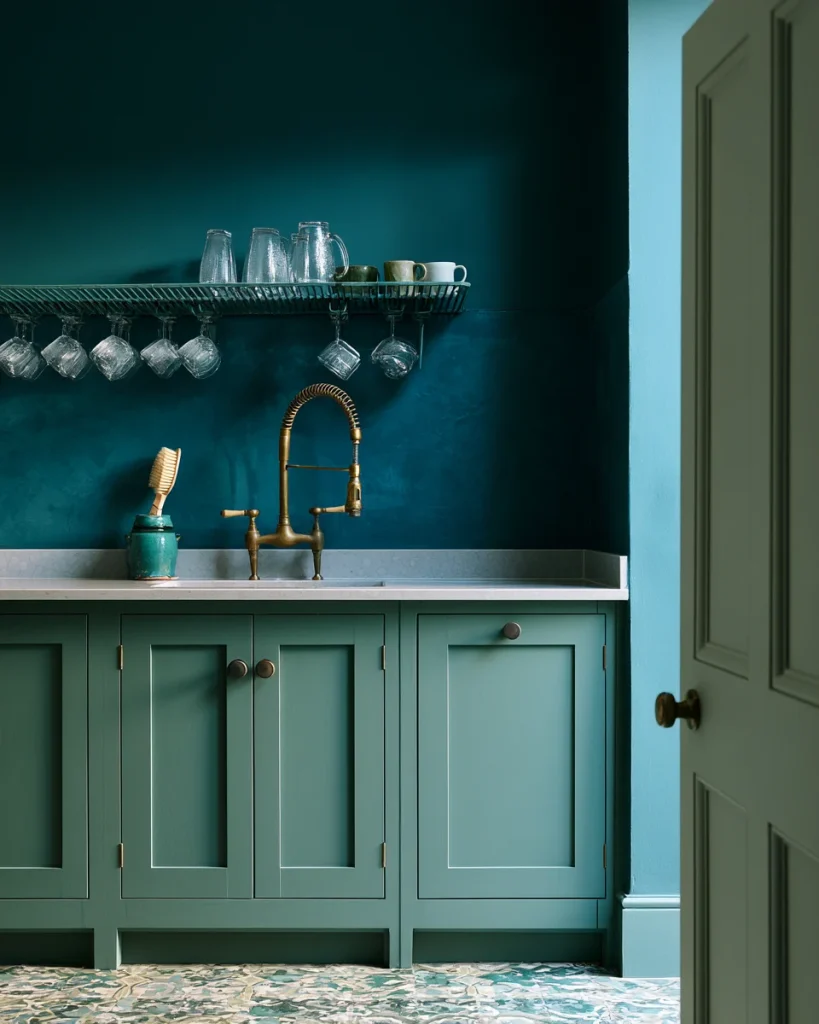
Zone three, the drywall
Away from both fixtures, you get the wall that behaves like any other wall in the house. This is where an open shelf holds up over years rather than months.
It is also where people put the heaviest thing they own, usually a stack of plates, without checking what the shelf is rated to carry.
The load nobody checks
Factory cabinets have a published figure for this. Under the ANSI/KCMA A161.1 certification programme, shelves and cabinet bottoms are loaded at 15 pounds per square foot and held for seven days with no excessive deflection permitted.
Open shelving has no equivalent standard at all. Whatever the bracket manufacturer prints on the box is the only number in play, and it is rarely tested the same way.
Span matters as much as the fixing. A board carried on two brackets 30 inches apart bends in the middle long before either bracket lets go of the wall.
Kitchen floating shelves make that worse by hiding the support. The whole load transfers into a concealed rod, so a sagging shelf gives you no visible warning first.
Run the arithmetic on your own shelf. A board 36 inches wide and 12 inches deep is 3 square feet, so the certified equivalent load across the whole thing is 45 pounds.
Now weigh a plate and multiply. A plate at 1.5 pounds, stacked twelve high, sits on an 11-inch circle, which is 0.66 square feet. That single stack works out at 27 pounds per square foot.
One stack of plates is running at roughly 1.8 times the load a certified cabinet shelf is tested to hold, concentrated on a fifth of the board.
Weigh one plate, multiply by the stack height, then divide by the footprint in square feet before you decide where plates live.
The fixing side of this is a longer subject, and it applies to every room in the house, so this article deliberately skips it.
Read more: how brackets fail, and which fixing suits which wall
Depth, and why twelve inches behaves like four
Standard wall cabinets are 12 inches deep because a dinner plate is 10.5 to 11 inches across. That single dimension sets the whole convention.
On an open shelf, depth stops paying at the front row. Anything in a second row is invisible and unreachable, so it becomes storage you forget you own.
A 12-inch shelf holding 4-inch jars can technically take three rows. In practice, you use the front nine and slowly forget the eighteen behind them.
| Item | Width each | Fits across 36 inches | Usable rows |
|---|---|---|---|
| Dinner plates, stacked | 11 in | 3 stacks | 1 |
| Bowls, stacked | 7 in | 5 stacks | 1 |
| Mugs | 3.5 in | 10 | 1 |
| Storage jars | 4 in | 9 | 1 of the 3 that fit |
| Cookbooks, upright | 1.5 in spine | 24 | 1 |
| Spice jars | 2 in | 18 | 1 of the 6 that fit |
The table is the argument for shallow shelves in a small kitchen. A 6-inch board loses almost nothing except the plates, and it takes far less light off the counter.
Size the shelf for the front row only, then add a second shelf rather than a second row.
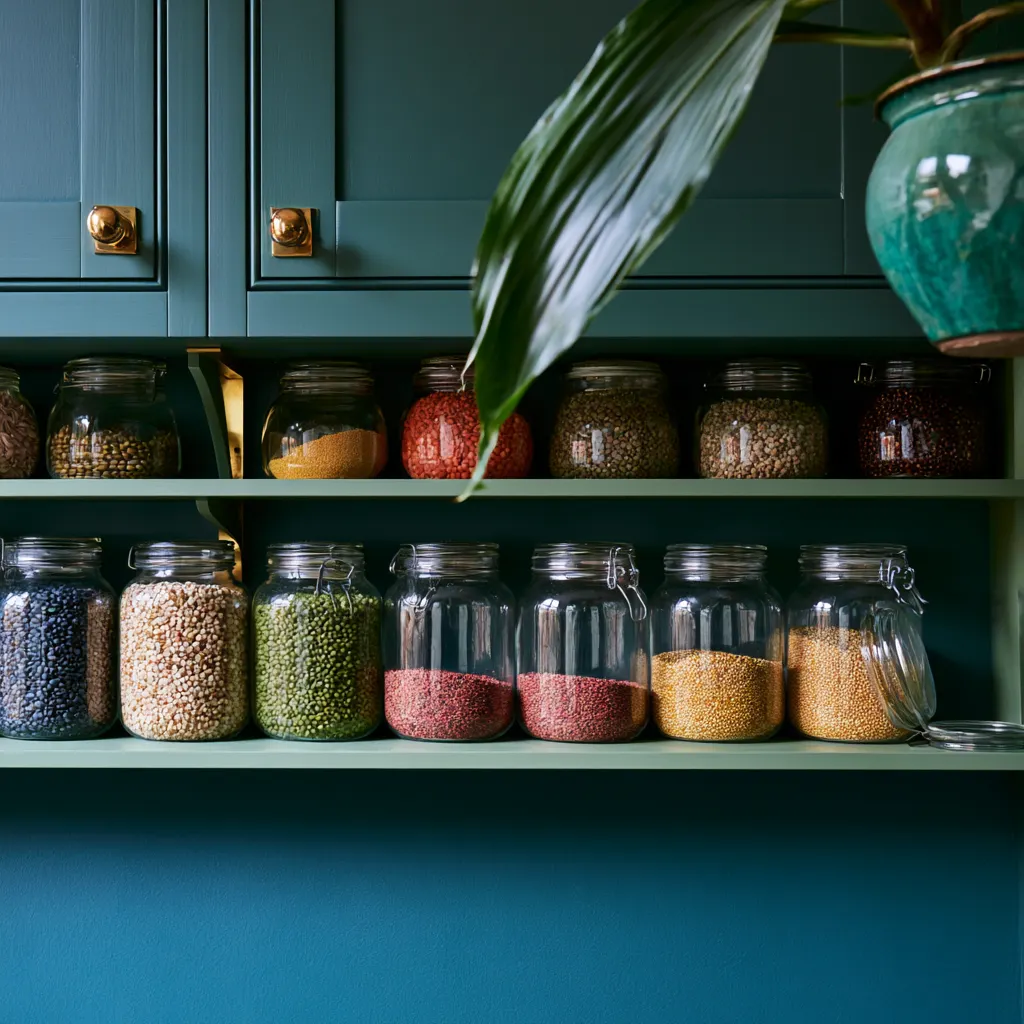
Zone four, the leftover walls
Every kitchen has drywall that is awkward rather than unusable. It is dry, so the finish survives, but the reach makes it wrong for anything daily.
Treat these places as long-term storage with a shelf on it, not as extra working space. What goes up there should be things you fetch on purpose.
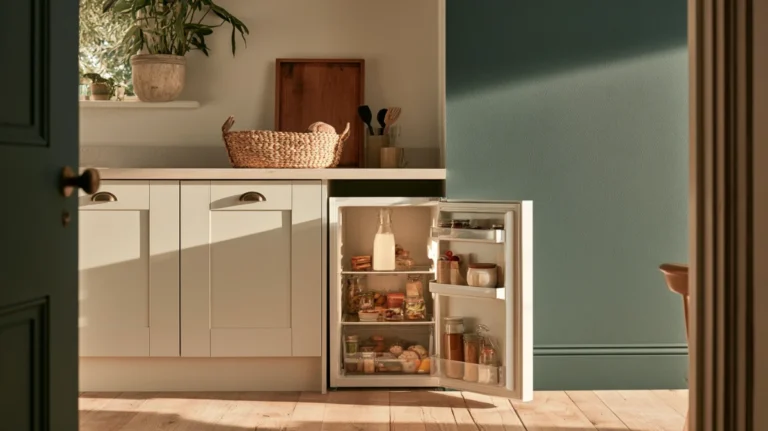
Above the fridge is the exception that catches people out. The compressor vents heat upward, so that shelf runs warmer than the rest of the room all year.
Keep oils, chocolate, and anything with fat in it off that one. A kitchen shelf sitting in rising heat will spoil stock faster than the date on the packet suggests.
Leftover wall sites and what each one suits
- Above the fridge, for bulk and back stock you buy monthly
- Above a doorway, for anything seasonal or once a year
- The narrow gap beside the cooker, for trays and boards on edge
- Above a window, for plants and light items only
- The end wall of a run of units, for a shallow vertical stack of shelves
- The inside of a cupboard door, for flat items under an inch thick
Back stock in particular wants a real system rather than a shelf. Rotating slow movers so they get used before the date matters more than where the packet physically sits.
Above the fridge is the one site with a temperature problem as well as a reach problem, and what the fridge itself should be holding usually decides how much overflow ends up on that shelf.
Finish, which decides how often you clean it
The zone tells you what will land on the shelf. The finish tells you how long it takes to get off again.
Raw and oiled wood absorbs grease. Once it is in the grain, degreaser lifts the surface film and leaves the shadow behind.
Sealed surfaces give it back. Polyurethane, laminate, powder-coated steel, and stainless all wipe clean with a cloth and hot soapy water.
Method matters more than product. Degreaser needs about a minute of contact time before it lifts anything, and it usually gets wiped away long before that.
Leave degreaser on the surface for a full minute before wiping, and clean the underside of the shelf as well as the top.
Finishes ranked by how well they survive a kitchen
- Stainless steel, which shows every mark and releases every one
- Powder-coated steel, close behind and available in colours
- Laminate or melamine board, cheap and completely sealed
- Polyurethane-sealed timber, good until the seal wears at the front edge
- Oiled or waxed timber, which needs re-oiling and stains in the meantime
- Raw timber and untreated MDF, which should not be in a kitchen at all
Put the sealed finishes in the splatter and steam zones, and save the oiled timber for the drywall.
A cheap laminate shelf on the greasy wall and a good timber shelf on the drywall will both still look right in three years. Reverse them and the timber one will be marked within a single winter of cooking, which is the more expensive mistake of the two.
What earns a place on an open kitchen shelf
Once the zone and the finish are settled, the remaining question is what goes up. Open shelving punishes anything you own more than one of.
Ten mismatched mugs on a closed shelf are ten mugs. On an open shelf, they are the first thing anyone sees when they walk in.
That is a storage argument rather than a styling one. Closed doors hide variety, and open shelving asks you to reduce it.
Open shelving in a small kitchen also costs you the ability to put something down and deal with it later. Everything is on show from the moment it lands.
What holds up on display and what does not
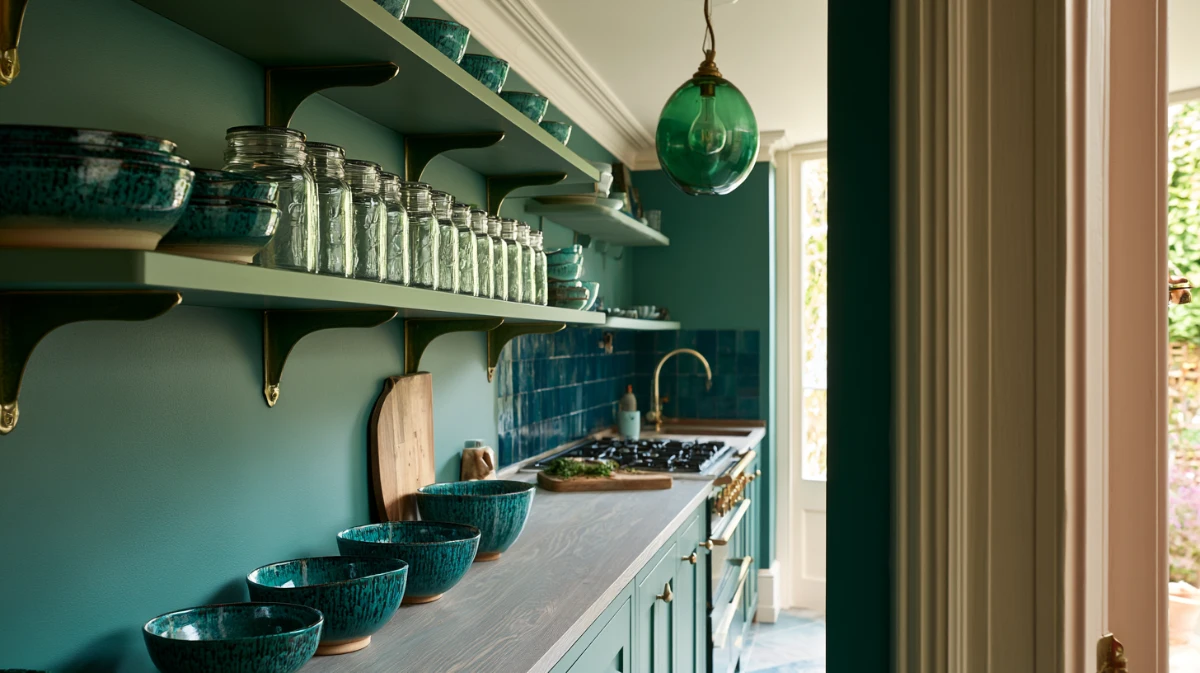
- Matching sets in one material, which read as one object
- Things you touch daily, because they never sit long enough to dust
- Glass jars with visible contents, which supply colour and need no labels
- Plants, provided they are not in the splatter zone
- Plastic containers with mismatched lids, which never look ordered
- Anything with printed packaging still on it
Containers are the usual failure. Getting the lid problem under control is what makes the difference between a shelf that looks deliberate and one that looks like a cupboard with the door removed.
If the count itself is the problem, a short removal pass beats a styling pass. A fixed daily count over a fortnight will clear enough duplicates to make one shelf viable.
Reduce the number of visible types before you buy any shelf, not after it goes up.
Read more: what stays out on the counter once the shelves are carrying their share
Renting, and what that takes off the list
A tenancy that bans drilling removes the drywall options first, which is the opposite of what most renters expect. The good wall is the one you cannot use.
Adhesive strips are rated for a load in pounds, and that rating assumes a dry, clean, painted surface at room temperature. A kitchen supplies none of those three reliably.
The workaround is to stop mounting things on walls. Freestanding units, over-door racks, and tension-mounted rails carry the same items without a single hole.
A no-drill kitchen shelf is nearly always a shelf that rests on something rather than one that hangs. Gravity is more reliable than adhesive in a room this warm and damp.
No-drill options by zone
- Splatter zone: a countertop riser that lifts without touching the wall
- Steam zone: an over-sink rack that rests on the worktop on either side
- Dry wall: a narrow freestanding unit, which also gives you four shelves for one footprint
- Leftover walls: over-door racks on the pantry or cupboard door
- Anywhere: a rolling cart that parks in the gap beside the units
A freestanding unit is usually the strongest of those, and the same logic applies in a studio where the kitchen is one wall of the room. How storage furniture earns its floor area decides whether it is worth the space it takes.
Spices are the one category worth solving flat instead of vertically, since a shallow drawer keeps every jar visible at once in a way that no shelf more than one jar deep can match.
Check the adhesive rating against a weighed load, and halve it before you trust it in a kitchen.
Read more: the storage moves that come first when the kitchen has no spare wall
Start at the hob, walk outward, and give each wall the shelf its position can support. A kitchen shelf in the right zone needs a wipe, and the same shelf in the wrong zone needs replacing.
Nothing about that changes with budget. A 40$ laminate board on the correct wall outlasts a 200$ oak one on the wrong wall by several years.